Water for a year at sea
Genesis tells Noah to take food aboard and never mentions water, the heaviest thing the ark would carry. How long it rained, by reading; whether the floodwater was fresh or salt, and whether the sea was fresher then; what the roof could catch, and how much the tanks must still hold.
Genesis tells Noah to gather food, "and it shall be for food for thee, and for them" (6:21) text. It says nothing about water, yet animals drink 3 to 4 litres for every kilogram of dry feed they eat study. For the smallest count on How many animals, and was there room?, the house and its animals need 1,040 to 1,260 m³ in the 371 days aboard, and for the larger counts 4,050 to 7,160 m³: about two thirds of the cargo's weight modelled. Was the water around the ark fresh? Could they catch the rain, and so leave the year's water ashore?
How long it rained
And the rain was upon the earth forty days and forty nights. … And the waters prevailed upon the earth an hundred and fifty days.
Genesis 7:12, 24 text
Then: "The fountains also of the deep and the windows of heaven were stopped, and the rain from heaven was restrained; … and after the end of the hundred and fifty days the waters were abated" (8:2–3) text. The stopping is told where the 150 days end, and is read three ways:
- Forty days, with 8:2 looking back to them: Josephus ("the water poured down forty entire days"), Genesis Rabbah, Rashi, Radak and Ramban historical; for Cassuto the closing "belongs, of course, to the end of the forty days" study.
- Lighter rain to day 150: after the forty days, Ibn Ezra reads, "rain fell one day and stopped one day"; Gill, "it ceased not to rain, more or less, though not so vehemently" historical.
- Rain all year, a modern reading from Answers in Genesis: "The evaporation of warm floodwaters would have likely caused more than enough rain to fall during the remainder of Noah's time on the Ark" study. It rests on physics, not on the text.
No commentator has rain once the ark has grounded. Ramban: "Neither dew nor rain came down" until they went out historical. Counting from the day they went in, the ark rests on day 151 (8:4) and they leave on day 371 (8:14), so on every older reading the last 221 days are dry text modelled.
Fresh, brackish or salt?
The flood had two sources: "the same day were all the fountains of the great deep broken up, and the windows of heaven were opened" (7:11) text. The windows give rain, which is fresh. The deep, tᵉhôm, could be either. It is the sea in "the sea, the waters of the great deep" (Isaiah 51:10), and fresh water from below in "fountains and depths that spring out of valleys and hills" (Deuteronomy 8:7) text. Babylon's creation story "begins with a description of the two primeval seas, the salt sea Tiamat and the sweet sea Abzu", the Abzu being the water under the earth study. Cassuto reads the fountains as "certainly the lower waters, from which the springs on the face of the earth flow"; creationist flood geology expects hot water from deep in the earth, and "Such waters today are very salty" (Snelling) study.
The rabbis added heat. In the Talmud "at first the waters of the flood had been scalding hot" (Rosh Hashanah 12a), and three of its fountains still run hot, among them the springs of Tiberias (Sanhedrin 108a). One passage fears that boiling water would have melted the ark's pitch, and answers that "the water on the sides of the ark cooled" (Zevachim 113b) historical. That is about heat, not salt.
So in the game the house's reading decides its floodwater: fresh (rain and springs), brackish (rain and springs over a fresher sea, or partly mixed) or salt (the sea came in) modelled. Water over about 1,000 mg of salt a litre is "significantly and increasingly unpalatable" to people, livestock manage 3,000 to 5,000, and the sea has 35,000 study.
Was the sea fresher before the flood?
Does the sea grow saltier over time, so that it was fresher before the flood? The text says nothing about it. In 1715 Halley suggested that the rivers make the sea "grow salter and salter" historical; today creation scientists and mainstream geochemists both publish on it, in three kinds of study.
Measuring the sea. The sea holds about 5 × 10¹⁹ kg of salt, and the rivers bring about 4.6 × 10¹¹ kg of sodium and chloride a year study. If none of it left, salinity would rise about 0.00003 grams per kilogram a century; the ocean's floats read to 0.01, so it would take some 30,000 years to show modelled. Austin and Humphreys, writing as creationists, agree the change "would be too small to be measurable" study. What is measured comes from the water cycle: since 1950 "salty ocean regions … are getting saltier, while fresh regions are getting fresher" study.
Budgets of what comes in and goes out. Austin and Humphreys (1990) find only 27 % of the sodium coming in leaving today. Run back, they reckon, that allows the sea at most 62 million years, and they conclude that "most of the Na+ in the ocean is there as a result of creation and the Genesis Flood" study. Holland (2005) finds the sodium not paired with chloride coming in and going out at "the same, within the uncertainty" study. On chloride the sides agree: with no great salt beds forming today, "the oceanic chloride budget is considerably out of balance", as a geochemistry textbook puts it study. Mainstream geochemists balance it over long ages by rare episodes when a sea dries; in their account the Mediterranean once dried out and locked up "almost 5% of the salt of the world ocean". Austin and Humphreys find too little rock salt in the world for that, and the sides differ most on the sodium taken up in the hot rock of the mid-ocean ridges: 0.44 × 10¹⁰ kg a year in their count, 2.5 in Holland's study.
Seawater trapped in salt. Mainstream geochemists read the drops of seawater sealed in rock salt as samples of the sea at the ages the salt is dated to. On that reading the sea's makeup has changed "significantly" (Holland), and the sea was as salty or saltier in the past, not fresher, the first oceans at "1.5-2×" today's (Knauth) study. Those results rest on the conventional dating of the rocks, which young-earth creationists do not accept.
The creation writers expect a fresher sea before the flood, but put the change in the flood itself: "Noah's Flood would have dissolved large amounts of sodium from land rocks" (Sarfati) study. Today's slow rates, run back over the 5,000 years or so that a young-earth chronology puts since the flood, would change the sea's sodium by only about 0.01 % modelled. The Creation Answers Book says: "We do not know how salty the sea was before the Flood" study.
So both sides agree that no change can be measured in the sea itself, and that chloride comes in faster than it leaves today. They part on the other rates, the ridges above all, and on whether today's rates can be run back study. In the game the sea before the flood stays a reading like the rest modelled.
What the roof could catch
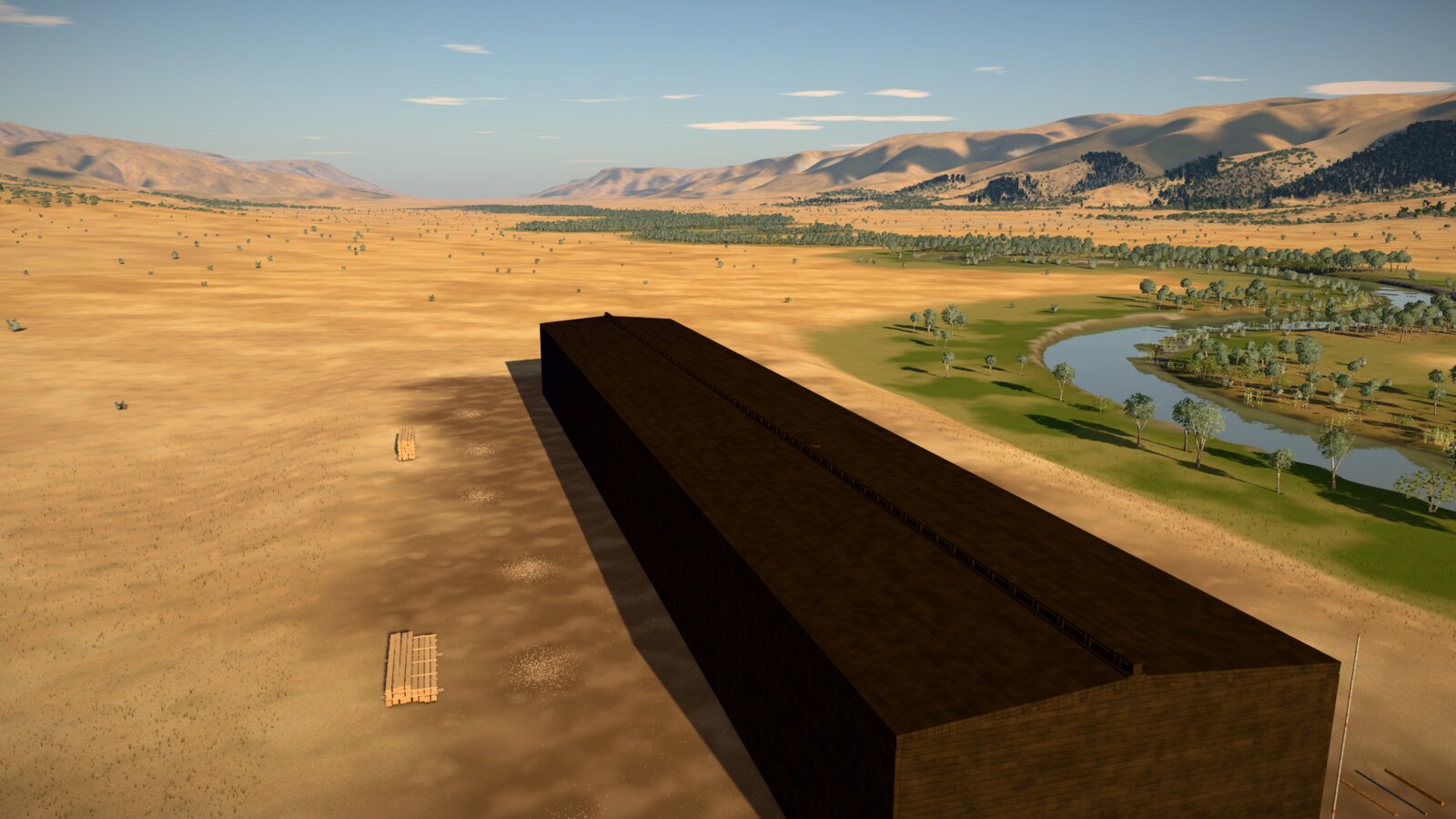
The reference ark's roof covers 4,033 m², and a roof sheds 75 to 90 % of the rain that falls on it study. Every metre of rain gives 3,000 to 3,600 m³: 30 to 36 m³ on a day of 10 mm, 150 to 180 m³ on a day of 50 mm modelled. India's weather service calls 64.5 to 115.5 mm a day "heavy rain" study; the text gives no rate. 10 mm a day meets every count's daily need, and 50 mm fills the low count's tanks in about a week modelled. Rashi has the first rain fall "in mercy (gently)" historical, so a few days' water aboard at the start is still prudent.
Rain is not the limit; the tanks are. On every reading but the modern one the rain stops while at least 221 dry days remain, and the tanks must hold their water modelled:
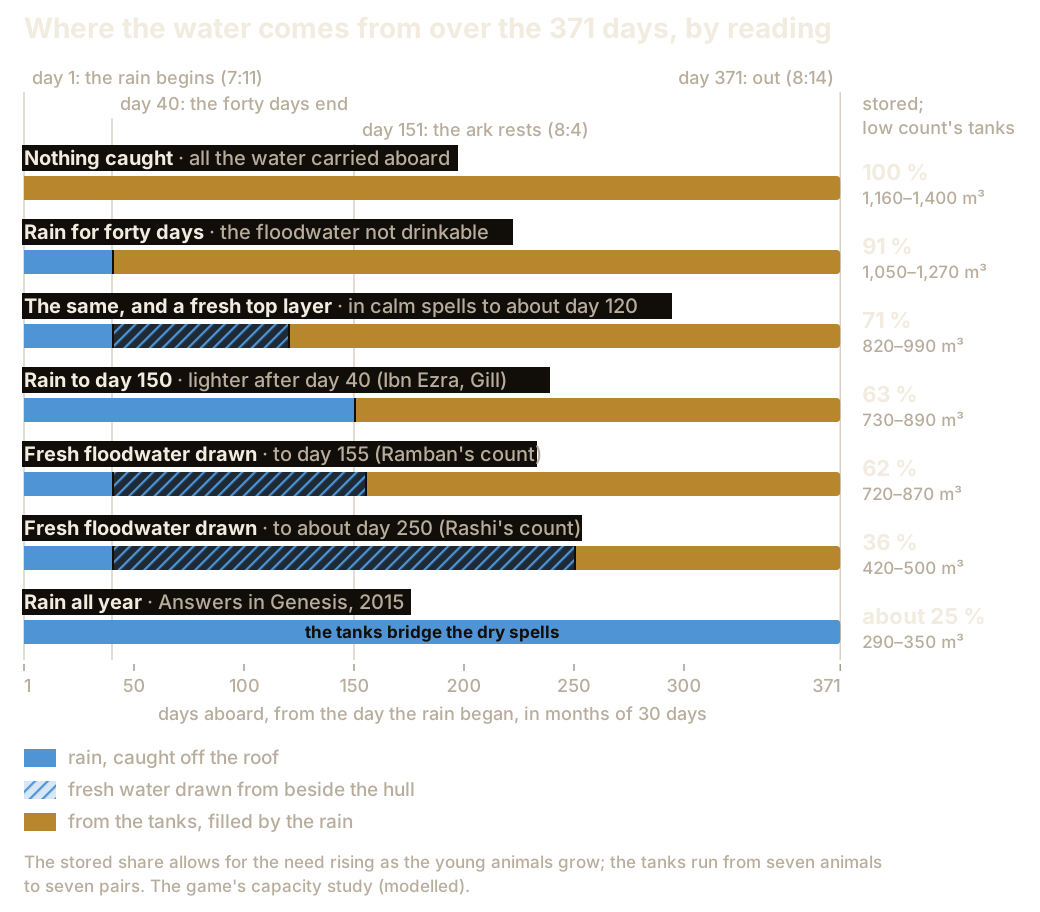
| The house's reading | Stored share | Tanks, low count | middle | high |
|---|---|---|---|---|
| Nothing caught | 100 % | 1,160–1,400 m³ | 4,500–6,790 m³ | 4,620–7,960 m³ |
| Rain for forty days; floodwater not drinkable | 91 % | 1,050–1,270 | 4,080–6,160 | 4,170–7,190 |
| The same, with a fresh top layer at times to about day 120 | 71 % | 820–990 | 3,190–4,820 | 3,240–5,580 |
| Rain to day 150 | 63 % | 730–890 | 2,840–4,290 | 2,870–4,960 |
| Fresh floodwater drawn to day 155 (Ramban's count) or about 250 (Rashi's) | 62 % to 36 % | 720–870 to 420–500 | 2,780–4,200 to 1,610–2,440 | 2,810–4,860 to 1,620–2,790 |
| Rain all year | about 25 % | 290–350 | 1,130–1,700 | 1,150–1,990 |
Each range runs from seven animals to seven pairs modelled. Catching the rain lets the tanks board empty; it does not let them be small. Only rain all year brings them down to a quarter, which is what Answers in Genesis proposed: cisterns "for one-fourth of the required water" study.
The carrying it saves
The rain began the day they went in (7:11–13) text, so empty tanks spare carrying 1,040 to 1,260 tonnes up the ramp at the low count, and 4,050 to 7,160 at the others modelled. In jars of 18 litres from a river 300 m away, each carry about 13½ minutes, the low count's water would be 1,600 to 2,000 days of eight hours' work: 200 to 250 days for all eight of the house doing nothing else modelled. Empty tanks also let the ark float off lighter; the rain then fills them low in the hull, where the weight steadies her modelled.
Cisterns in the tradition
The rabbis gave the ark water stores of its own historical. The Aramaic paraphrase called Targum Pseudo-Jonathan, on Genesis 6:14, gives it "five repositories on the right, and five on the left". Pirqe de-Rabbi Eliezer has them along both long sides, and on every storey the openings of "the water channel", which "opened and closed"; its translator, Friedlander, writes "protected cisterns" and "the openings for the water pipes". Jastrow's dictionary reads the rare word as "protected cisterns (in Noah's ark)" study, though its sense is uncertain.
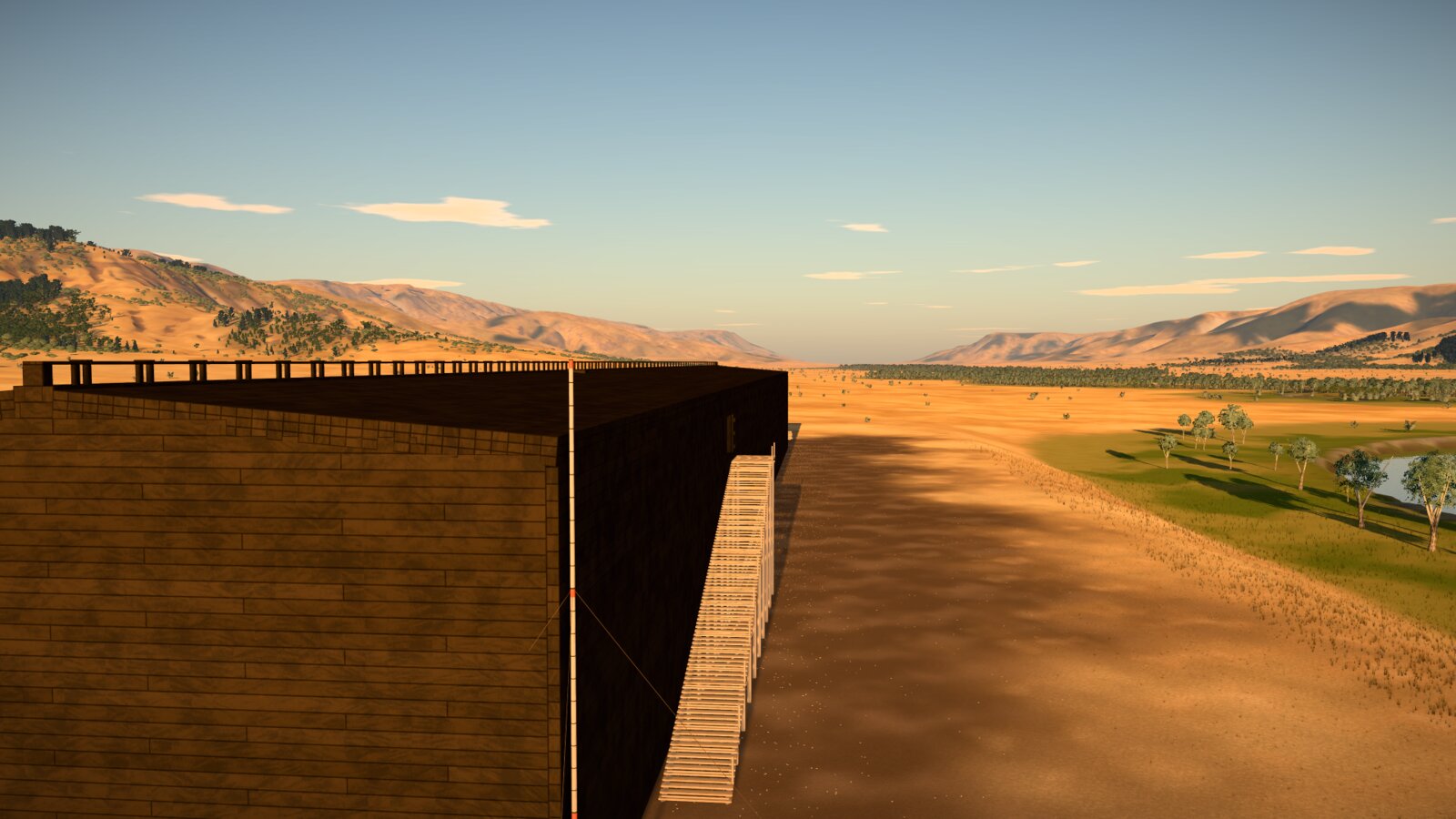
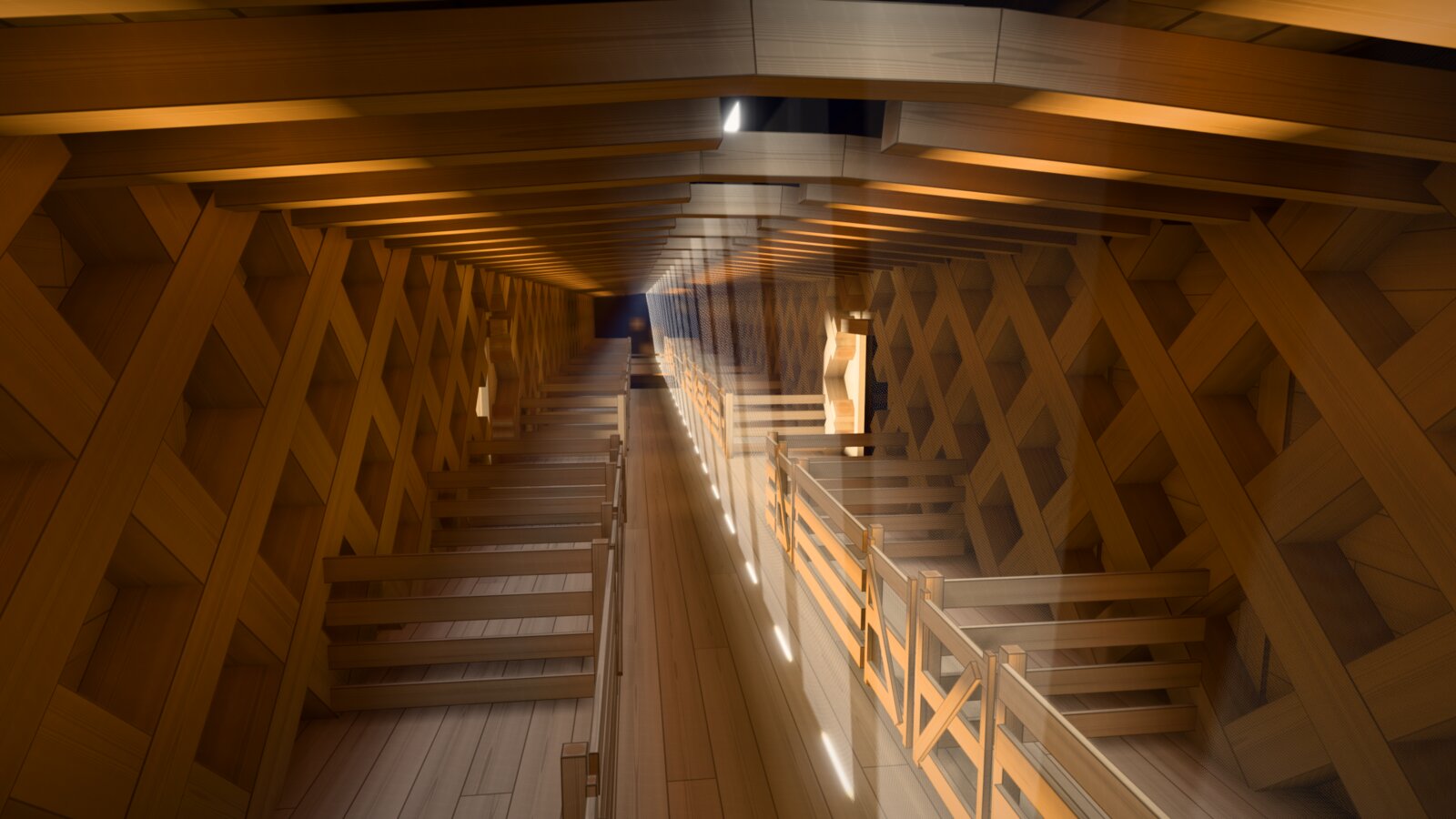
A house could build the same; the final check asks for none of it modelled. The reference roof sheds its rain off the eaves, as Rashi read the slope, "in order that the water should run off on both sides" historical. A trough hewn 0.3 m wide along each eave, falling from the middle to outlets at a few points, carries even a downpour of 100 mm an hour, and chutes through the decks lead to cisterns low in the hull, in narrow cells, since water sloshing in a wide tank costs a ship stability modelled.
How long it rained, what the floodwater was and how salty the sea had been are readings, and a house holds its own. Under all of them the roof catches far more rain than the ark needs, and the tanks must still carry most of the year.