Build the ark together.
A realistic co-op game for up to eight players, the size of Noah's family. Fell the cypress, haul the timber, cut the joints and pitch the hull, at the ark's real size.
Filmed in the game, at real size. The ark as it could have been built (modelled).
The game
A family, a valley and an ark
Three hundred cubits long, fifty wide, thirty high: Genesis gives the measures in a single verse. House of Noah asks what it took to build it. The trees, the timber, the joints, the pitch, and the people.
Built to the text
Gopher wood, rooms, pitch within and without, a window, a door in the side and three storeys (Genesis 6:14–16), at the ark's real size. How you build it is up to you: the finished ark will be judged on the result, on the text, its strength and whether it keeps the water out.
A house of up to eight
You play Noah's family, and only by invitation: Noah, his wife, their three sons and the sons' wives. Some loads need more than one pair of hands, and the calls (Lift! Hold! Wait!) bring everyone in on the count.
Real work, real weight
Fell a cypress with a bronze or an iron axe: the notch, the back cut, the hinge. A log weighs what it really weighs and moves by rope, roller and lever. The calendar counts the real work done, not the hours you play.
Decades, not minutes
The years pass with the work, and the family grows with them. Once a job is done well by hand, more of it will run as a batch at the quality you showed, and houses will be ranked by how many years their ark took.
In the game today
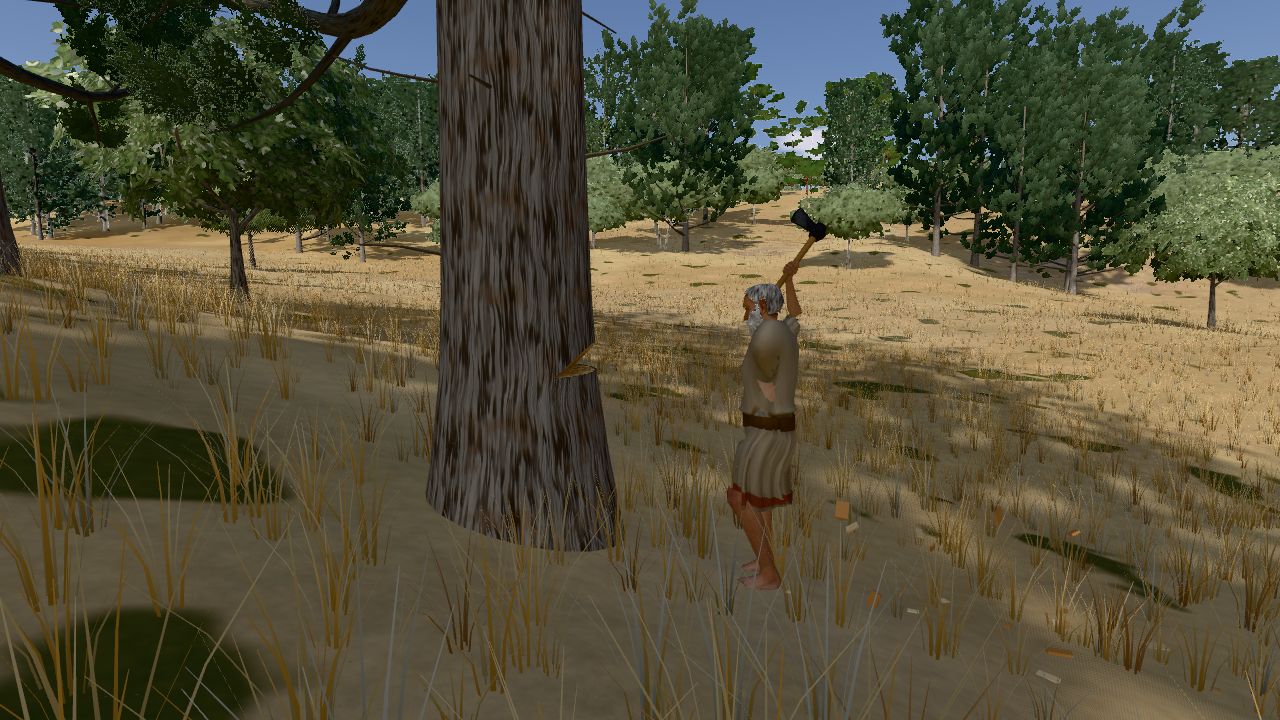
Felling a cypress by hand: notch, back cut and hinge, stroke by stroke. 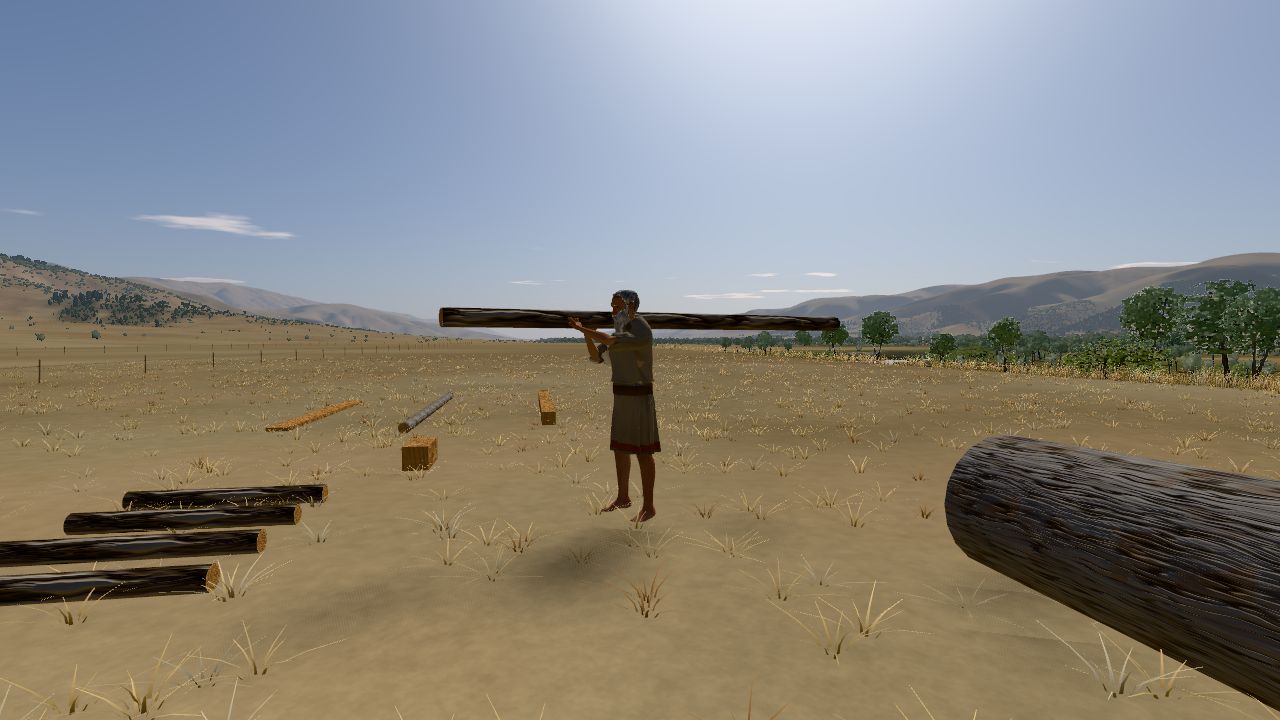
A pole on the shoulder, at the weight of its wood. Heavier timber needs two, or a rope and rollers. 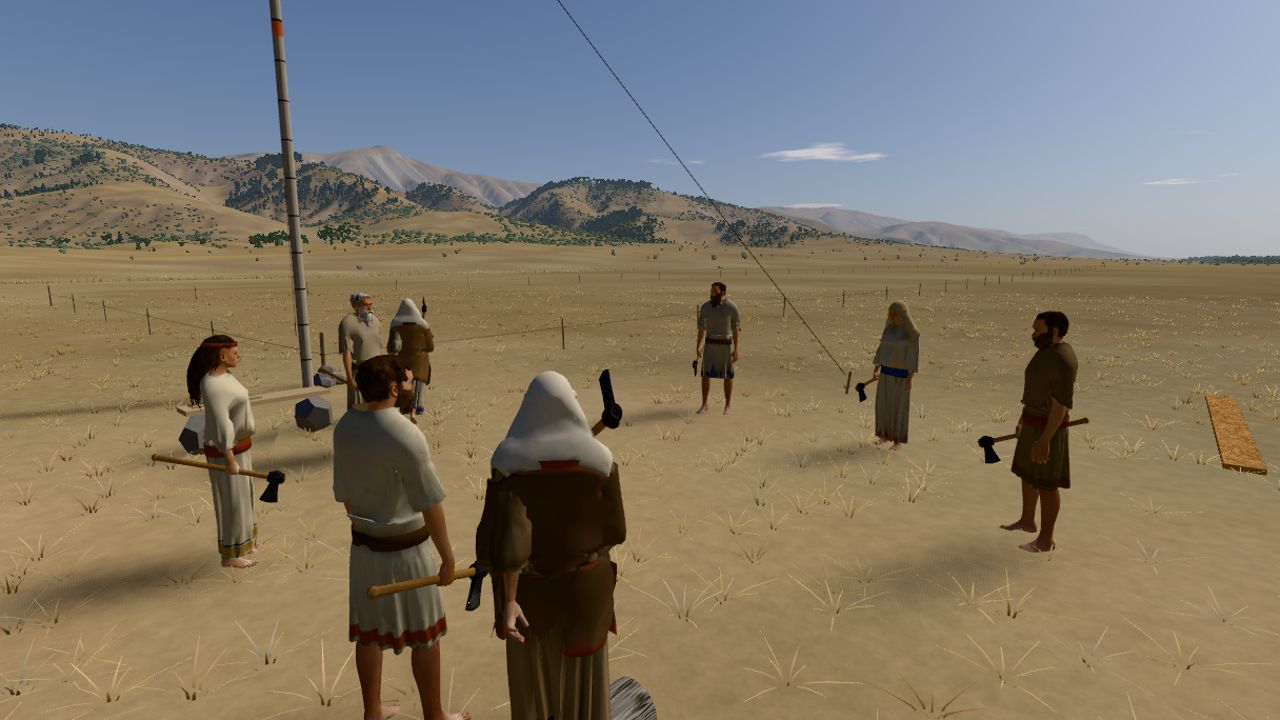
A house of eight at the staked-out site, by the pole that marks the ark's height of 30 cubits.
The blueprint
The ark at its real size
Genesis gives the ark in cubits, and the cubit has varied. We use the long cubit of 51.85 cm, the length of the oldest measuring rod ever found: a copper-alloy bar from Nippur, which archaeologists date to about 2650 BC. Built to it, the ark is 155.55 metres long, of wood, by hand. It is the best-supported reading, not a certain one.
- Length text
- 300 cubits155.55 m
- Breadth text
- 50 cubits25.93 m
- Height text
- 30 cubits15.56 m
- The cubit archaeology
- 51.85 cmthe Nippur rod
- Cypress trees modelled
- 7,932for the reference design's hull
- The work modelled
- about 122,000person-days of 8 hours
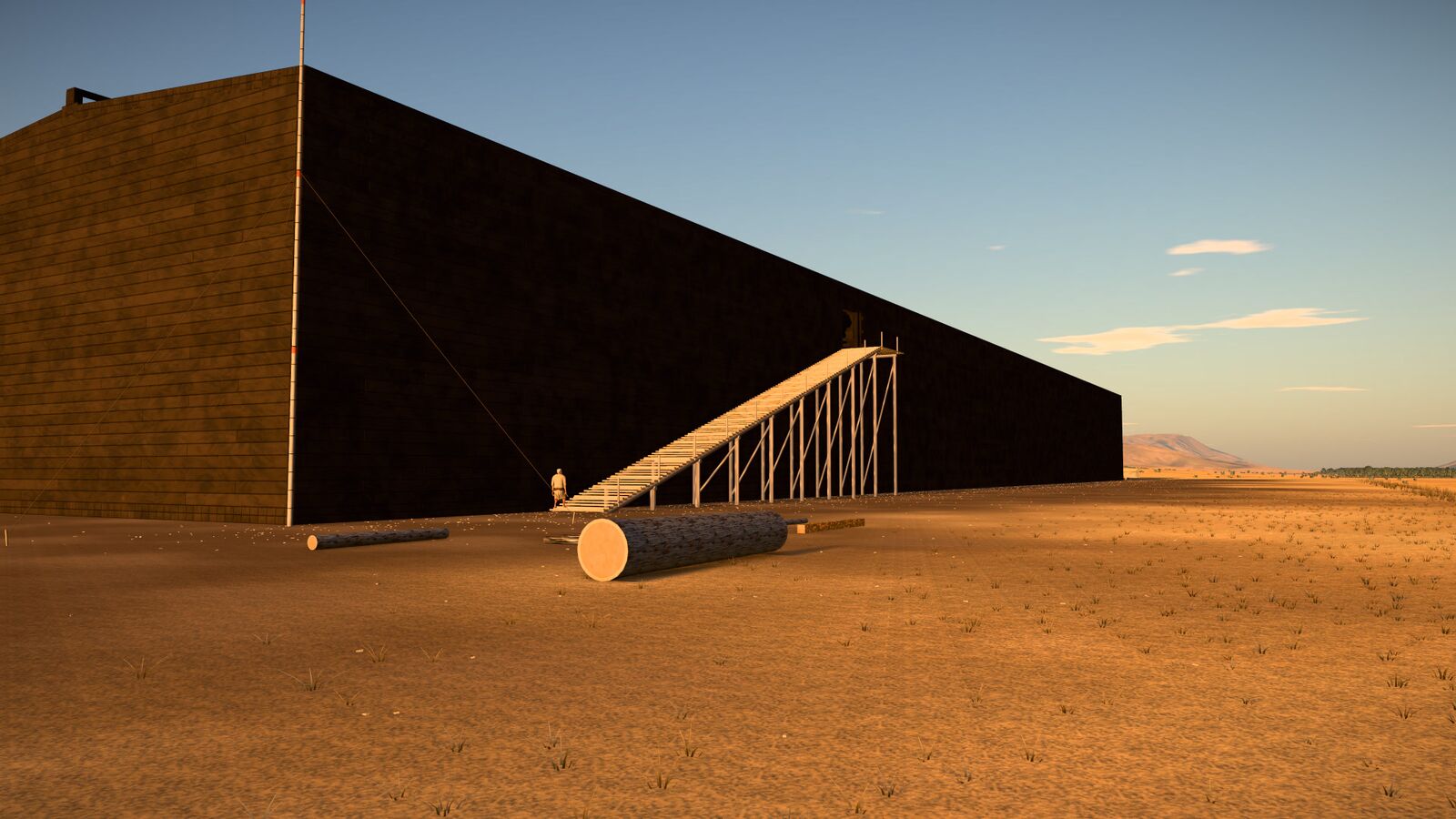
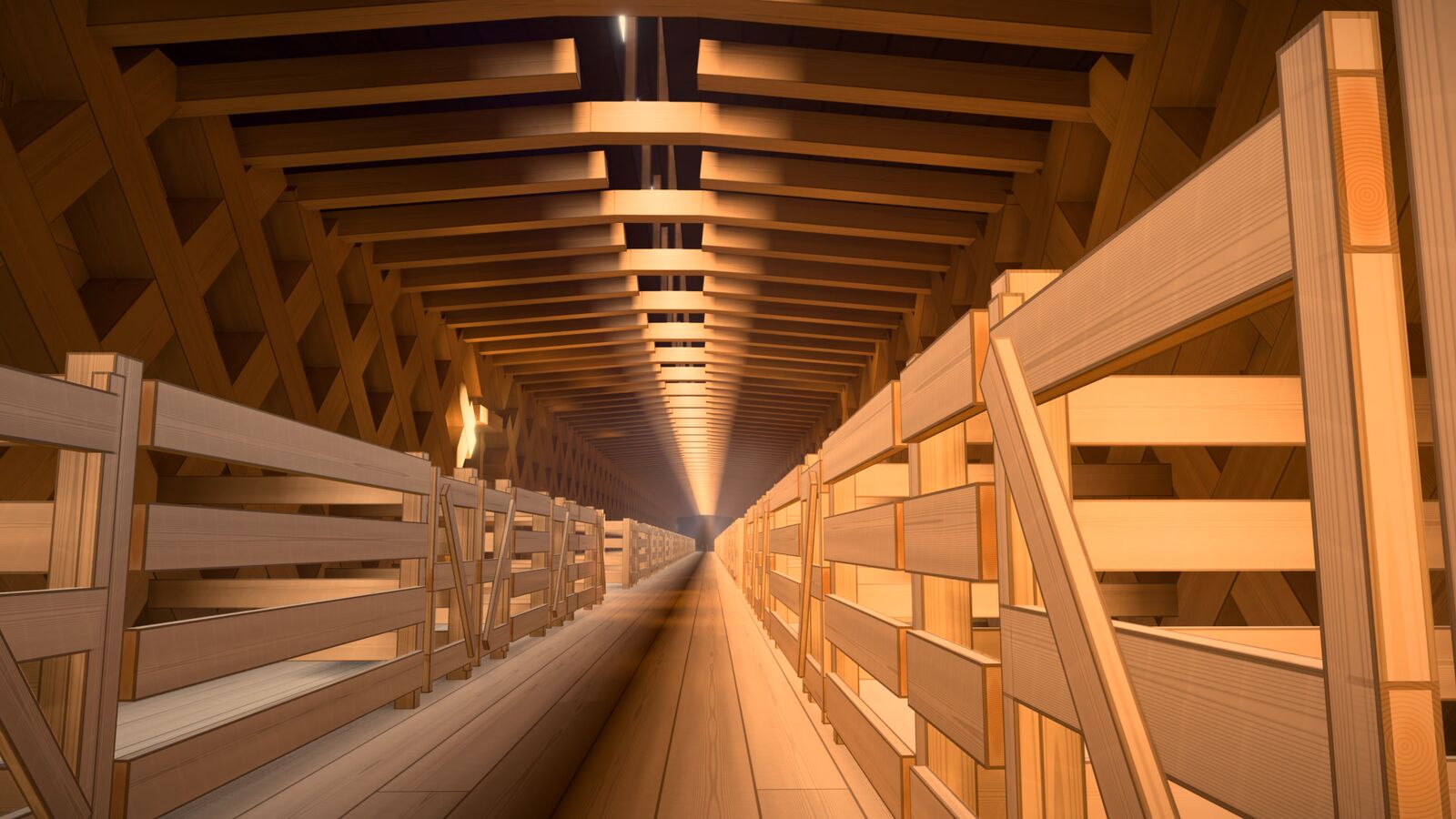
The length of the ark shall be three hundred cubits, the breadth of it fifty cubits, and the height of it thirty cubits.
Genesis 6:15
The family
The house of eight
In the selfsame day entered Noah, and Shem, and Ham, and Japheth, the sons of Noah, and Noah's wife, and the three wives of his sons with them, into the ark.
Genesis 7:13
A house is one to eight players building one ark in one shared world, and you join one only by invitation. Players have no names, only their roles. The Bible doesn't name the wives, so the game doesn't either.
Alone, you are Noah. In a house each person takes a free role, and some work needs more than one pair of hands: a long timber carried at both ends, a lift on the count. Roles nobody plays are kept by the game as family members working from the work board, so the family is always whole.
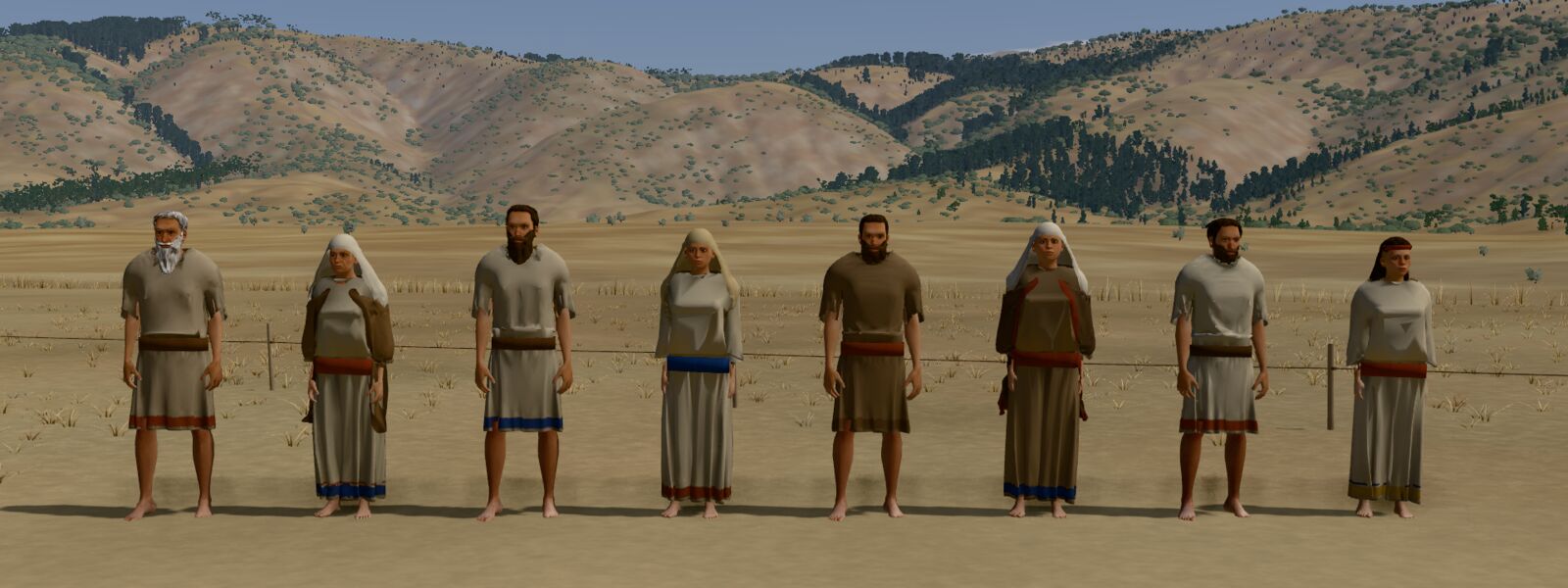
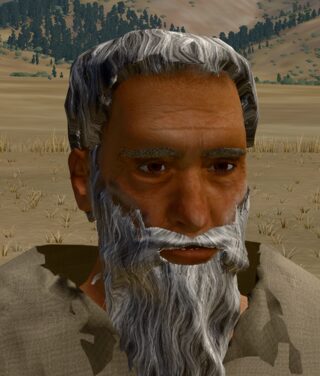 Noah
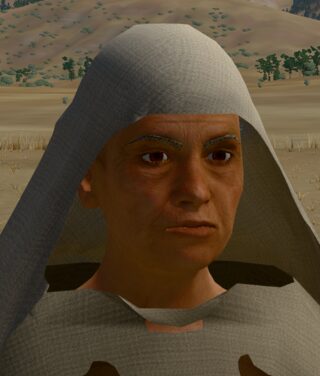 Noah's wife
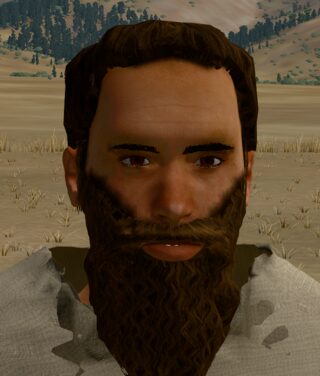 Shem
 Shem's wife
 Ham
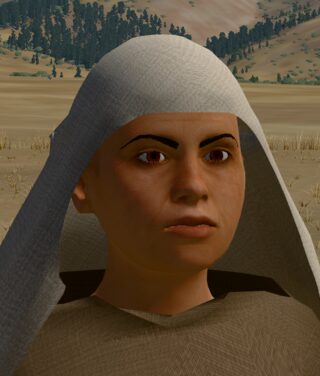 Ham's wife
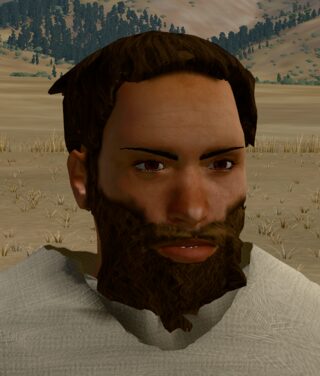 Japheth
 Japheth's wife
The years
A family over 120 years
God's word comes in Noah's 480th year, and the flood in his 600th. The game's calendar runs between the two, and the house grows as the family did: for its first decades it is Noah and his wife alone.
Year 1
God's word, and the first work
The 120 years of Genesis 6:3 begin twenty years before Noah has children, as Rashi reads them: Noah is 480. He and his wife prepare for a large family and for the build: the site staked out, the ground cleared, trees marked and planted, fields, a herd and a home. In the game a house begins as the two of them; their preparations, run as quick batches, are planned. historicalmodelled
Years 21, 23 and 25
Japheth, Shem and Ham are born
In Noah's 500th, 502nd and 504th years (Genesis 5:32, 11:10): Japheth the eldest, as Rashi reads it, and Ham the youngest, his year modelled. The boys help with small chores as they grow. texthistoricalmodelled
Years 36, 38 and 40
The sons at full work
From fifteen, as youths worked in their parents' households in the Bronze Age. From his year, a son's role opens in a house. modelled
Years 39, 42 and 45
Three marriages
The sons marry young, at 18, 19 and 20 (“at eighteen the bridal canopy”, Mishnah Avot 5:21), and each wife joins the work at her marriage. From year 45 all eight can work. historicalmodelled
Year 116
Lamech dies
Noah's father, at 777 (Genesis 5:28–31). Each death in the family will stop the work for days of mourning (planned). text
Year 121 · month 2 · day 10
Methuselah dies
At 969 (Genesis 5:25–27), seven days before the flood: the tradition reads the “seven days” of Genesis 7:4 as the days of mourning for him. texthistorical
Year 121 · month 2 · day 17
The flood
“In the six hundredth year of Noah's life, in the second month, the seventeenth day of the month” (Genesis 7:11). text
How long does the ark take? The game's labour study puts it at about 79 to 87 years for a house of eight, and about 458 for Noah alone. There is no deadline: the 120 years and the flood are marks on the calendar, and houses will be ranked by the time their build took. modelled
Around the build
Life goes on around the ark
A house lives in the valley for decades, and living is work. Around it the world goes on, and it grows worse (Genesis 6:5, 6:11).
PlannedDesigned and researched, and built next with the work chain. None of this is in the game yet.
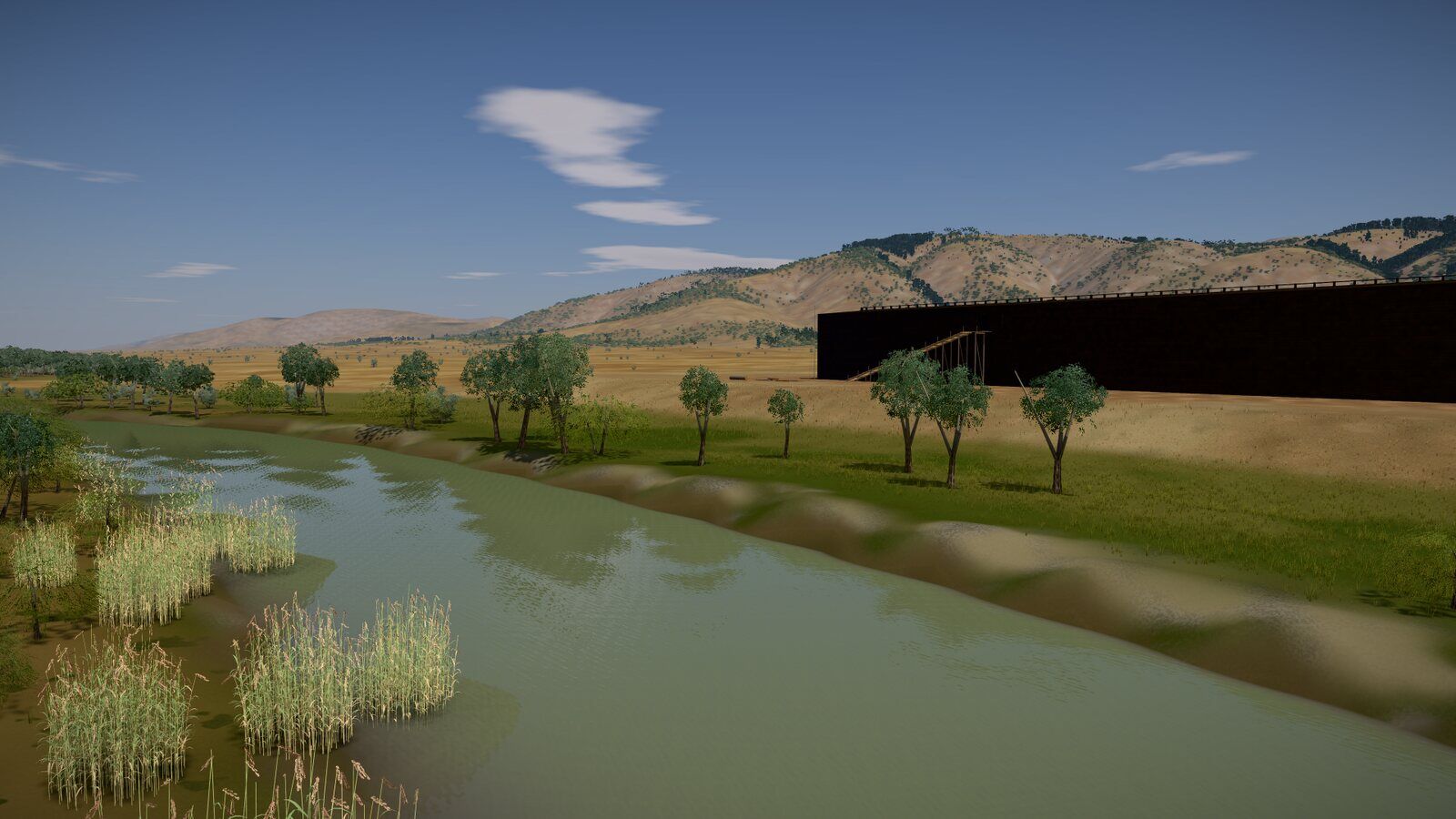
Fields and the herd
Grain and pulses by the river, from seedtime to harvest (Genesis 8:22); sheep and goats for milk and wool, cattle for milk and the oxen that haul. No meat before the flood (Genesis 1:29, 9:3).
PlannedWater
Carried from the river for the people, the herd and the work, some 15–20 litres a person a day, unless the house digs a well or a cistern near the site.
PlannedOnlookers
People from the plain come to watch, to ask and to mock: “Old man, why are you building this ark?” (b. Sanhedrin 108b). You answer from a few set answers, never typed, and answers have consequences.
PlannedHardships
Heavy rain and drought, wind, fire at the pitch kiln, rot in badly stored timber, and injuries from carelessness. A house can guard against each, and none costs the whole build.
Planned
The journey
Four parts, one family
Every part is a game of its own, and what you build carries on: a leaky hull from the build leaks on the voyage, and the food you load is all there is after the flood.
- In development now
Part one · The build
From the first tree to the pitched hull.
- Later
Part two · The animals
Bring them in before the rain: two of every kind, and of the clean by sevens.
- Later
Part three · The voyage
A year and ten days on the water: food, water, and the hull you built.
- Later
Part four · After the flood
Start again from the mountains of Ararat: plan, plant, and wait for the harvest.
Part one comes first, and alone, until it works.
How we work
Every fact has a source
The Bible text is the specification: Genesis 6:14–16 is the blueprint. Where the text is silent (the wood, the methods, the tools, the site), we model the gap on the earliest real practice we can find.
So the gopher wood is the wild Mediterranean cypress: the most common identification, not a certain one, and the oldest Jewish translations say cedar. The work is timed from experimental archaeology and old shipyard records.
Every number in the game and in the journal is labelled with where it comes from:
- textthe Bible's own words, or an ancient translation of them
- historicala writing outside the Bible: classical authors, the Talmud and midrash, the medieval commentators
- archaeologya find or a measurement
- studya published study, lexicon, experiment or standard
- modelledour own estimate or choice, where the sources are silent
Journal
From the workshop
The journal: the research behind the game, a page at a time, with its sources.
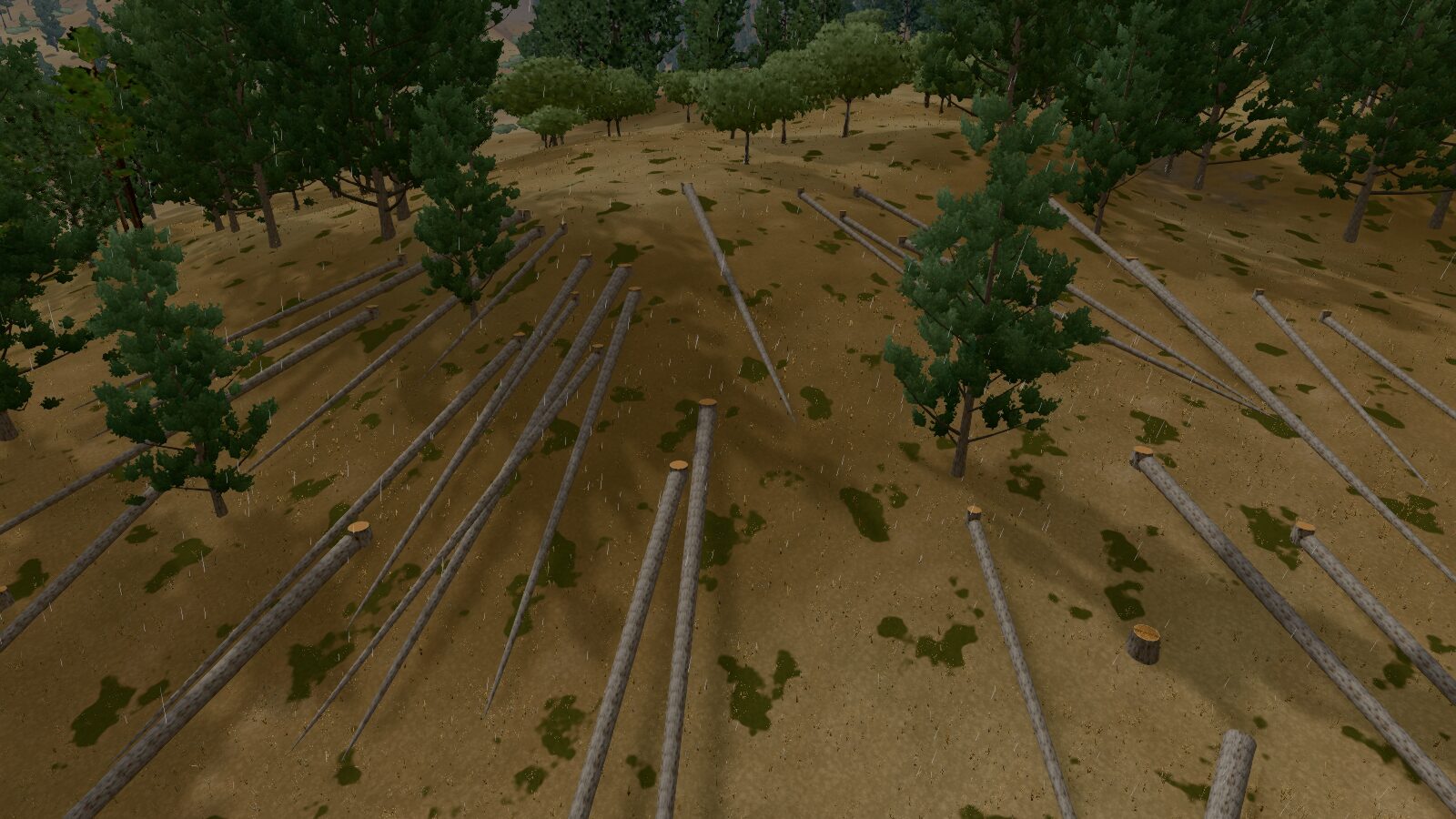
A few by hand, the rest in batches: making decades of work playable
The ark is about 350,000 separate jobs, and nobody can play them all. Why the game has a player do one job in thirty by hand and watch the rest as a short time-lapse, why the calendar still counts every hour of the real work, and what that comes to in hours of play.
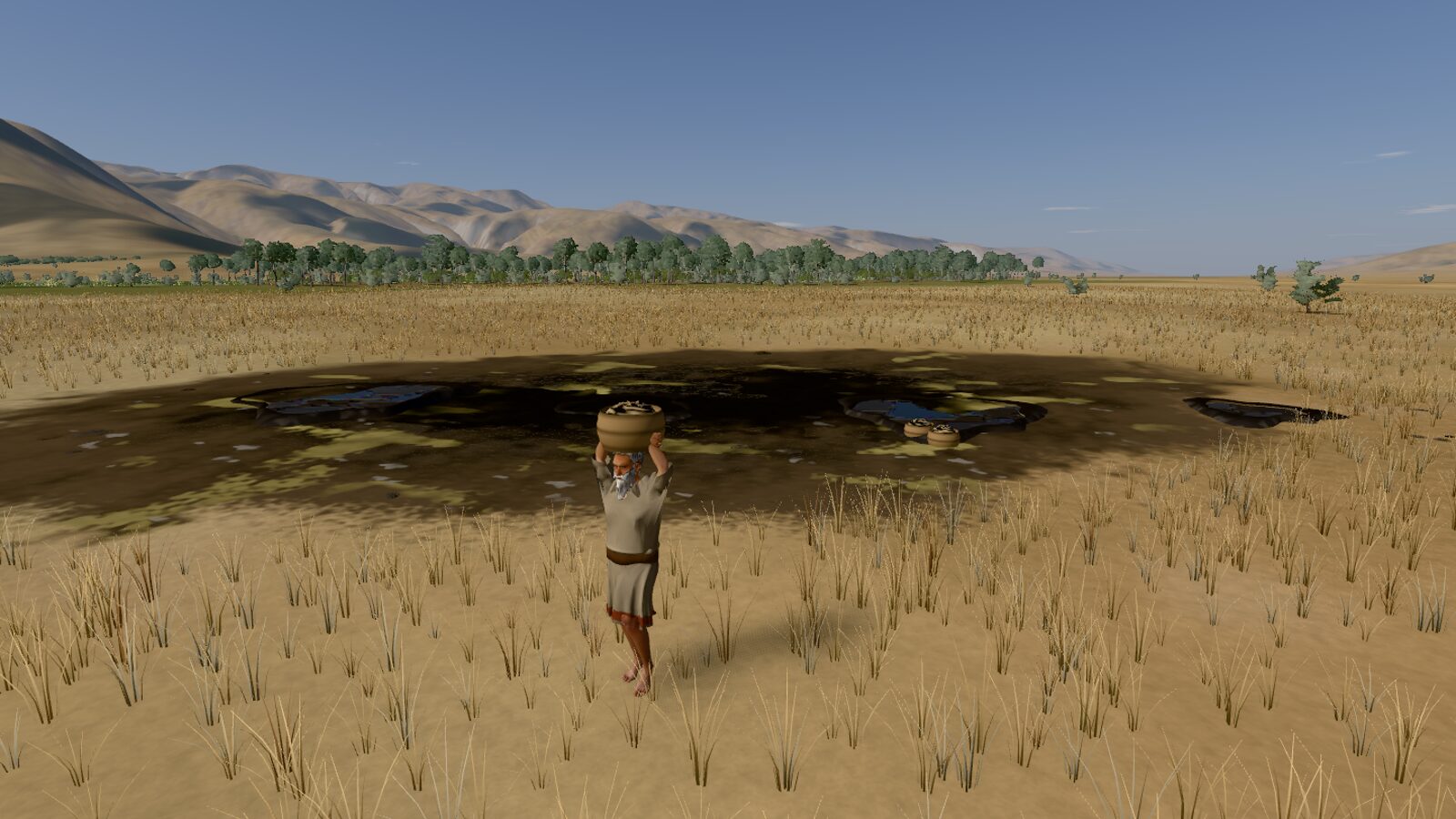
Bitumen from a seep, and pine tar from the hills
The ark's pitch can come out of the ground or out of the pines. Where the game's bitumen seep is, how crude bitumen was gathered by hand and melted into a mastic, how pine tar was burned out of resinous wood in an earth-covered pit, and what each costs a house.
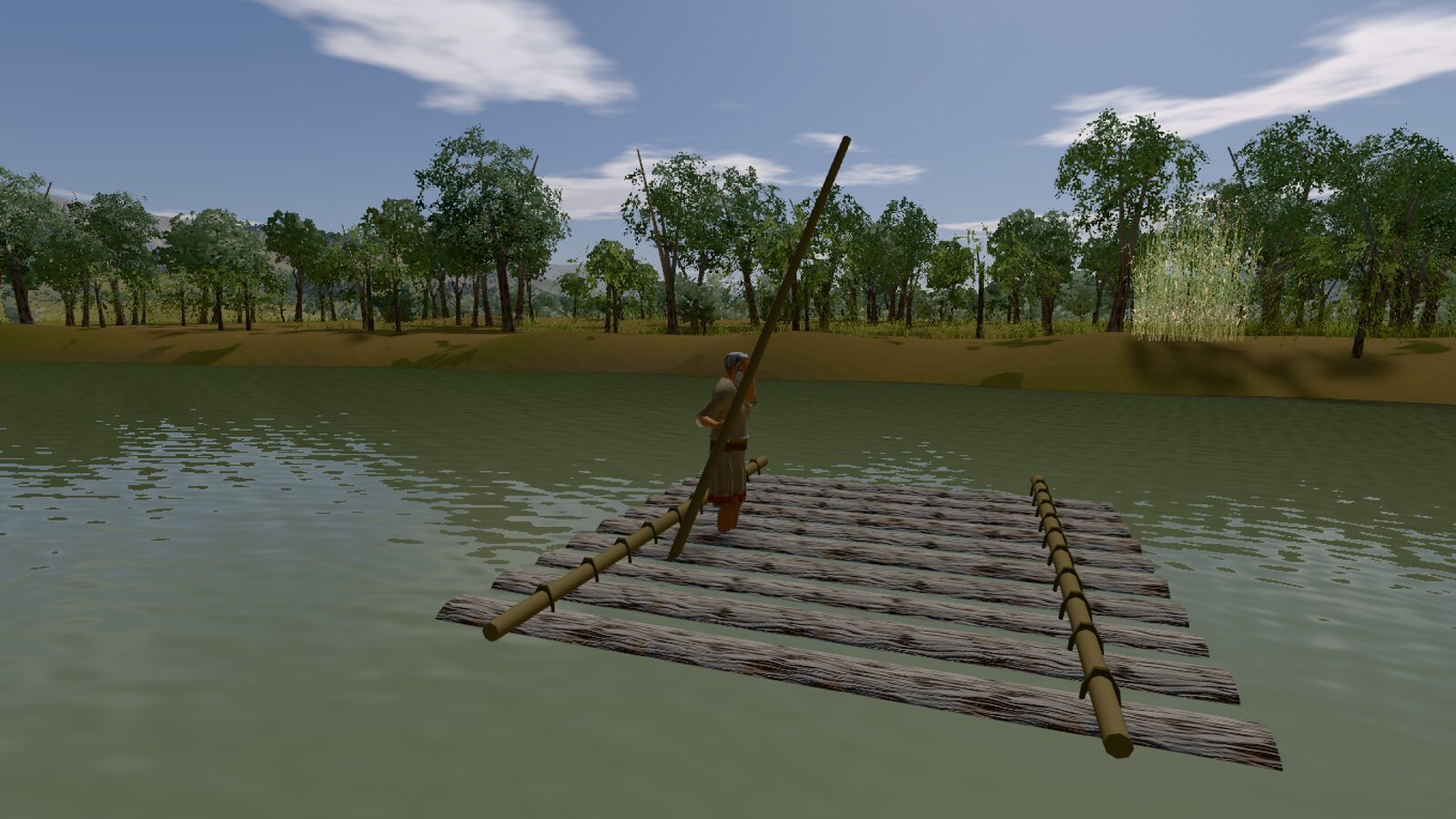
Down the river: does green cypress float, and how timber was rafted
A river carries for nothing what a crew drags for weeks, but only downstream, only when there is water, and only wood that floats. Which of the valley's woods float fresh-cut, how the ancient world rafted its timber, and how a house binds a raft and steers it down to the site in the game.
Build it right, and it holds. Build it together, and you finish sooner.
Support House of Noah
Help build and run House of Noah
House of Noah is free for everyone. Your gift helps build it, keep it running and keep developing it. You can give monthly or once.
Monthly or once: you choose on PayPal's page.
Gifts go through PayPal to John Tibell, who makes House of Noah.
Every supporter gets our thanks, and a name on the supporters' page if they'd like. Why support, and our supporters