Down the river: does green cypress float, and how timber was rafted
A river carries for nothing what a crew drags for weeks, but only downstream, only when there is water, and only wood that floats. Which of the valley's woods float fresh-cut, how the ancient world rafted its timber, and how a house binds a raft and steers it down to the site in the game.
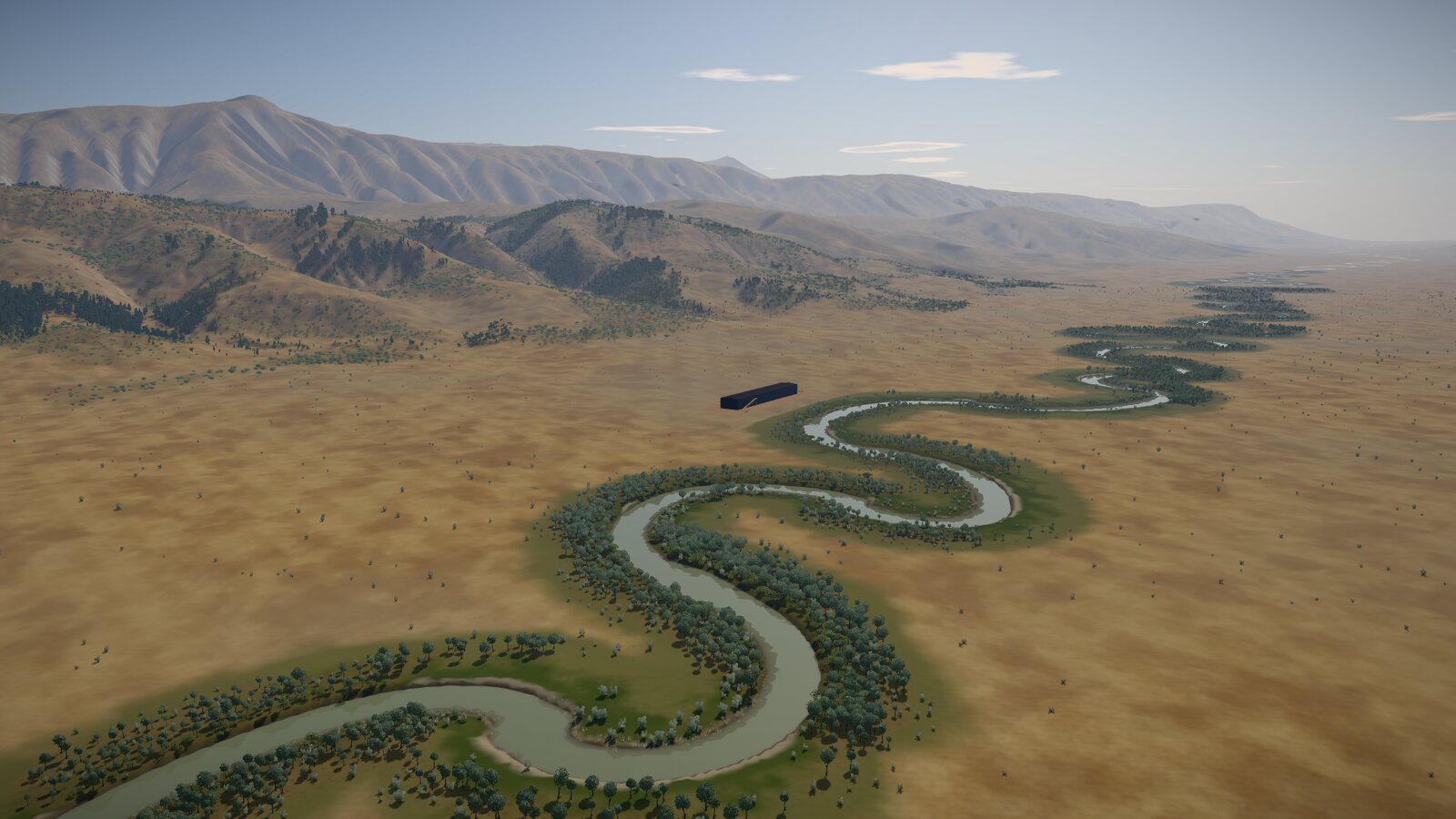
The game's valley has a river through it, and it runs past the building site. Every log that can be put into it upstream travels down for the cost of steering. The catch is in three conditions: the river runs one way, it is not always deep enough, and the log has to float.
Does it float?
Wood floats while it is lighter than water, 1,000 kilograms a cubic metre study. Dry, almost every wood qualifies. Fresh-cut, a log is full of water, and some woods are then too heavy.
Fresh Mediterranean cypress weighs about 900 kilograms a cubic metre in the game, within a range of 800 to 1,000 modelled. So it floats, low, with about 100 kilograms a cubic metre to spare. The range matters: no one has measured the moisture of fresh cypress from these hills, and the game reasons from its relatives in the cypress family, whose heartwood holds about a third to a half of its dry weight in water and whose sapwood holds much more study. A big, heartwood-rich log comes out lighter and floats higher; a young, sappy pole is heavier and may sink modelled.
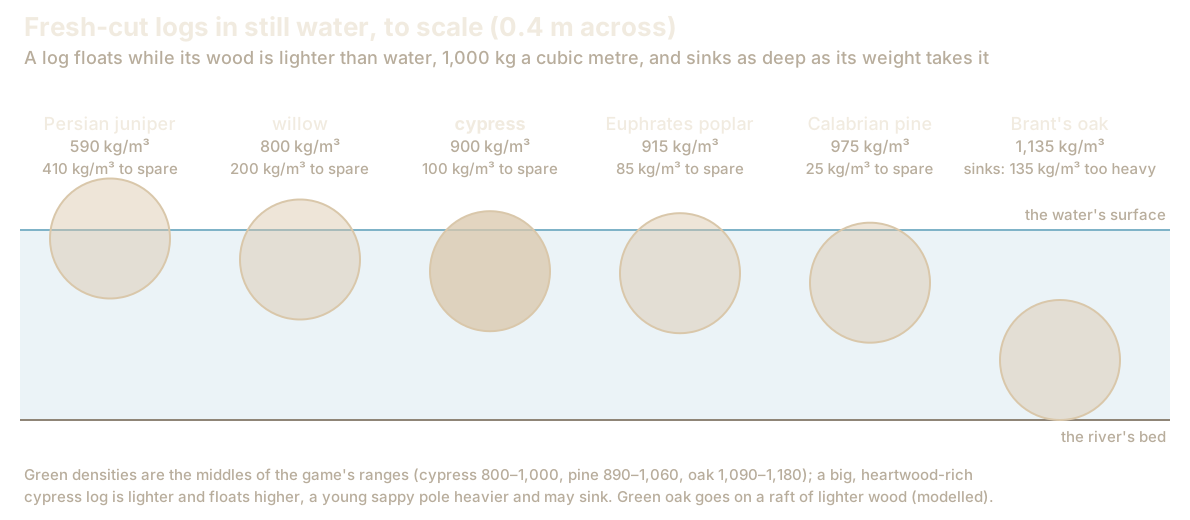
The other woods of the valley spread out on both sides. Juniper floats high and willow well; Theophrastus noted that willow is light even when green historical. Calabrian pine, almost all sapwood, floats awash. Fresh Brant's oak, at about 1,135 kilograms a cubic metre, sinks modelled. Builders knew the problem: Vitruvius wrote of larch that "it will not float in water … and is either conveyed in vessels, or floated on fir rafts" historical. Foresters in Myanmar girdle teak and leave it standing three years so that it dries enough to float study. Even light wood is lost: in the Swedish timber drives about 2.5 % of the logs sank on average, a third of a per cent of the largest historical.
How the ancient world rafted its timber
Gudea, a ruler of Lagash whom historians date to about 2125 BC on the conventional chronology, recorded the timber for his temple coming by water: "the long rafts floating downstream … logs of cedar wood from the cedar hills, logs of cypress wood from the cypress hills" historical. Another of his inscriptions says he "formed into rafts cedar logs 60 cubits long, cedar logs 50 cubits long" historical. Hiram of Tyre promised Solomon the same for the cedar of Lebanon:
I will convey them by sea in floats unto the place that thou shalt appoint me.
1 Kings 5:9
A relief from Sargon II's palace at Khorsabad shows boats carrying beams and towing logs through the water archaeology. And rivers run one way. Herodotus describes the skin boats of the upper Euphrates being broken up at Babylon, because "the current is too strong to allow a boat to return upstream" historical. On the Tigris in the 19th century, Layard wrote that in the spring floods small rafts might float from Mosul to Baghdad "in about eighty-four hours", while "in summer, and when the river is low, they are frequently nearly a month in reaching their destination" historical.
The river through the year
The game's river follows a real one. Its flow month by month is the Khabur's at Zakho in northern Iraq, measured from 1958 to 1989: high in April and May with the snow-melt, low from August to November study. Two hydrologists' rules for how a river's depth and speed change with its flow carry that into the water over the river's shallowest crossings and the speed a steered raft drifts study modelled.
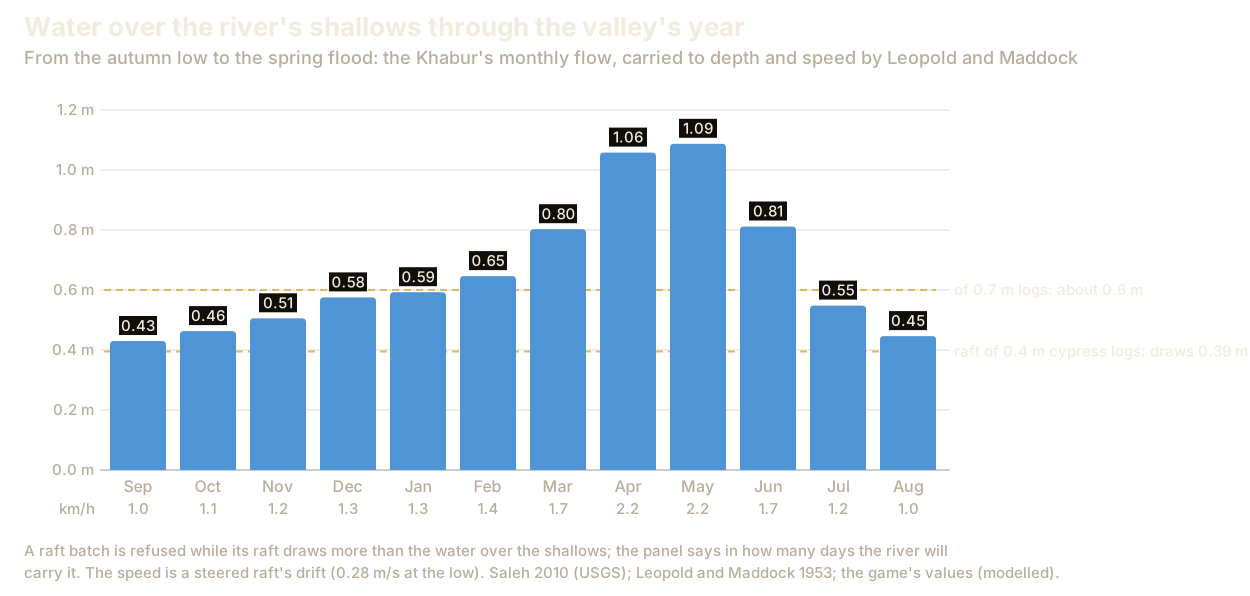
At the September low there are 0.43 metres over the shallows and a raft drifts at about a kilometre an hour; in May, 1.09 metres and 2.2 kilometres an hour modelled. A raft of logs 0.4 metres across can go in any season. A raft of big ones, the logs the ark's long beams come from, waits for the spring water. When the river is too low for a raft, the game says in how many days it will carry it modelled.
In the game
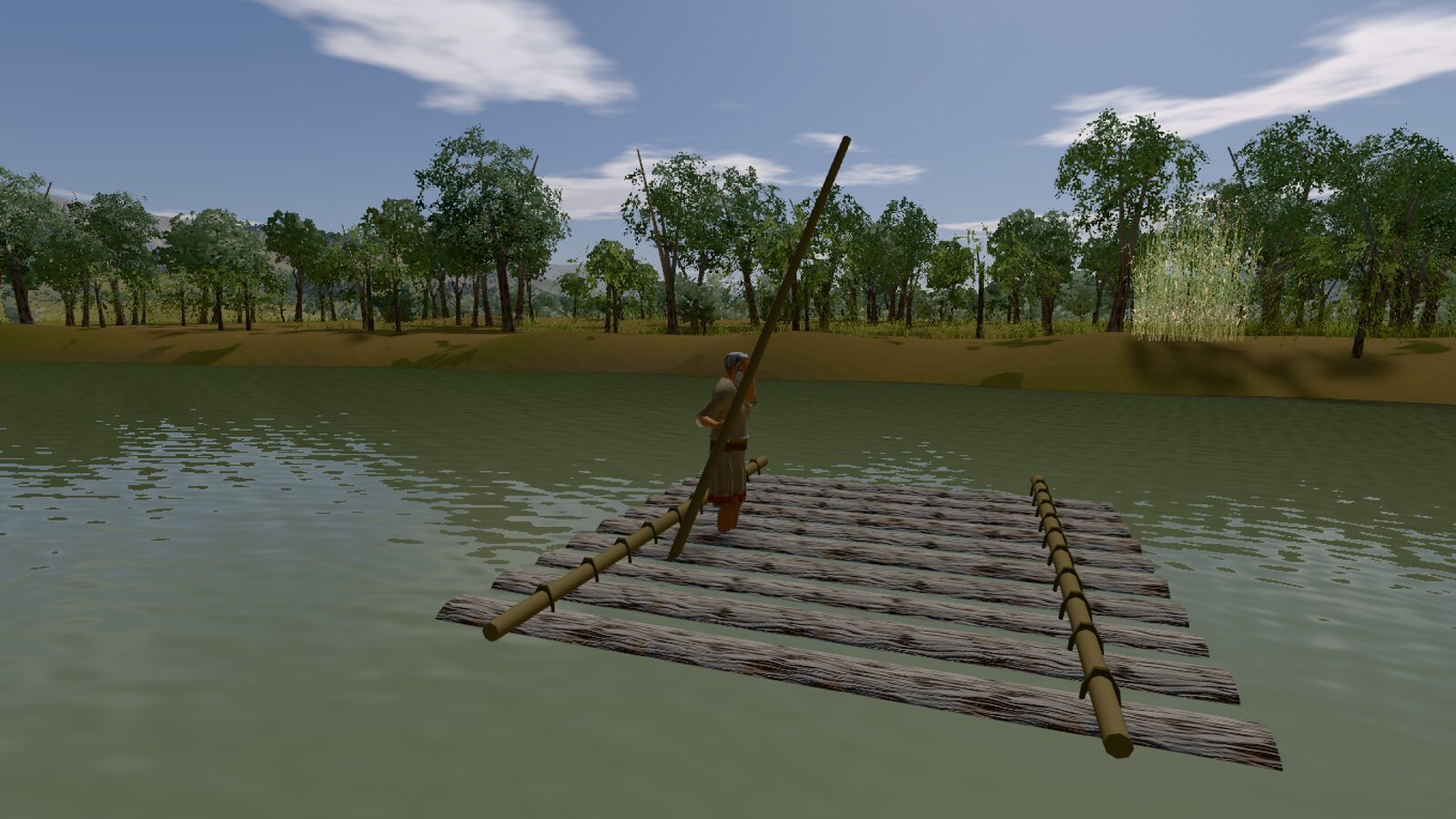
A log lying within ten metres of the water can be bound into a raft by hand: it is rolled down the bank into the water and lashed beside the others, butts alternating, at 1.5 person-hours a cubic metre, after the raftsmen of the German river Neckar, who spent six days of a fourteen-day run binding their rafts historical modelled. A raft takes about two and a half willow withies a cubic metre, cut and twisted by hand modelled. Then someone takes a steersman's pole on it: one for every 15 cubic metres, after foresters' rafts where one man guided "two to three logs of 4 to 5 cubic meters … in swift water" study modelled. A raft batch binds more of the pile into it, as many as the leads leave room for, and drifts the raft down to a landing, where the logs are rolled out into a deck modelled.
The raft in the picture is ten cypress logs 4 metres long, 0.36 to 0.46 metres across: 5.2 cubic metres and about 4.7 tonnes modelled. With Noah aboard it uses about 91 % of its buoyancy and draws 0.39 metres. It drifted 900 metres down to the site's landing in the spring flood, at about 2.3 kilometres an hour. All told it cost 16 person-hours modelled. The drift itself was about half an hour of Noah's time; binding the logs and rolling them out at the landing were nearly all the rest modelled. Dragging the same 4.7 tonnes the same distance over dry ground would take a crew about 150 person-hours modelled.
A few logs are lost on the way: half a per cent in the game, one and a half for logs under 0.3 metres across modelled. Green oak can't go alone; it rides on a raft of lighter wood that carries its extra weight modelled.
What it means for the ark
The river does not reach the trees. In the game's valley the cypress groves are 0.9 to 2.9 kilometres from the water, and landings below them sit 1.24, 2.75 and 3.42 kilometres up the river modelled. Every log still has to be hauled down to a landing on a track, with oxen or by hand, before it can float.
But the river takes the long part for almost nothing. In the game's labour study, hauling the reference ark's timber by river costs about 46,000 person-hours, against about 11 % more for the whole build if it all goes two kilometres overland with oxen modelled. A house that times its rafts to the spring flood and its felling to the groves near the landings saves years.