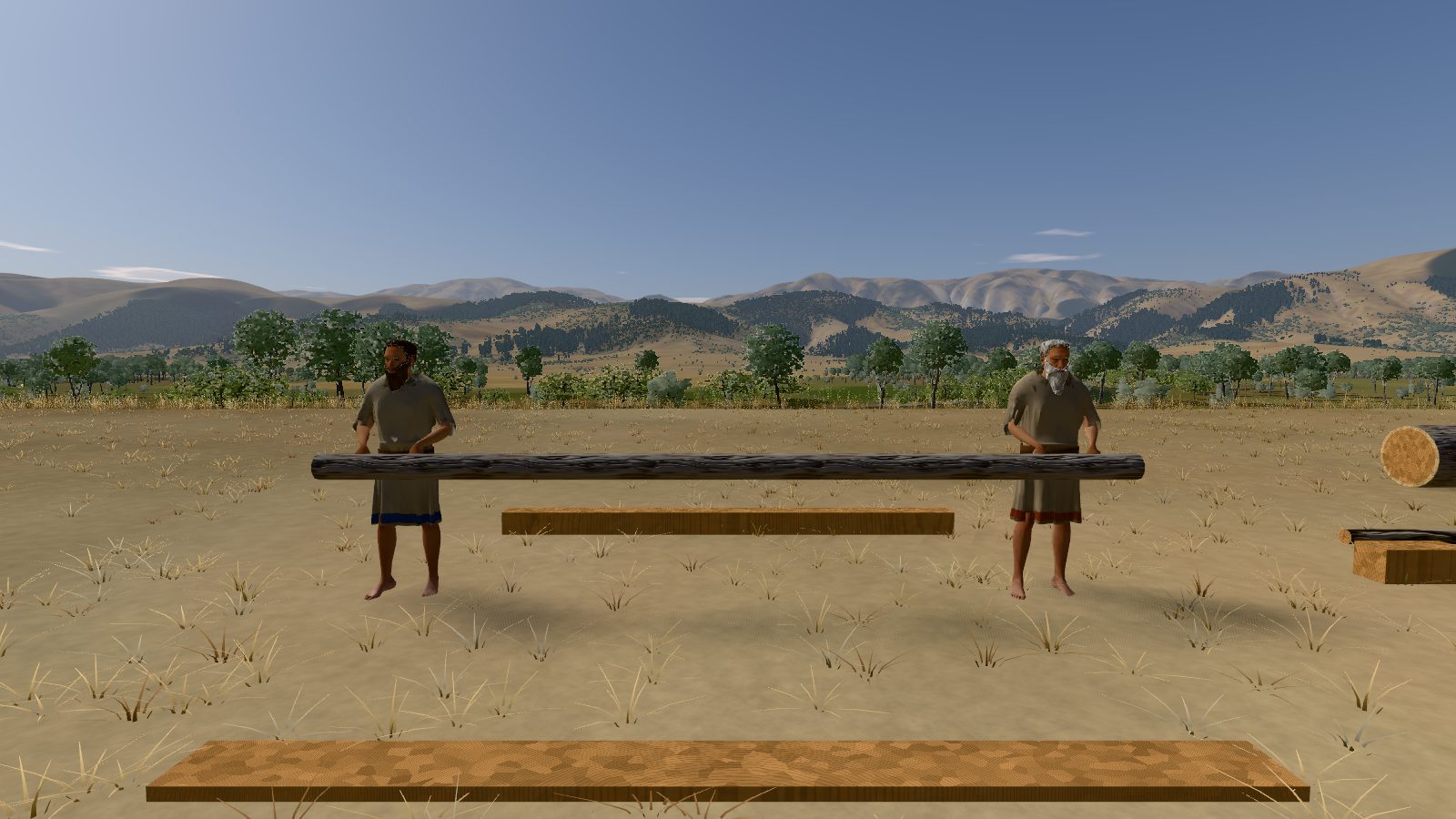
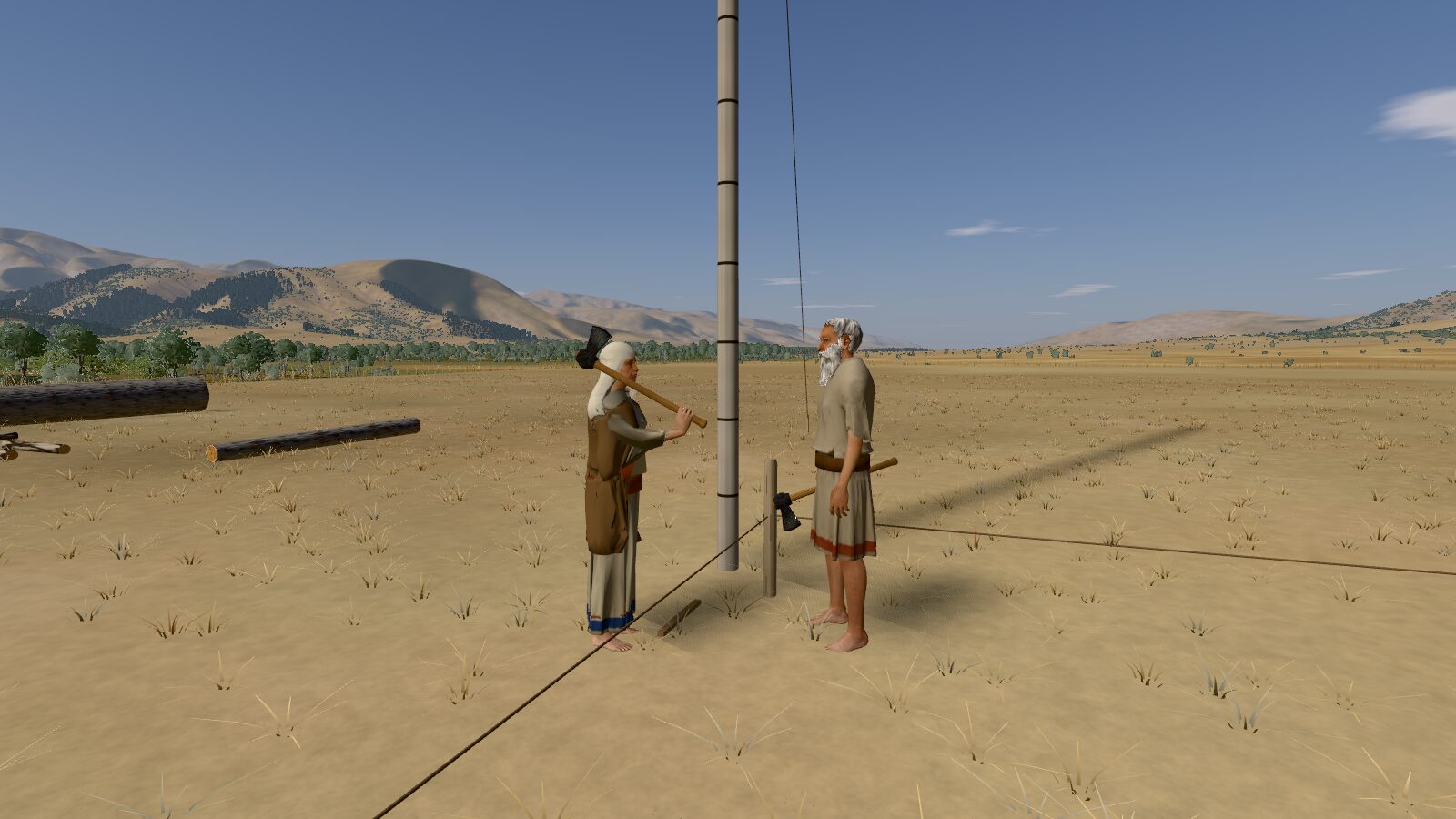
What a log weighs, and why some things need two
Fresh-cut cypress is heavy, and the ark is made of tonnes of it. How the game weighs every piece of timber, how much one person can lift, why a 90-kilogram pole needs two and a beam four, and why logs are never lifted at all.
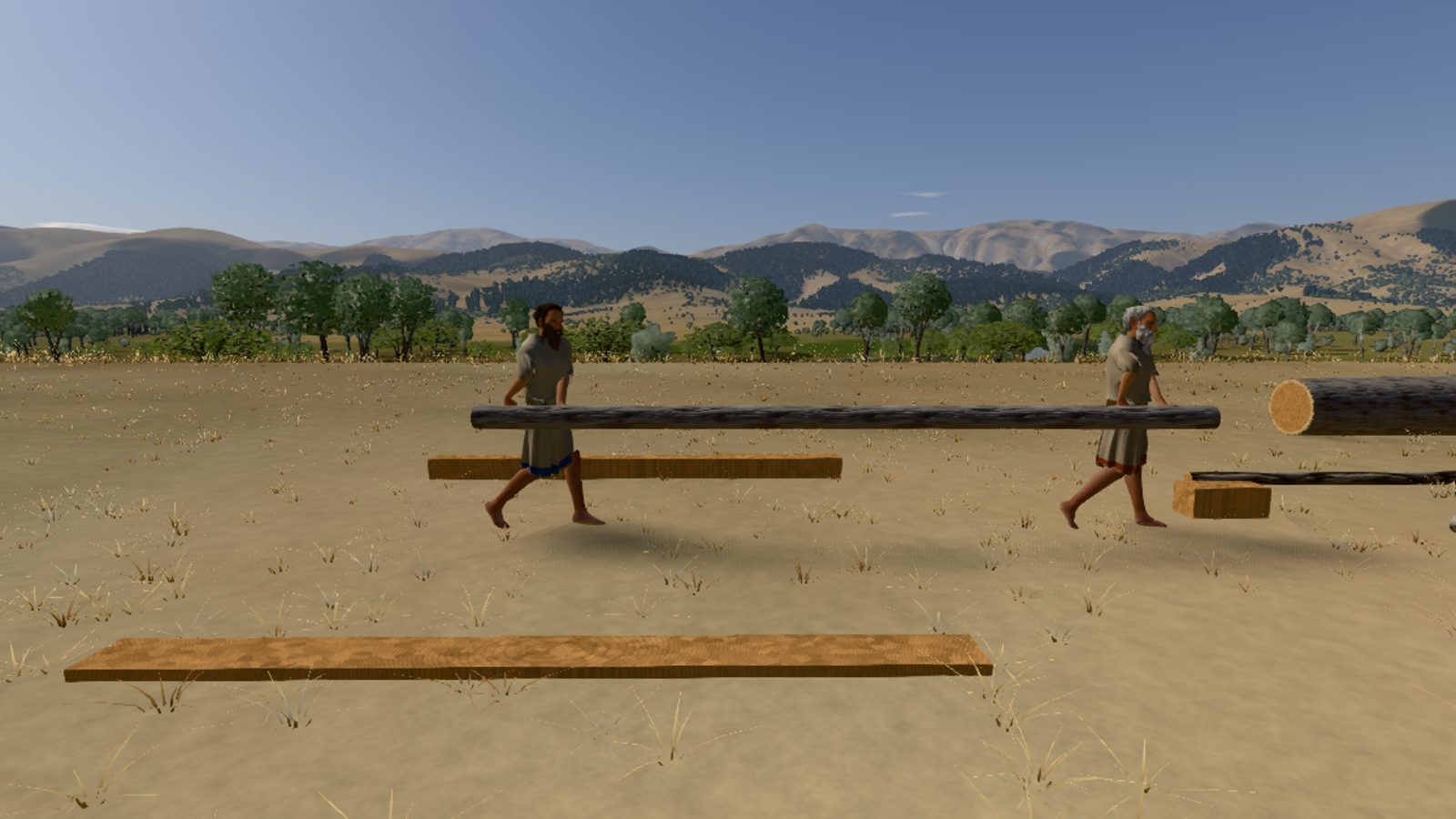
Every piece of timber in House of Noah has a weight, and the game works it out the way a forester would: the volume of the piece times the density of its wood modelled. For the volume of a log it uses Smalian's formula, the average of the areas of its two ends times its length, a standard of forest measurement study. The density is the harder part.
Fresh wood is heavy
A living tree is full of water, and a freshly felled log is still full of it. Foresters call that weight "green": the wood's basic density, its dry mass for each cubic metre of fresh wood, times one plus its moisture, as the US Forest Products Laboratory's Wood Handbook gives it study.
No measurement of the moisture in fresh Mediterranean cypress was found, so the game reasons from its relatives modelled. Its dry wood, at the usual 12 % moisture, weighs 600 to 621 kilograms a cubic metre study. The heartwood of the cypress family holds about a third to a half of its dry weight in water, the sapwood much more study, and saturated wood from Cupressus plantation trees 20 to 30 years old measured 820 to 930 kilograms a cubic metre study. So a big, heartwood-rich log might weigh 700 to 850 and a young, sappy pole 900 to 1,050 modelled. The game takes 900 kilograms a cubic metre for all fresh cypress, within a range of 800 to 1,000 modelled. Fresh Brant's oak is heavier still, 1,090 to 1,180: it sinks in the river.
What one person lifts
A widely used standard for safe lifting at work, from the US National Institute for Occupational Safety and Health, starts from a load of 23 kilograms, which it judges acceptable to most workers lifting in a good posture study. It is a safety limit, not a limit of strength. So the game uses it as the comfortable load and lets a person lift up to 60 kilograms for a moment, the middle of a man's brief maximum of 50 to 70 modelled.
People lifting together do not simply add up. British guidance on team handling puts a team's capability at about 85 % of the sum of its members', and says teams of more than four rarely work well study. In a lifting study, teams of two to four reached 80 to 91 % study. In the game each member of a team may take at most 85 % of 60 kilograms, 51 kilograms, and a piece can be held by six at most, and by no more than one person for every 60 centimetres of its length study modelled.
The test stock
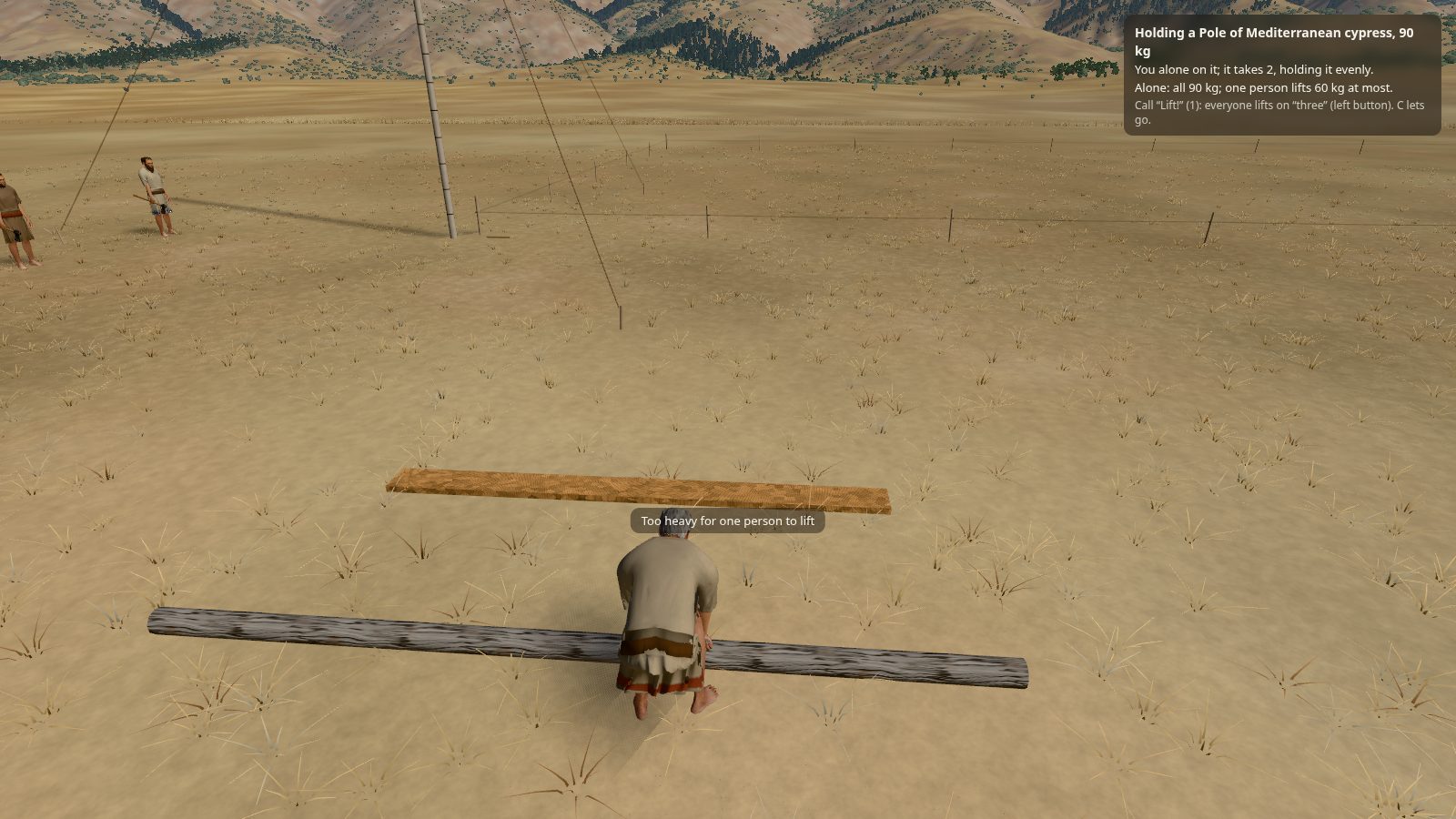
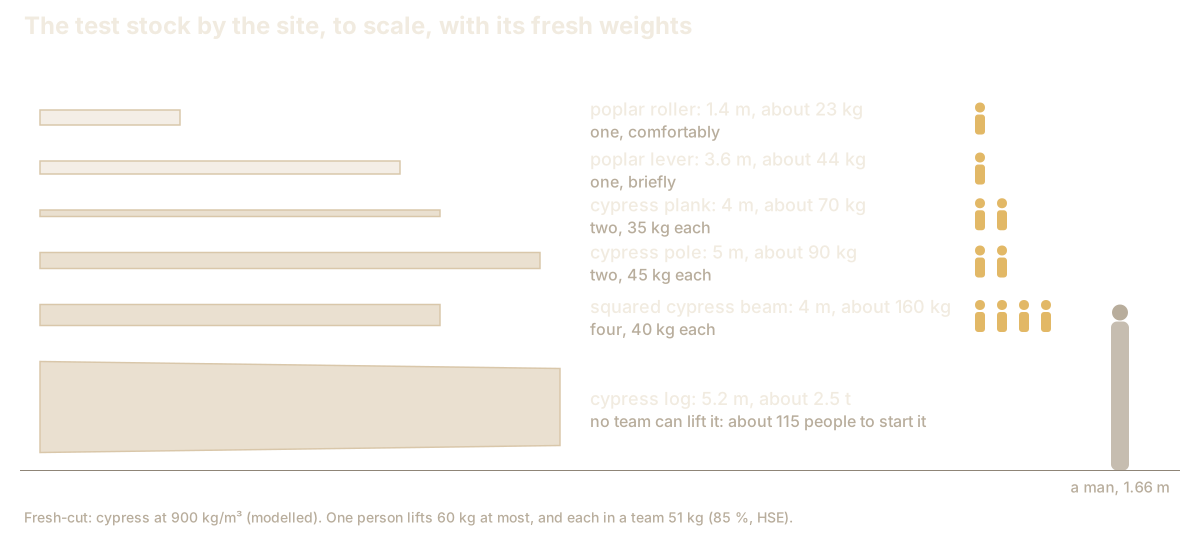
By the building site lies a small stock of timber, the same in every house, for trying all this out modelled. Weighed fresh, the cypress at 900 kilograms a cubic metre:
| Piece | Size | Weight | Who can lift it |
|---|---|---|---|
| A poplar roller | 1.4 m long, 15 cm across | about 23 kg | one, comfortably |
| A poplar lever | 3.6 m long, 13 cm across | about 44 kg | one, briefly |
| A cypress plank | 4.0 m × 30 cm × 6.5 cm | about 70 kg | two, 35 kg each |
| A cypress pole | 5.0 m long, 16 cm across | about 90 kg | two, 45 kg each; one can't |
| A squared cypress beam | 4.0 m × 21 × 21 cm | about 160 kg | four, 40 kg each |
| A cypress log | 5.2 m long, 0.91–0.77 m across | about 2.5 t | nobody: it has to be moved another way |
The beam is the interesting one. Three people would have to take 53 kilograms each, more than a team member's 51, so it takes four modelled.
Carrying slows you down, too. The game's pace falls from a walk of 1.4 metres a second with nothing in hand to 0.6 at the most a person may carry modelled. In one study, two men carrying 80 kilograms at a brisk walk were worn out by hand in 2.7 minutes, and lasted 14.5 with straps over their shoulders study.
Logs are never lifted
A cypress log half a metre thick weighs about 177 kilograms for every metre of its length modelled. A team of six can hold about 306. So no log of the ark's size can be lifted by hand, and the game says so: "Far too heavy to lift or carry." You drag it, roll it or lever it.
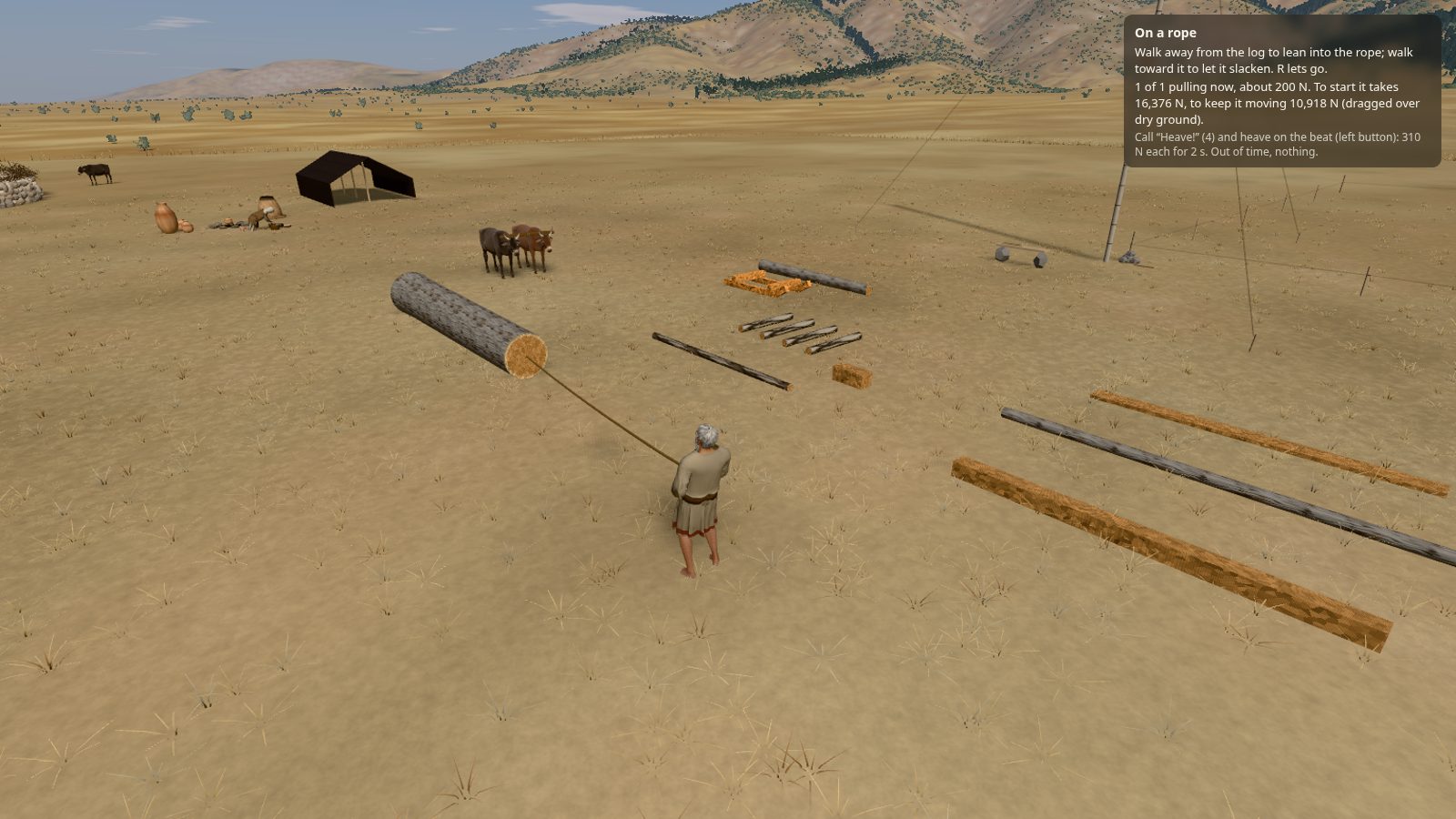
Dragging is a matter of friction. A log on dry ground needs a pull of about 45 % of its weight to keep it moving, half as much again to start it study modelled, and a person on a rope keeps up about 200 newtons, roughly the weight of 20 kilograms study modelled. The 2.5-tonne log in the test stock needs about 115 people to start it over dry ground, counting the losses of a big crew; on rollers, about 34 modelled.
A whole stem is worse. The game's demo tree, limbed, is a log 27 metres long weighing 6.4 tonnes: about 300 people to start it on dry ground modelled. That is why real heavy timber moved on tracks and rails, behind oxen, by water, or hewn square where it fell to shed weight. Those methods are planned, not yet built modelled.
What it means for the game
The reference ark is about 12,400 tonnes of green timber modelled. Every tonne of it has to be felled, moved, shaped and raised by a family of eight at most, with ropes, levers and each other. Some of it one person can handle alone, slowly. Much of it needs two, or four, at the same moment. How a house lifts together on the count is the next page.