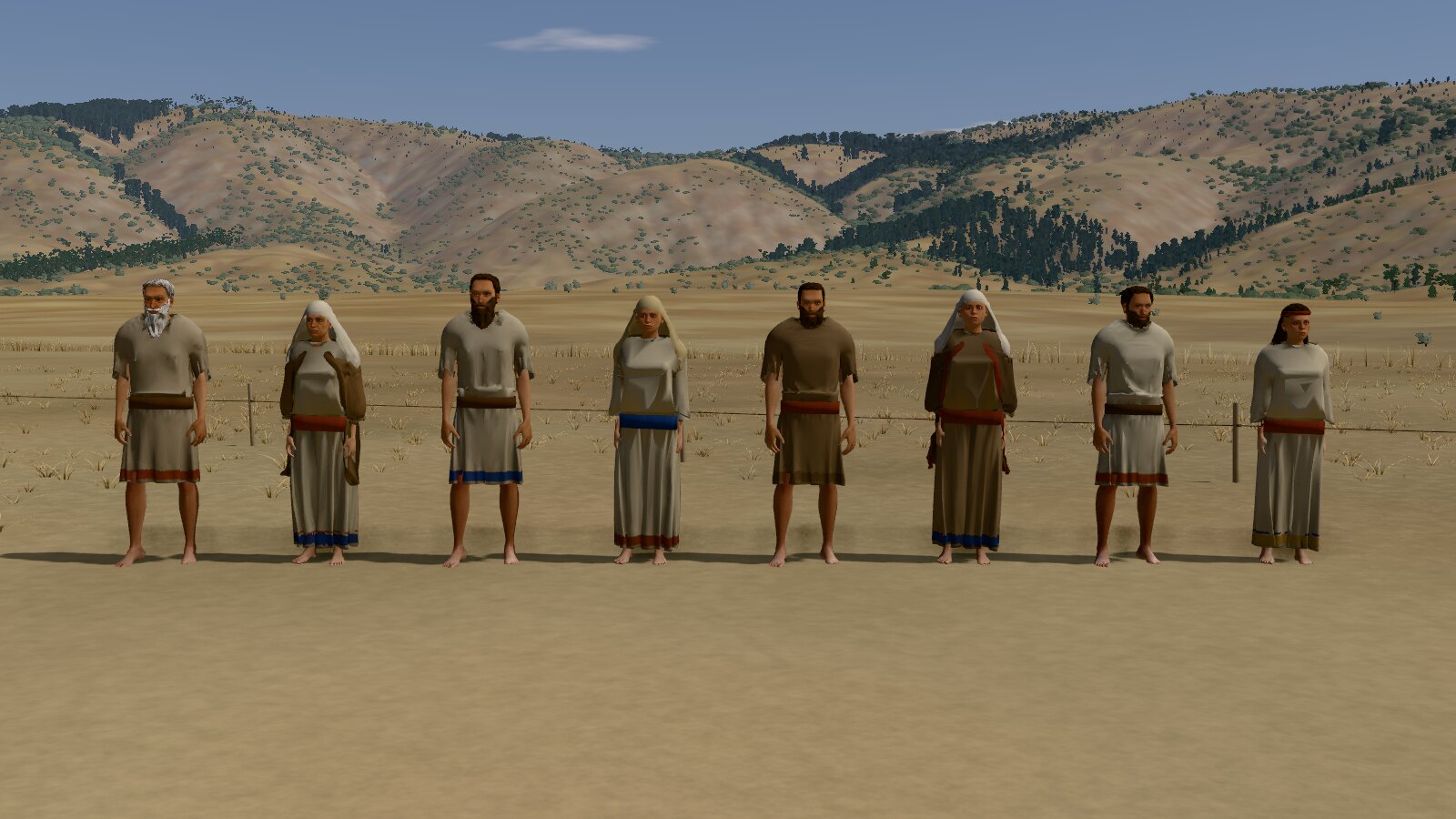
How tall were they? Bodies from Bronze Age bones
Genesis gives Noah's age, never his height. Why each of the game's eight people has a height of their own, from 1.51 to 1.69 metres, where those numbers come from, and what a body's height changes in play: the eye, the shoulder, the head room under a beam.
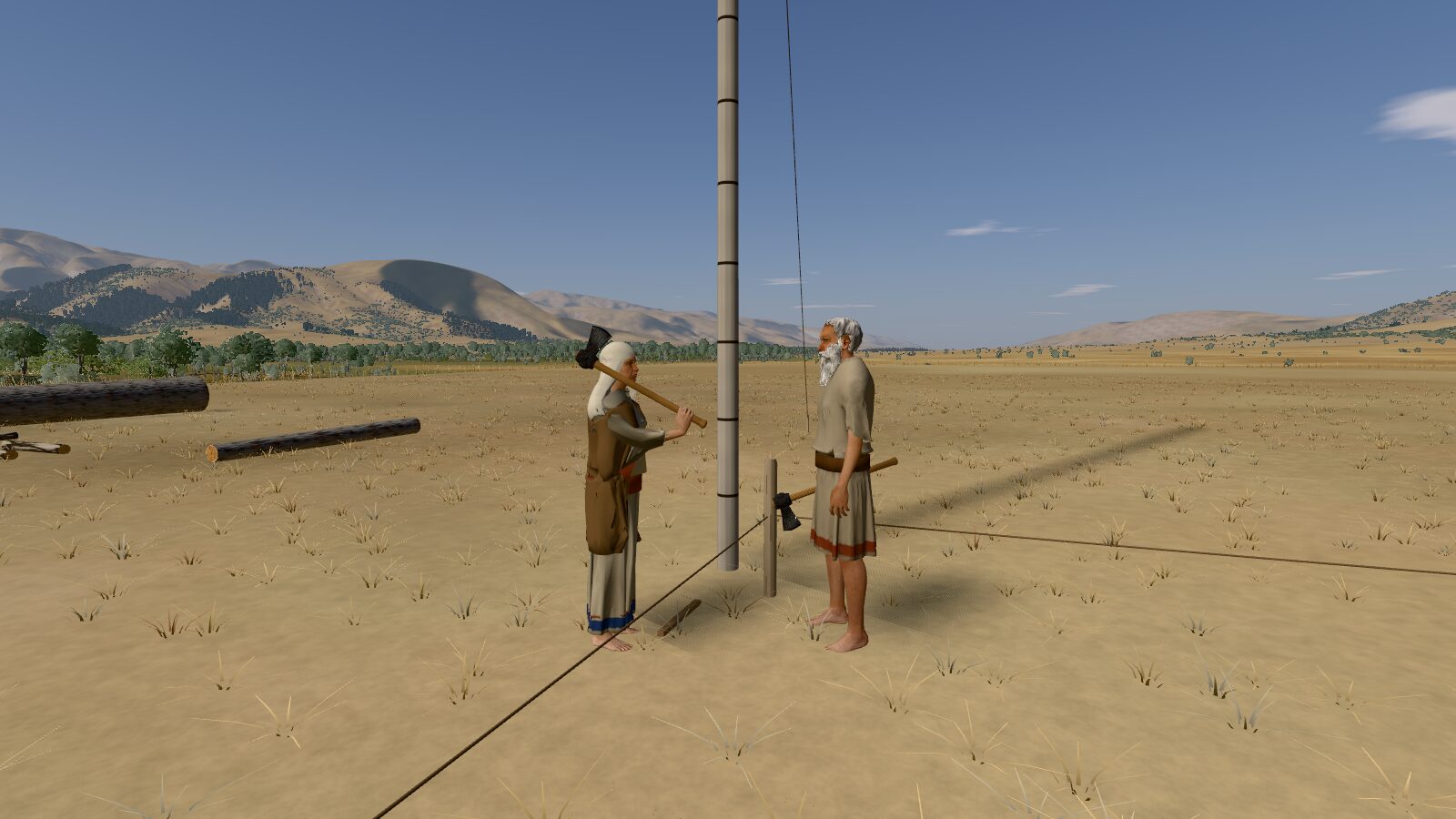
Genesis is generous with ages. Noah began to have sons at 500, and the flood came when he was 600:
And Noah was six hundred years old when the flood of waters was upon the earth.
Genesis 7:6 text
It says nothing about how tall he was, or anyone in his house text. A game cannot leave that blank. Every body in House of Noah has a height, and from that height come the eye you look through, the shoulder a pole rests on and the beam you can walk under. This page is about where the game's heights come from.
Measured bones
The nearest evidence is the people of the ancient Near East themselves: skeletons, measured. At Bab edh-Dhra', on the Dead Sea plain in Jordan, the burials of the Early Bronze Age, which archaeologists date to about 3150 to 2300 BC, give a mean stature of about 1.66 metres for the men and 1.56 metres for the women, "slightly smaller than contemporary Middle Eastern populations" archaeology.
These figures come to us from summaries of the excavation report (Ortner and Frohlich, 2008). The report itself could not be reached, so the game's sources mark the figures "reported". Bab edh-Dhra' is not Mesopotamia, and the numbers make no claim about Noah's own height: they give the family the size of real people of the ancient Near East. Nor do they date Noah's family. The dates are those of the conventional chronology, which a young-earth chronology does not accept, and the game borrows these people's size, not their date modelled.
A mean is not a person. Around it, the people of any population spread out taller and shorter. How far they spread at Bab edh-Dhra' has not reached us, but the Nile valley has been measured, in burials dated to the same millennia, about 4000 to 1900 BC: there, statures worked out from long bones spread by about 5 centimetres either side of the mean, for men and for women alike (one standard deviation) study. In Britain today, among better-fed people, the spread is 6 to 7 centimetres study. The game takes about 5 modelled: about two in three of the period's men would then have stood between 1.61 and 1.71 metres, and two in three of its women between 1.51 and 1.61.
Eight people, eight heights
Nothing in the text or the finds gives any one of the eight a height, so the game gives each of them a height of their own within that spread modelled:
- Within the spread. Each grown height lies within about one standard deviation of the period's mean for men or for women; the four men's average is the period's 1.66 metres and the four women's 1.56. Everyone differs, and each wife is shorter than her husband, as most wives are modelled.
- With age. Noah and his wife are drawn as people of about seventy. People lose height as they age, mostly in the discs of the spine; measured on the same people over the years, men had lost about 3 centimetres between 30 and 70 and women about 5 study. So Noah, 1.69 metres grown, stands at 1.66, and his wife, 1.58 grown, at 1.53 modelled. Both still stand upright, without an old person's stoop; Genesis makes him 600 at the flood (Genesis 7:6) text, and the game shows him as a strong older man modelled.
- The sons. Shem has his father's grown height, 1.69 metres; Ham stands 1.64 and Japheth 1.62. The order carries no meaning: no son's height says anything about the peoples later traced to him modelled.
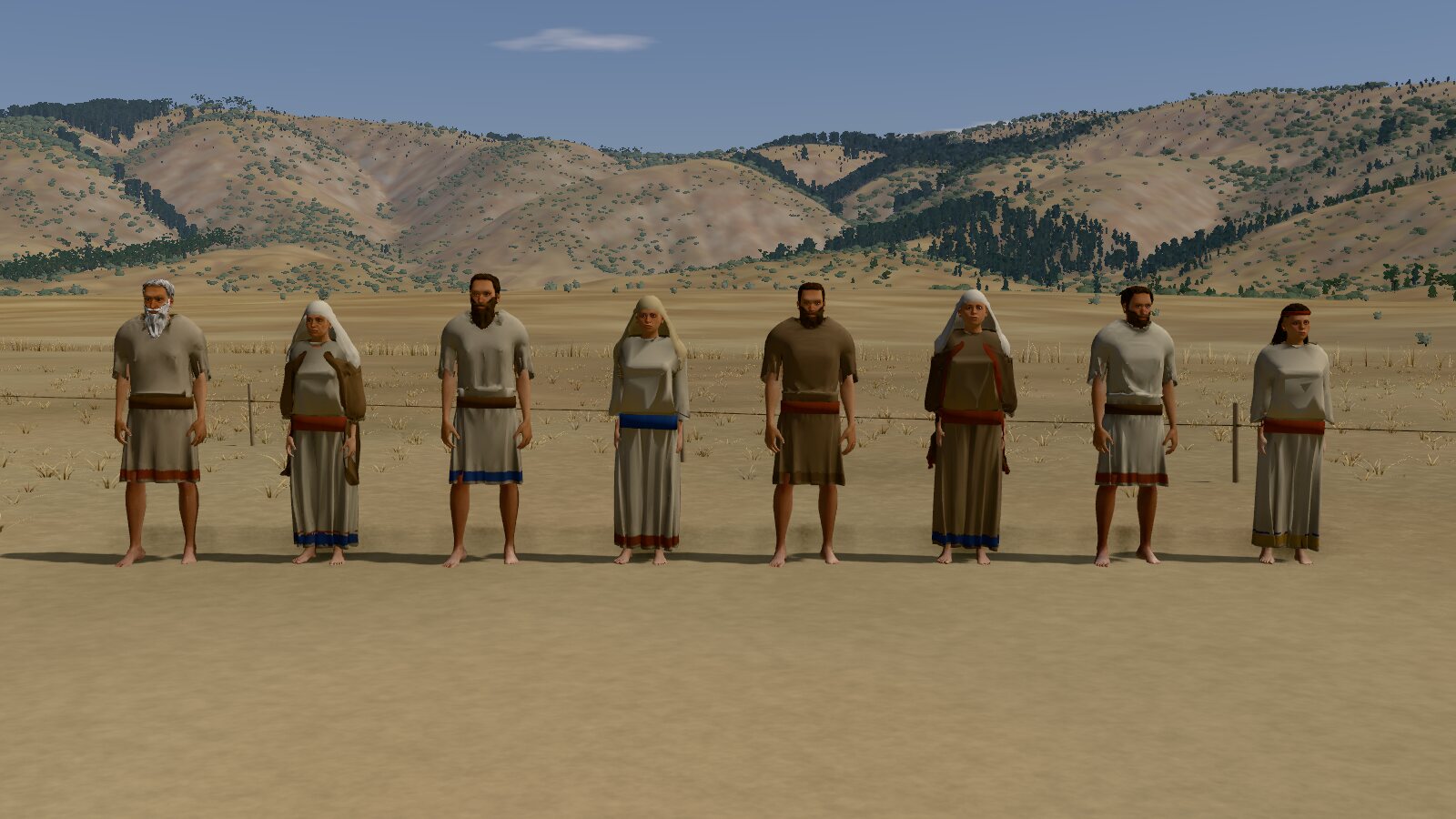
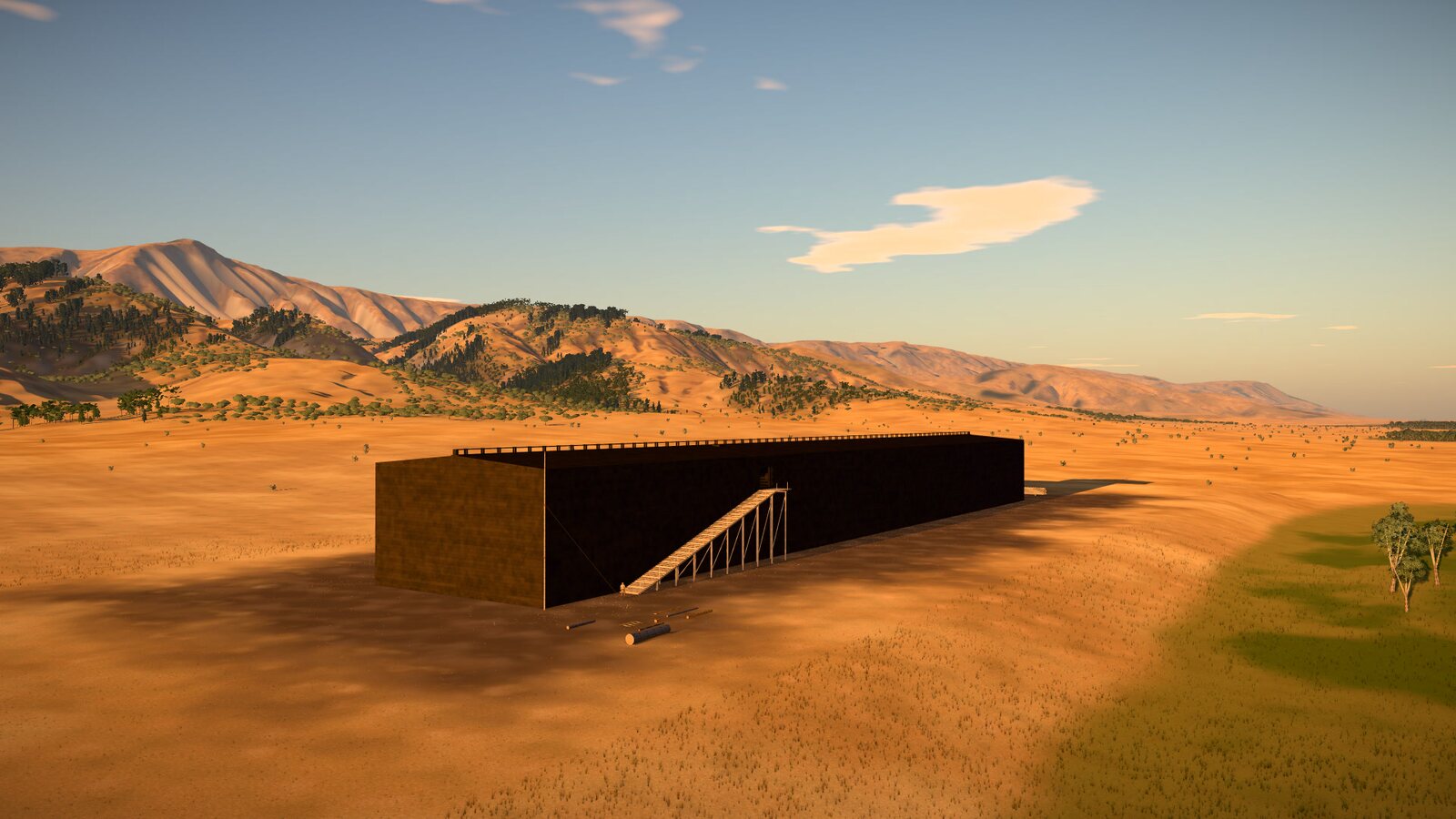
In the game's own measure, the family stands between about 2.9 cubits of 51.85 centimetres (Japheth's wife) and 3.3 (Shem) modelled. A cubit is the length of a forearm study, so a cubit rod is a body measure to begin with; Deuteronomy calls the everyday cubit "the cubit of a man" (3:11) text. Beside the ark, which rises 30 cubits, even Shem is less than a ninth of its height.
From height to eye and shoulder
A height alone is not enough. A first-person game looks out of an eye, and a pole carried alone rests on a shoulder, so the game needs both, for every role. For those it uses a standard work of anthropometry, Pheasant's Bodyspace, which gives the eye and the top of the shoulder (the bony tip, the acromion) as shares of a person's height: 0.937 and 0.819 for men, 0.935 and 0.814 for women study.
| Height, m | Eye, m | Shoulder tip, m | |
|---|---|---|---|
| Noah | 1.66 | 1.555 | 1.359 |
| Noah's wife | 1.53 | 1.430 | 1.245 |
| Shem | 1.69 | 1.583 | 1.384 |
| Shem's wife | 1.56 | 1.458 | 1.269 |
| Ham | 1.64 | 1.536 | 1.343 |
| Ham's wife | 1.59 | 1.486 | 1.294 |
| Japheth | 1.62 | 1.518 | 1.327 |
| Japheth's wife | 1.51 | 1.412 | 1.229 |
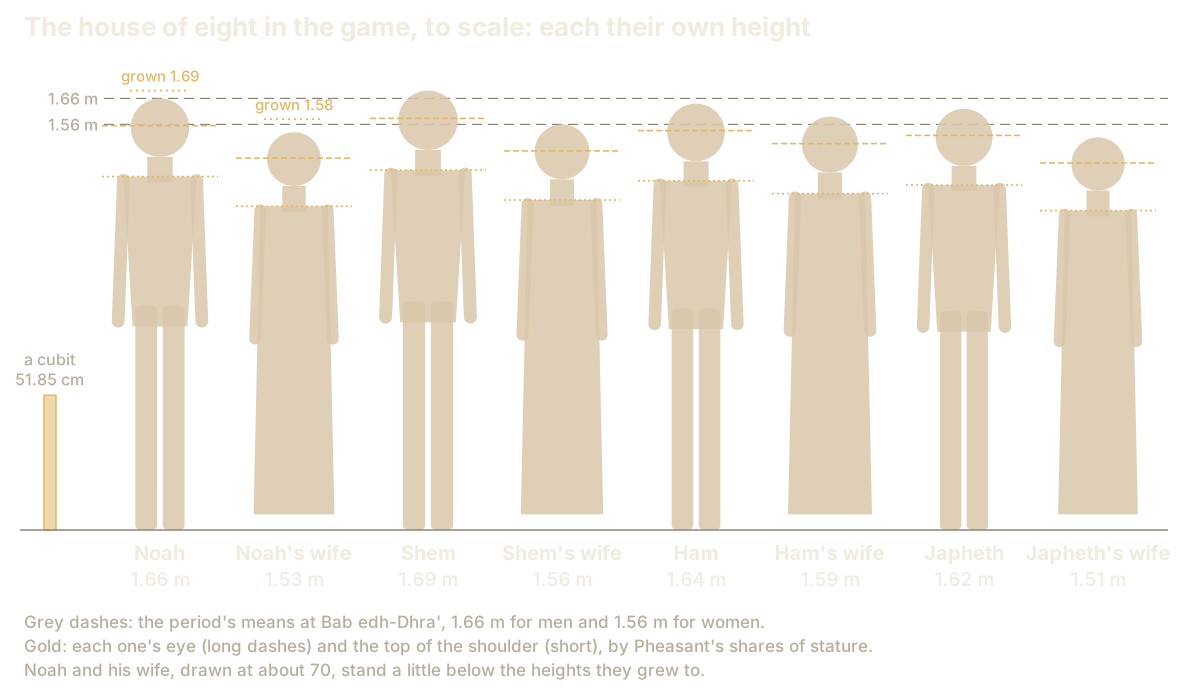
The shares come from British adults of today, whose median man is 1.74 metres tall and median woman 1.61 study; an older study gives the eye at 0.936 of stature for both study. Applying them to shorter people of another age is an assumption, because proportions vary between populations modelled.
What changes with a body
Height reaches further into the game than it looks, because the simulation uses it, not just the drawing modelled:
- Your eye. In first person you look out at your role's eye height: 1.555 metres as Noah, from 1.41 as Japheth's wife to 1.58 as Shem. When you swing an axe, the game's server judges the stroke from that eye.
- Head room. You can walk under a raised beam or a log on trestles only if its underside is at least 15 centimetres above your eye: 1.705 metres for Noah, from 1.56 for Japheth's wife to 1.73 for Shem. A beam that Ham's wife walks under can stop her husband. At first the game used 1.85 metres for everyone.
- The shoulder. A pole carried on the shoulder rests 2 centimetres above its bony tip: at 1.379 metres for Noah, from 1.25 for Japheth's wife to 1.40 for Shem. It used to rest at 1.50 metres for everyone.
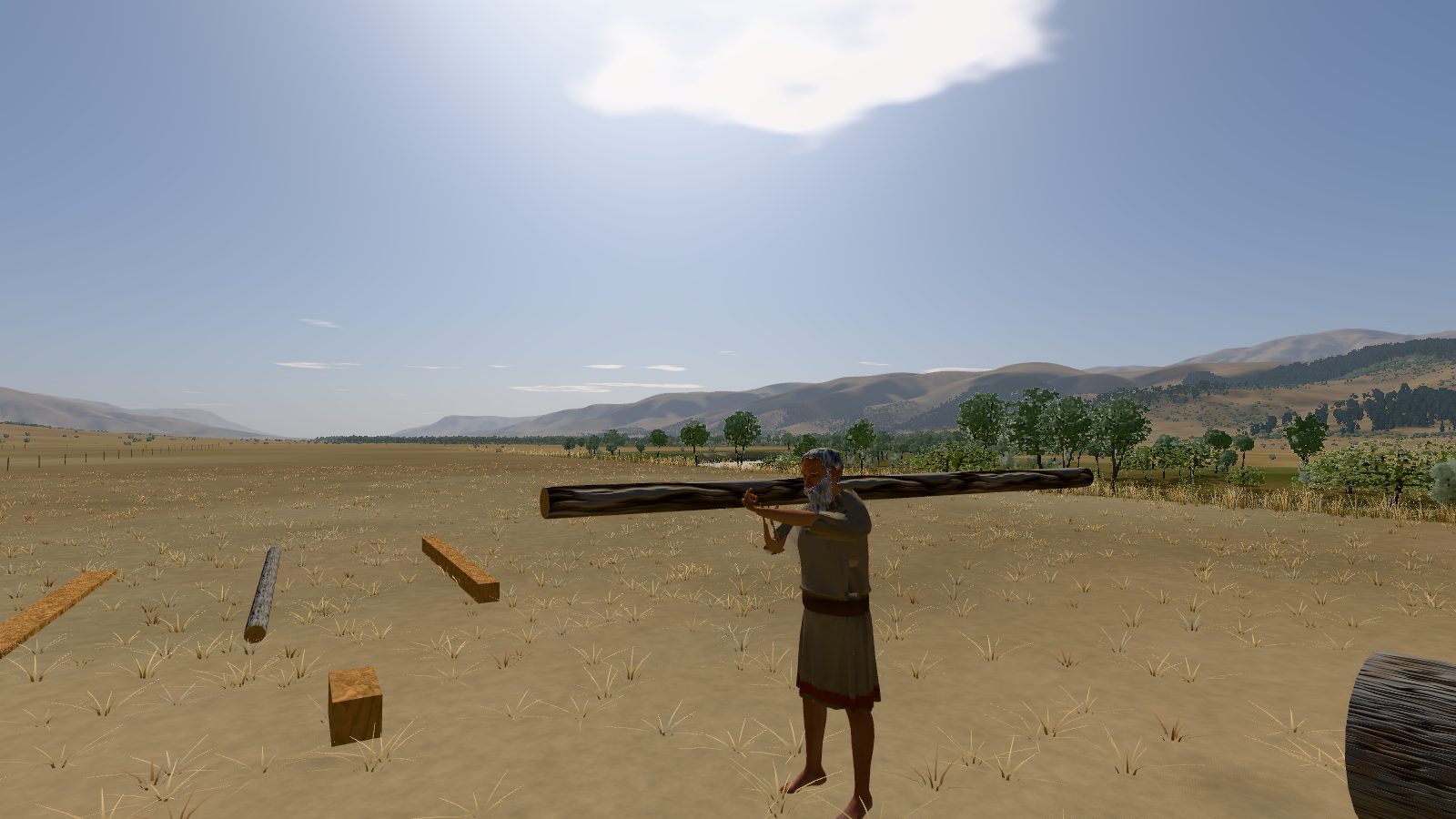
The game did not start this way. Its first walking figure had its eye at 1.7 metres, which belongs to a person about 1.81 metres tall, some 15 centimetres taller than the men of the period modelled. When the realistic bodies were built at the period's statures, the two did not match, and since 4 October 2026 every role's eye, shoulder and head room come from its own body modelled. Then every man stood at the mean, 1.66 metres, and every woman at 1.56; since 6 October 2026 each has a height of their own modelled.
Building the bodies
The people are built from open body models, MakeHuman and MPFB 2, whose bodies, skins and targets are shared under CC0 study. For each role the height slider is set by repeated halving until the top of the head stands at that role's height, to about a millimetre, and the clothes are then made to fit modelled. They walk at about 1.4 metres a second, a comfortable pace for adults in a published study of walking speed study, and run at about 4 modelled.
The game's food study gives the people a weight: about 60 kilograms for a man and 52 for a woman of the period's mean heights, at a body mass index of 21 to 22 modelled. Those weights set how much a family of eight eats, which a later page will come to.
What we don't know
The text gives no heights, the bones come from one site, in summary, and the spread around their mean is borrowed from the Nile valley. If a better regional average or spread turns up, the heights change in one place in the game's data, and every eye, shoulder and head room follows. Until then, the family stands within the range of the people buried at Bab edh-Dhra', some five thousand years ago on the conventional dates.