The house of Noah: eight people, and why players are roles
Genesis names the eight who went into the ark, but not the four wives. How the game builds its house from them: roles instead of player names, a family that grows over the 120 years, and work that needs more than one pair of hands.
The game takes its name from a short command in Genesis: "Come thou and all thy house into the ark" (Genesis 7:1) text. We chose house because it takes in the whole family, the wives too. A few verses later the text says who that house was:
In the selfsame day entered Noah, and Shem, and Ham, and Japheth, the sons of Noah, and Noah's wife, and the three wives of his sons with them, into the ark.
Genesis 7:13 text
Eight people, the "eight souls" of 1 Peter 3:20 text. They are the people you can play in House of Noah, and they set the size of a house: one to eight players building one ark modelled.
Four wives without names
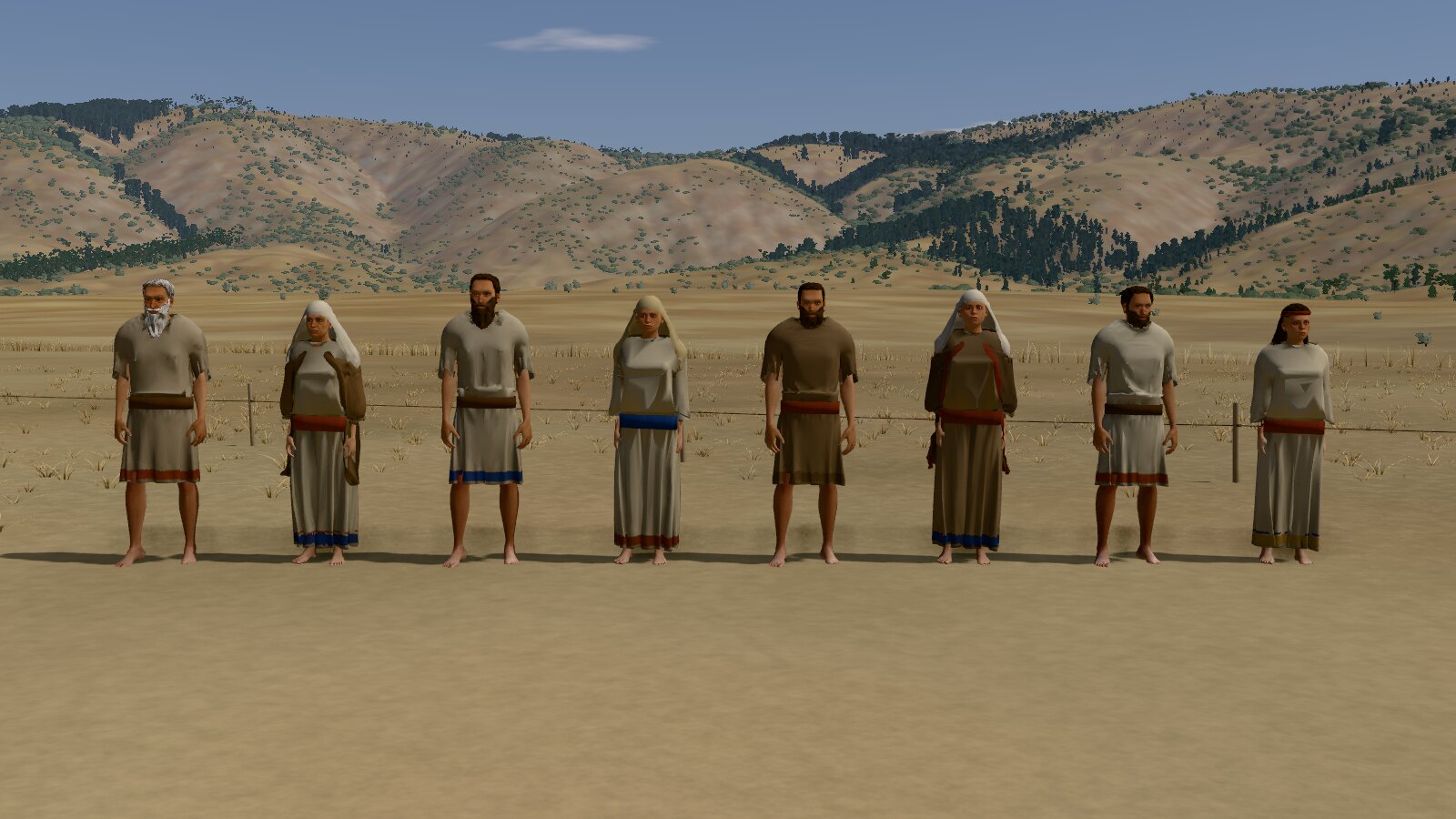
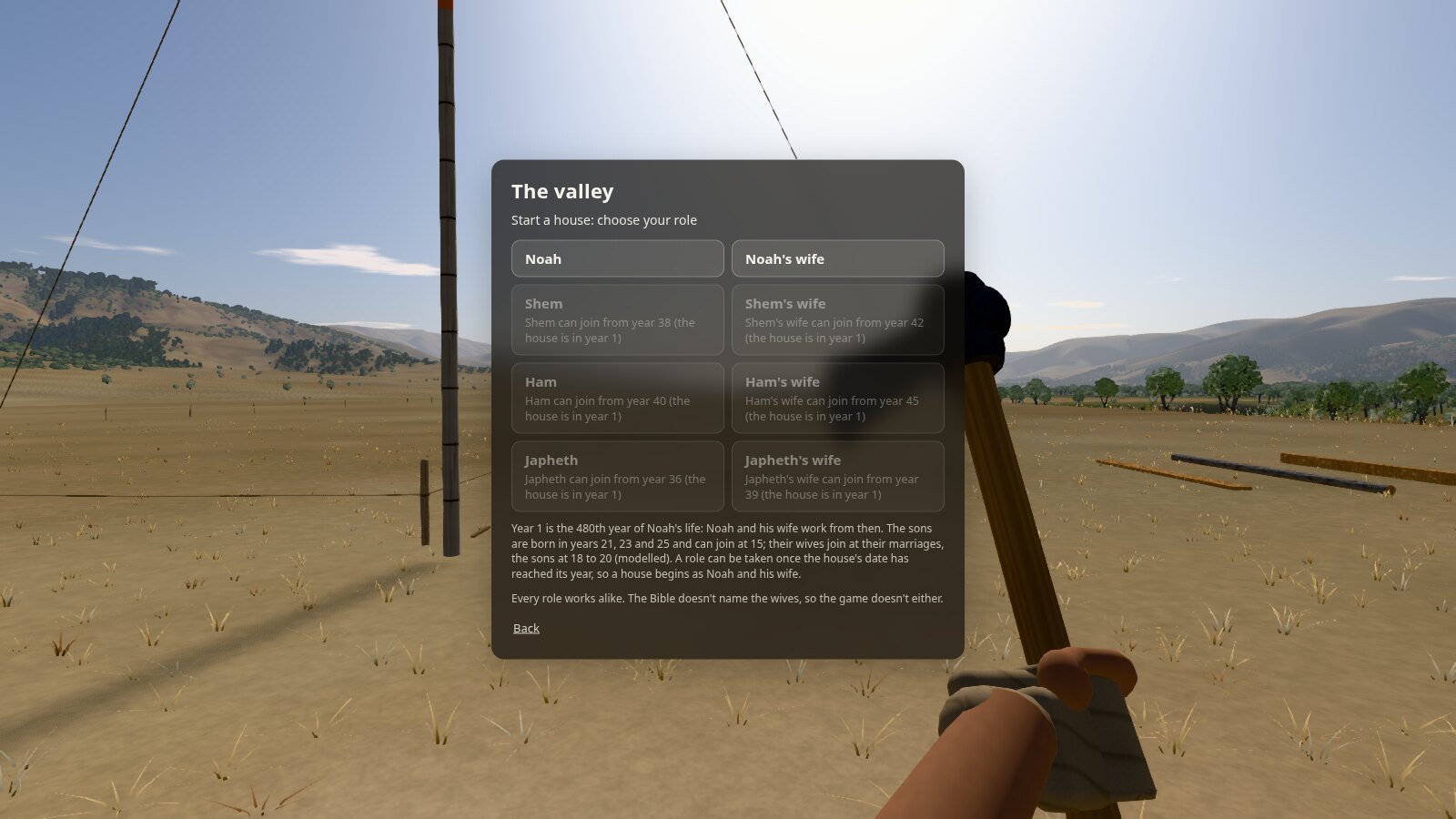
Genesis names Noah and his sons. The women are "Noah's wife" and "the three wives of his sons", and the Bible does not name them text. Later writers did: the Book of Jubilees, written about 160–150 BC, gives each a name historical. That is tradition, not the text, so the game leaves those names out. Its women are Noah's wife, Shem's wife, Ham's wife and Japheth's wife, in play and on these pages modelled. Each is still a person of her own, with her own face and clothes, and as the game stands, every role that can work has the same capacity for it modelled.
Players are roles, not names
You never type a name in House of Noah: you are a role, Noah, or Shem's wife, or Ham. It is one of the safety rules the game is built on modelled:
- Invitation only. Others join a house through an invite link with a short code. There is no matchmaking with strangers.
- No free-text chat and no in-game voice.
- No player names, only the roles.
- Little personal data. No accounts with personal details for now; a house is known by a secret key.
The game is made for older children and adults. With these rules nobody comes in uninvited, and nobody can type or speak to anyone through it.
A house still needs to talk, because much of the work needs timing. So it has preset calls, such as "Lift!", "Hold!", "Here!" and "Wait!", and pointing markers for a place or a thing modelled. Families can talk on their own phones beside the game. Even on the ranking, a house's name will come from a preset list, never typed.
A house of one to eight
A player alone is Noah. Others join through the invite and pick a free role modelled, but a role opens only when the house's calendar reaches the year that person can work, so a new house is Noah and his wife. The way in says so: "Shem can join from year 38 (the house is in year 12)".
Roles that nobody fills will be kept by the game, so a whole family always follows the timeline. These family members played by the game are planned, not yet built modelled. They will do chores and batch jobs from the work board (herding, water, grinding, the fields, and work a player has already shown by hand) at the quality the house has shown. Hand work, decisions, the count of a team lift and the answers to the onlookers are left to real people. A player can take over a role at any time and hand it back.
The family over time
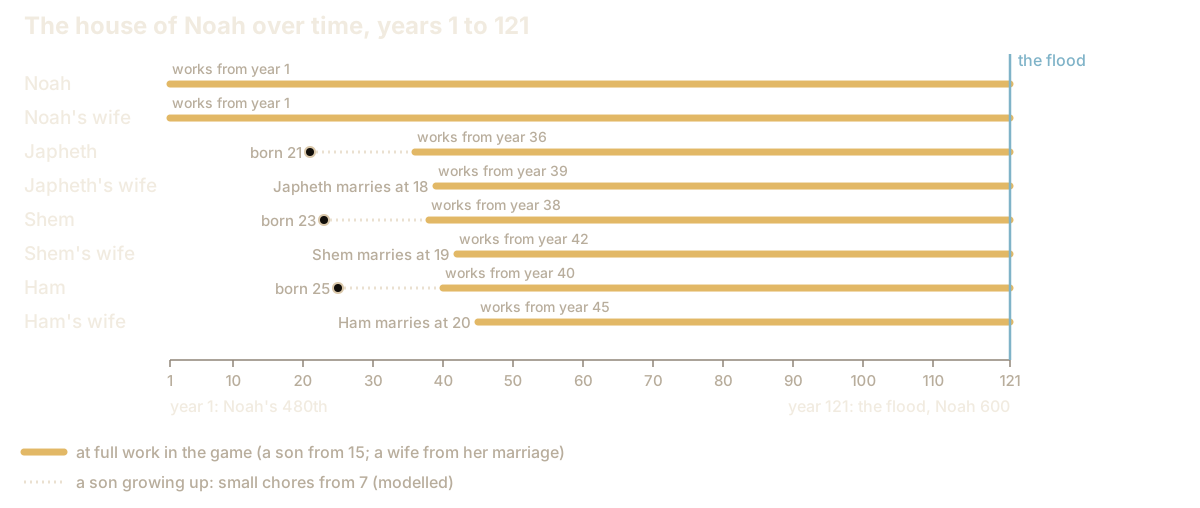
The calendar begins in Noah's 480th year. Genesis 6:3 says "His days shall be an hundred and twenty years" text, read by some as the time until the flood, and Rashi, after Seder Olam, dates that decree "twenty years before Noah had any children" historical. Noah's sons were born from his 500th year (Genesis 5:32) text, so year 1 is the year he is 480, and the flood, "in the six hundredth year of Noah's life" (Genesis 7:11) text, comes in year 121.
Genesis 5:32 names "Shem, Ham, and Japheth", but not in order of birth. Shem "was an hundred years old, and begat Arphaxad two years after the flood" (Genesis 11:10) text, so, by a simple sum, he was born in Noah's 502nd year. Genesis 10:21 calls Shem "the brother of Japheth the elder" text, Hebrew that can be read either way, and Rashi settles it by that sum: "you must admit that Japheth was the elder" historical. Ham is "his younger son" (Genesis 9:24) text, a word Rashi reads as "the unworthy one" rather than an age historical. The game takes Ham as the youngest, born two years after Shem modelled. So the sons are born in years 21, 23 and 25.
In the game's pacing the boys help with the herd, water and fuel from seven, and take a full share at 15 modelled, in years 36, 38 and 40: youths in early Mesopotamia worked in their parents' households study, and Joseph at seventeen "was feeding the flock with his brethren" (Genesis 37:2) text. They marry young, at 18, 19 and 20 modelled, after "At eighteen the bridal canopy" (Mishnah Avot 5:21) historical. That is a choice: a study of Babylonian and Assyrian marriage in the first millennium BC found men marrying at 26 to 32 study, and the text says only that the sons were married by the flood, "thy sons' wives with thee" (Genesis 6:18) text. Each wife joins the work at her marriage, in years 39, 42 and 45.
So a house of eight is two people for its first 35 years modelled, in which Noah and his wife are to prepare the site, the trees, the fields, the herd and the home, played quickly as batches; this opening is planned, not yet built. There is no deadline: the end of the 120 years and the flood are marks on the calendar, not a timer.
Eight bodies
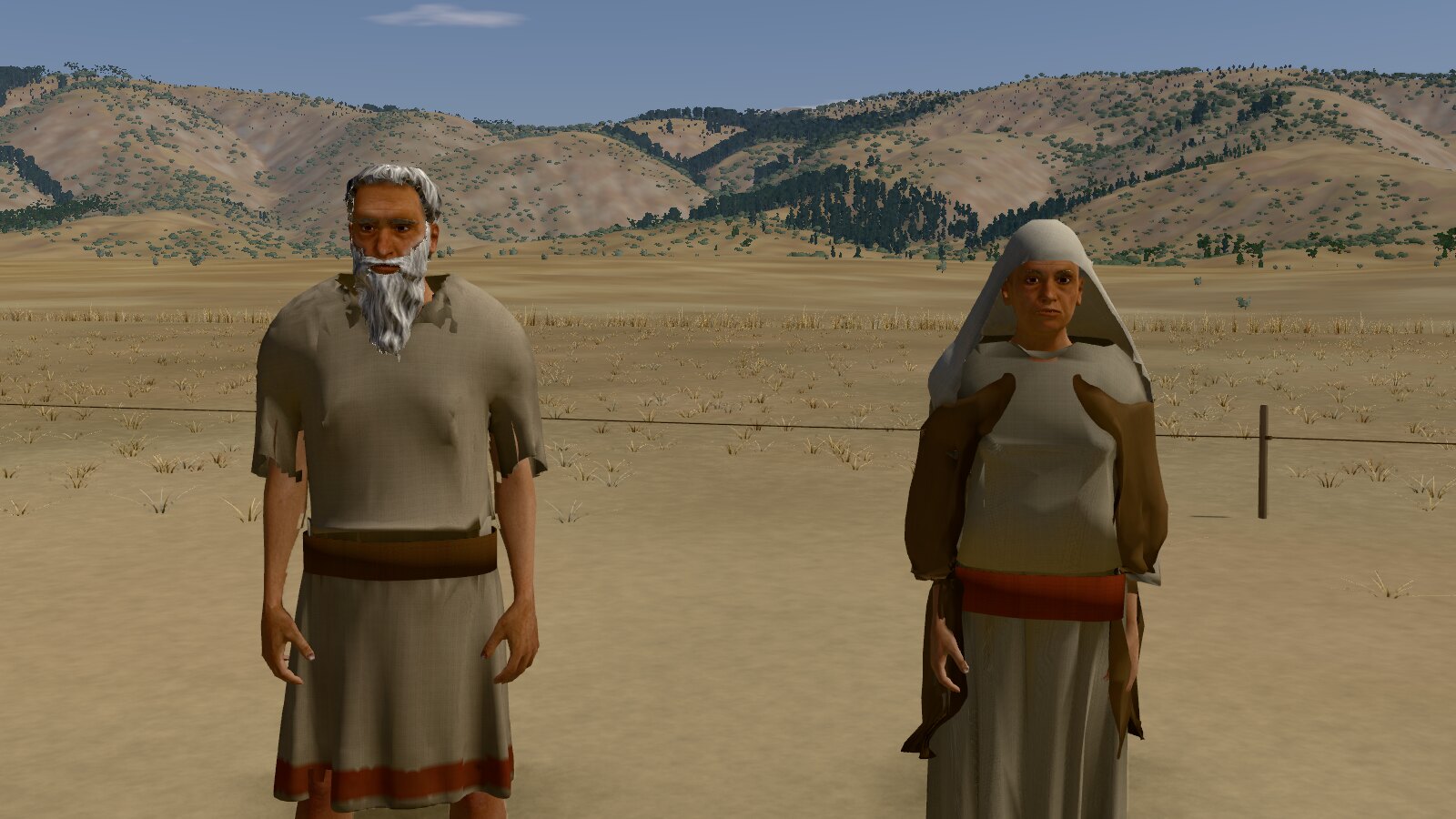
Each has a height of their own, from 1.51 metres for Japheth's wife to 1.69 for Shem modelled, spread around the mean statures of the Early Bronze Age people buried at Bab edh-Dhra' in the southern Levant, 1.66 metres for the men and 1.56 for the women archaeology; Noah and his wife, drawn as people of about seventy, stand a little below the heights they grew to modelled. They are one family of one people, sun-browned, in plain linen and wool, and no son is given a "type" modelled: the curse on Canaan (Genesis 9:25) was later read as the origin of dark skin, but the text mentions neither race nor skin colour historical.
Working together
This is the heart of the game: more hands don't just add output, they make some jobs possible. One person lifts about 23 kilograms comfortably study, so long timbers go with one at each end, and a pole of 60 to 90 kilograms is a load two can carry and one cannot modelled. A pit saw needs one person above and one below; one holds a plank while another fastens it. Alone, you drag, roll, lever and prop: slower, but possible modelled. A team lift works only when everyone lifts at the same moment, on the call.
Work done side by side counts once: eight people felling eight trees at once spend one tree's time, not eight modelled. No role has a fixed job; a house divides the work as it chooses. On the game's estimates, a house of eight needs about 79 to 87 years for the reference design, one sound way of building the ark among several: well inside the 120. Noah alone would need about 458 modelled.
That is what the ranking will measure: one list for all houses, by the calendar time from the first stake to the ark passing the final check. It can be filtered by house size, and each row will show how many real people were in the house.
What it means for the game
In Genesis the house is a family, and in the game it is too: a few people who know each other, each in one of the eight places the text sets out, under the only names it gives. The game doesn't need to know who you are. It needs you there when the call comes.