Lifting together on the count
A load that needs two people only comes up if both lift at once. How teams share a weight, why big crews pull less than the sum of their members, and how the game's preset calls let a house count to three without a word typed or spoken.
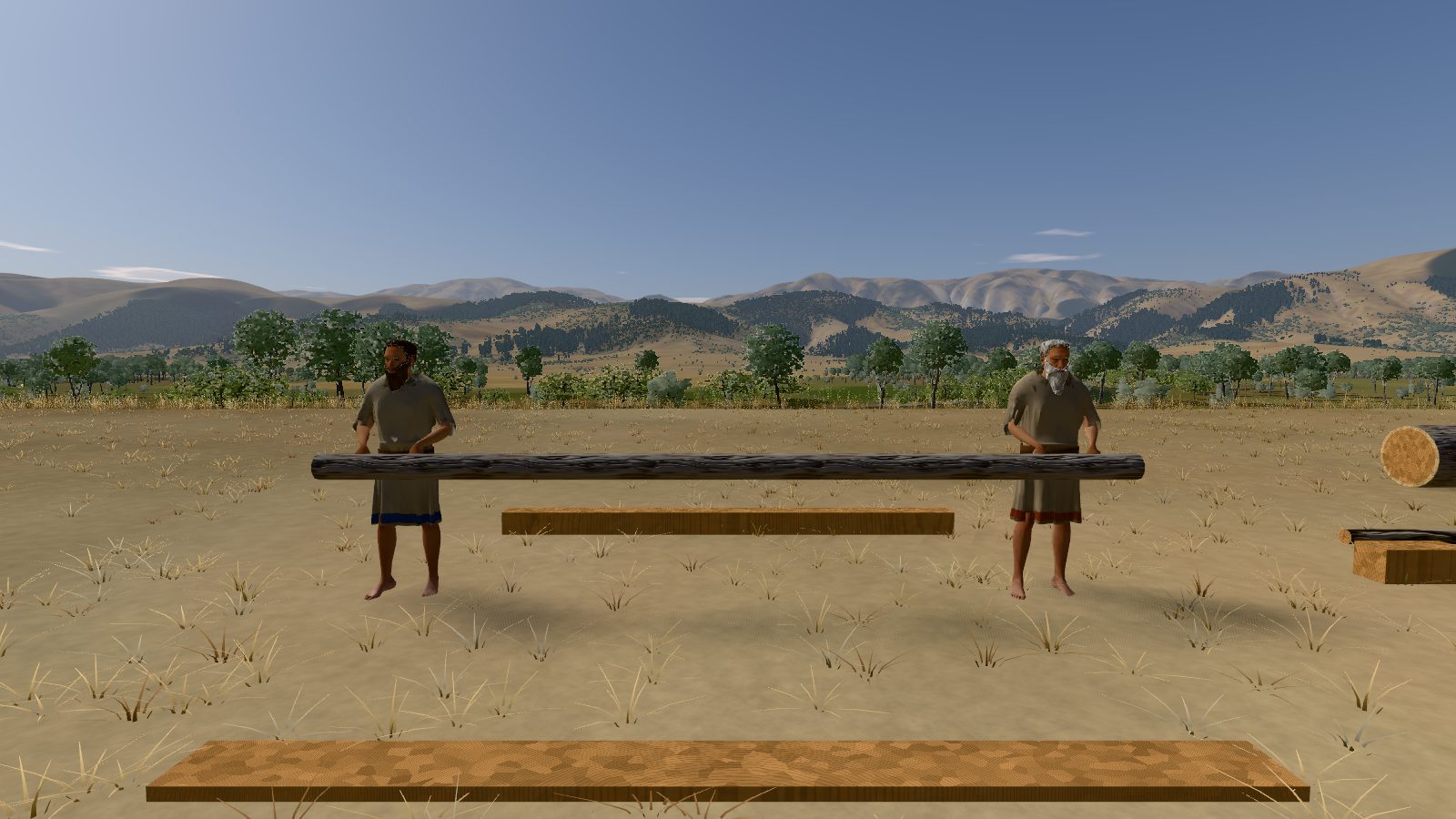
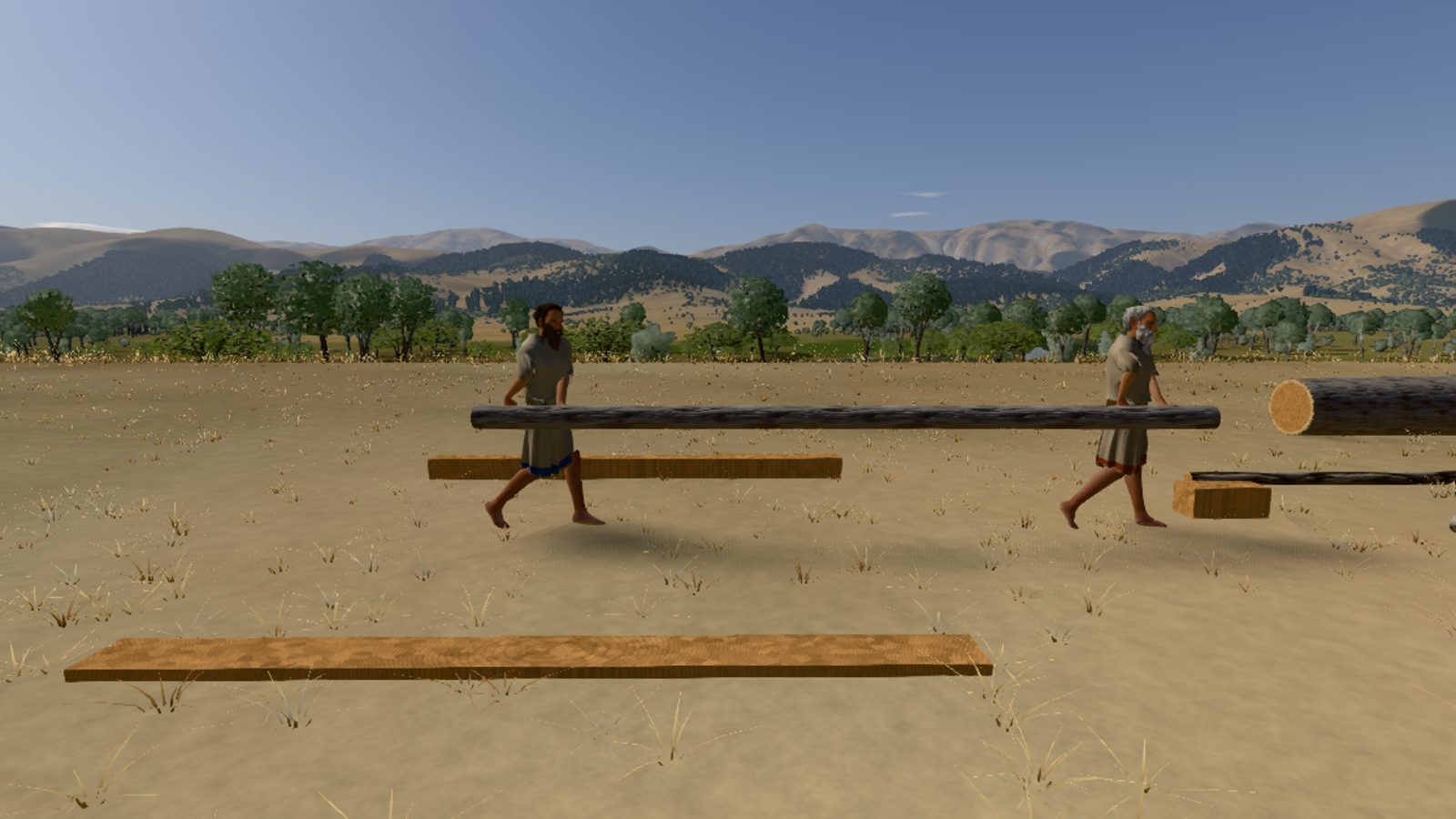
Some things in House of Noah cannot be done alone. What a log weighs explains why: a cypress pole of 90 kilograms is more than one person may lift, and a squared beam needs four. But two people do not lift a pole just by both being there. They have to lift at the same moment. If one end comes up and the other doesn't, the load twists and drops.
The usual answer is a count: one person calls it, and everyone lifts on it.
How teams share a weight
Studies of team lifting agree that a team lifts less than the sum of its members study. British guidance on manual handling puts a team at about 85 % of the sum of what its members could each handle, and says that teams of more than four are unlikely to work well. In a laboratory study, teams of two to four reached 80 to 91 % of their members' summed maximum lifts, and the share did not fall as the team grew from two to four. Another found a pair limited by its weaker member. A US military design standard lets two people lift twice what one may, and counts each further lifter at no more than three quarters of one person.
The game follows the British figure modelled. Each member of a team may take at most 85 % of one person's 60-kilogram limit, which is 51 kilograms, at the point where they hold the piece, and at most six people can hold one piece. The weight is shared between them by where each one holds the piece.
Pulling together
On a rope the losses are larger. In Ringelmann's classic trials, people pulled on a rope alone and in groups: pairs gave 93 % of what their members gave alone, trios 85 %, and groups of eight only 49 % study.
Big crews can do better. In a full-scale hauling trial, 130 people hauled a 41-tonne load up a slope of 1 in 20 on greased timber rails, about 310 newtons each, with peaks of 450 study. So the game keeps each puller's full 200 newtons for the first eight on a load, and counts every extra puller at 65 %, the middle of a range of 50 to 80 modelled.
The count
In the game a lift starts with a call modelled. Anyone holding the piece presses 1 for "Lift!", and a count runs on every holder's screen: "one" half a second later, "two" half a second after that, and on the beat, "three — lift!". Everyone who presses the left button within 0.4 seconds of the beat lifts with the others. "Down!" sets a load down the same way, and "Heave!" times a pull on a rope.
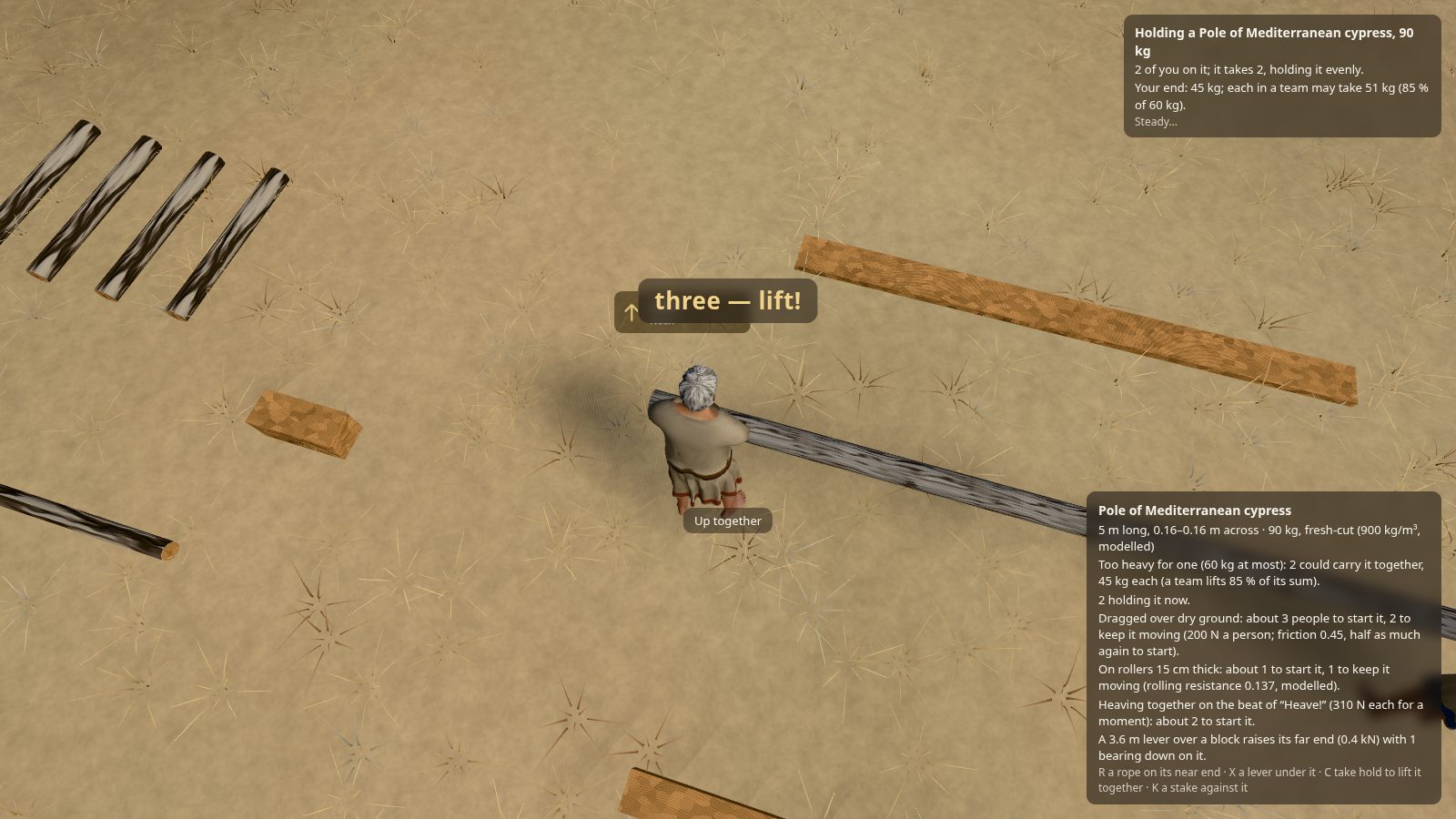
A lift out of time fails, but gently modelled. If one holder lifts and the other doesn't, that end tips up with a thud, the load stays down, and the game says what happened: "Out of time: on the beat, with the others", or "Not together: the others weren't with you on the beat". Nobody is hurt, for now.
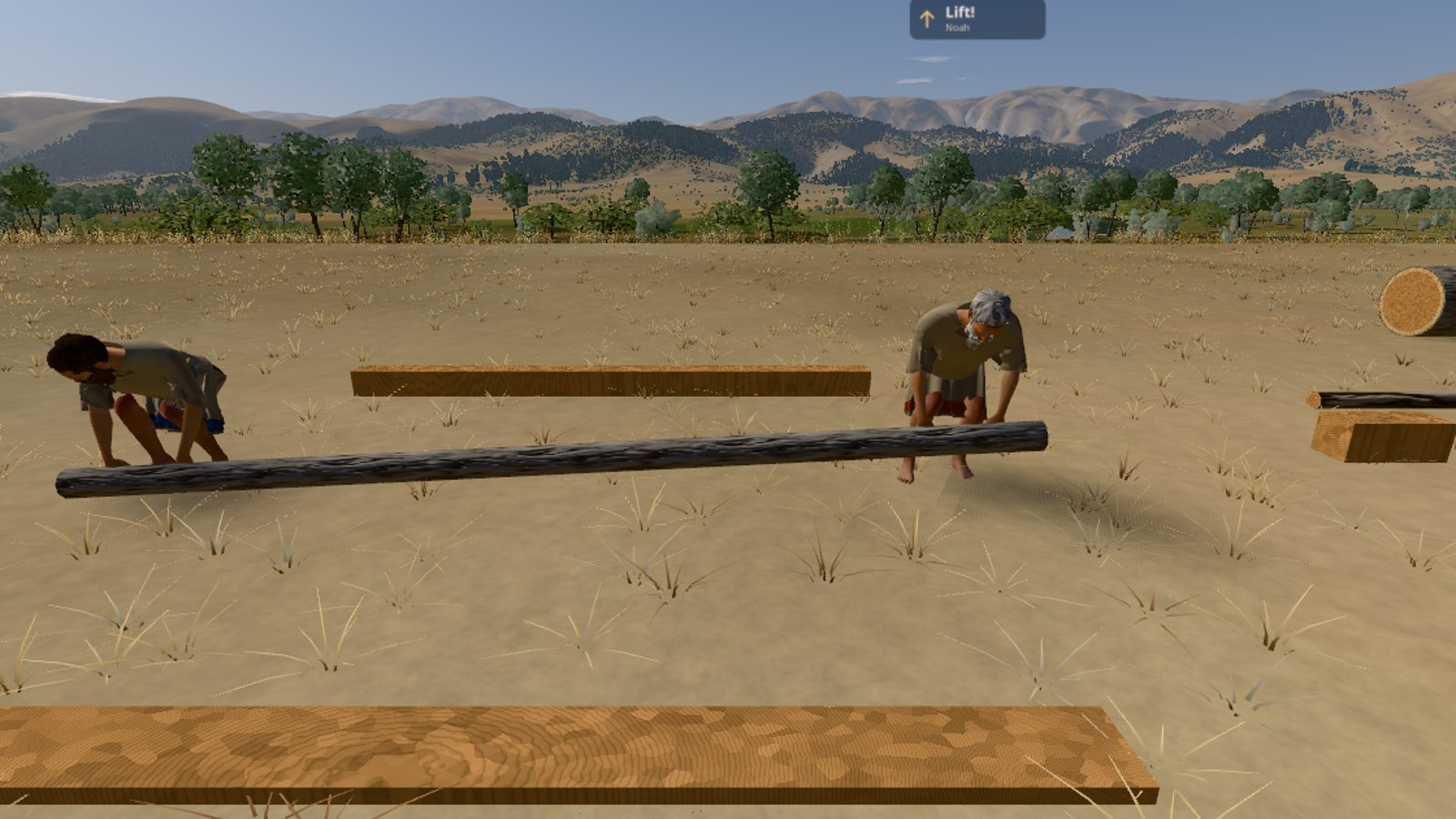
Once a load is up, the team carries it at a pace that falls with the weight each person bears, from a walk toward 0.6 metres a second near the limit modelled. If one person lets go, their end drops.
Heave!
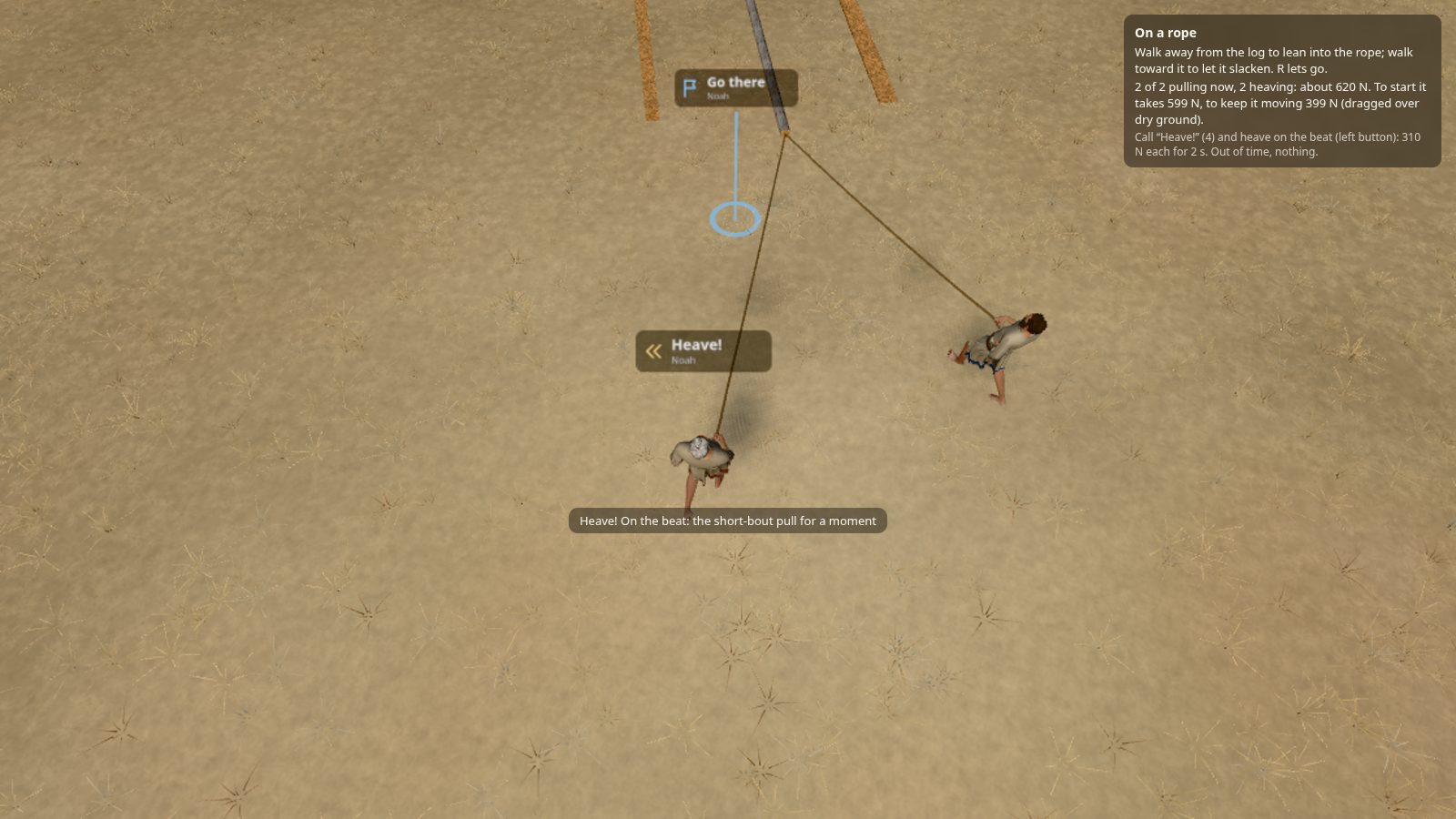
On a rope the beat buys strength. A person leaning steadily on a rope gives the game's 200 newtons. A puller who heaves on the beat of "Heave!" gives 310 newtons for two seconds, the effort of that 130-strong crew study modelled. Out of time, the heave gives nothing extra.
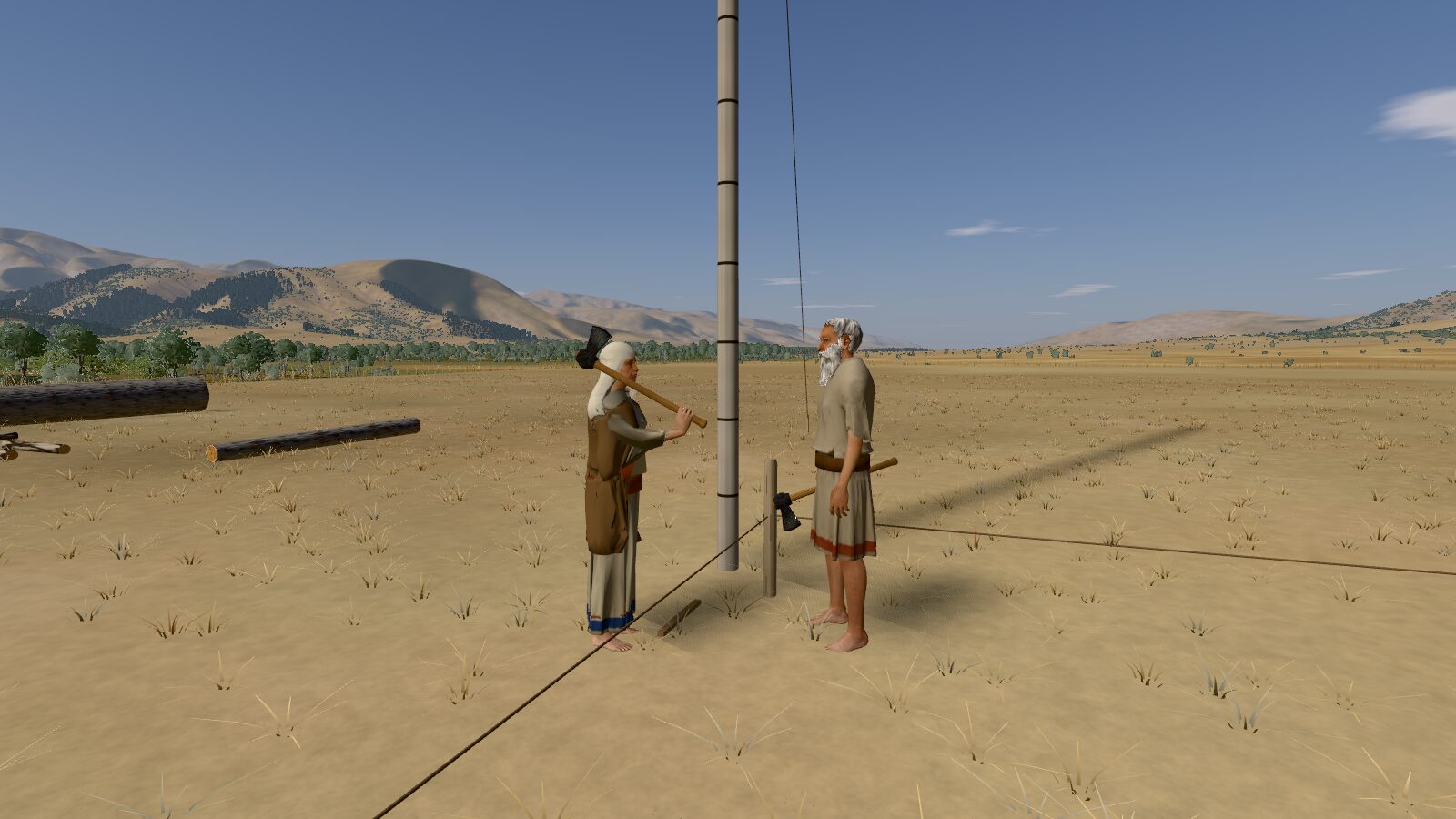
When the pictures for this page were made, Noah and Shem leaned on a rope tied to the 90-kilogram pole, which needs about 600 newtons to start over dry ground. Leaning steadily on the rope, they could not start it. Heaving together on the beat, with about 620 newtons between them, they slid it more than three metres modelled.
Talking without chat
House of Noah has no text chat and no voice, by design: players are family roles, join only by invitation, and cannot type or speak to each other through the game modelled. So the calls are the language. There are eight of them, on the keys 1 to 8 or a wheel: "Lift!", "Down!", "Hold!", "Heave!", "Here!", "Wait!", "Come!" and "Well done!". Each shows above the caller with their role, and in a short list of recent calls. There are three markers too, "this", "here" and "go there", which a player sets where they look, for twenty seconds. All of it travels as numbers, never as text. Families who want to talk can use their own phones beside the game.
On the calendar
The count also settles the calendar modelled. In the game's work clock each member has their own clock, and the house's date is the latest of them. When a team lifts a load together, everyone holding it moves to the latest of their clocks at the beat, and from then they work it together, in the same time.
What it means for the game
A team lift is the moment a house of real people is better than one player alone, and the moment it shows. The game's planned family members, played by the game when nobody fills a role, will never count a team lift: that is left to real people modelled. And later, carelessness will cost: letting go of a team lift off the count is one of the injuries the game plans modelled. Until then, "one, two, three" is the most important thing a house says.