How many animals, and was there room?
Genesis gives the rule, two of every kind and sevens of the clean, but not the number. What a “kind” might be, three counts from about 1,400 kinds to 39,000, how many animals each puts aboard, and whether the game's sturdy reference ark has the floor for them and a year's food and water.
God's instructions for the ark end with who goes in, and what they eat:
And of every living thing of all flesh, two of every sort shalt thou bring into the ark, to keep them alive with thee; they shall be male and female. … And take thou unto thee of all food that is eaten, and thou shalt gather it to thee; and it shall be for food for thee, and for them.
Genesis 6:19, 21 text
The text gives a rule, not a number. Because House of Noah builds the ark at its real size, the question comes back in square metres: how many animals is that, and does our ark have room for them and a year's food and water? Our research for Part 2, the animals, gives the answers, and they reach back into the ark a house builds in Part 1.
Two, and sevens
The unit is the kind: two of every kind, male and female, of the birds, the cattle and the creeping things (6:19–20). Then "of every clean beast thou shalt take to thee by sevens, the male and his female: and of beasts that are not clean by two … Of fowls also of the air by sevens" (7:2–3). Only the land's animals are at risk, those "in whose nostrils was the breath of life" (7:22), and the stay is a year and ten days (7:11; 8:14) text: 371 days, in months of 30 modelled.
The Hebrew "by sevens" is šivʿâ šivʿâ, "seven seven", read two ways:
- Seven animals: three pairs and one more, often the one Noah offered when he came out (8:20); the Geneva Bible's note says "six were for breeding and the seventh for sacrifice" historical. A 2024 study of the Hebrew by Kerr argues that as "two two" in 7:9 means two each, "seven seven" means seven each study.
- Seven pairs: fourteen. Genesis Rabbah asks of the birds, "would there not be one that remains without a mate? It means, rather, seven males and seven females" historical. Cassuto reads "the male and his female", literally "a man and his wife", as a mated pair study, and the JPS Tanakh of 1985 has "seven pairs" text.
Which animals are clean is a reading too. Leviticus makes clean what "parteth the hoof, and is clovenfooted, and cheweth the cud" (11:3) text, today's cattle, sheep, goats, deer, antelopes and giraffes modelled; a narrower reading takes only the animals of sacrifice, "of the herd, and of the flock" (Leviticus 1:2) text. Leviticus names only about twenty unclean birds, so about nine bird kinds in ten are clean modelled.
What is a "kind"?
The count turns on one word, min, "kind", which the text never ties to a modern rank text. Three readings give three counts, each five to six times the last:
| A "kind" read as | Held by | Kinds | Animals aboard |
|---|---|---|---|
| About the family, living and extinct | Answers in Genesis, for the Ark Encounter | about 1,400 | about 2,800–6,500 |
| The genus, living and fossil | Woodmorappe, Noah's Ark: A Feasibility Study (1996) | about 7,900 | about 16,000–46,000 |
| The species | critics such as Isaak (1998) | about 39,000 living land vertebrates | about 81,000–216,000 |
The kinds are the published counts study. The animal numbers are ours, each count rebuilt from its kinds under every reading of seven and of the birds; where the rules match, they come close to the published totals, 6,504 against Answers in Genesis's 6,744 and 16,204 against Woodmorappe's 15,754 modelled. Insects, which the text does not name, are left out.
Both creationist counts take in animals known today only as fossils: the Ark Encounter counts extinct kinds beside the living, and 668 of Woodmorappe's genera are dinosaurs, because their authors hold that those animals were still alive at the flood study. The species count in the table is of living species only; with extinct ones it would be larger modelled.
Most animals are small
With adult weights for about 17,000 species from two large datasets study, the middle animal aboard weighs 30 to 100 grams, a mouse or a rat modelled; Woodmorappe found his "about the size of a rat" study. The few large ones decide nearly everything: the animals over 10 kg as adults are 2 to 16 % of those aboard, but they need 72 to 96 % of the floor and 60 to 90 % of the food modelled.
So their age matters. An old tradition has the giant reʾem stay out while "its young did enter" (Genesis Rabbah 31:13) historical, and both creationist studies take the large kinds young study. So do we: a kind whose adults weigh 20 kg or more comes aboard just weaned, at about 30 % of its adult weight, and leaves at about 50 %. That cuts the space and the food by a third to a half modelled. A yearling giraffe stands about 3 m; a grown one 4.3 to 5.5 m study, taller than any storey of the reference ark.
Does it fit?
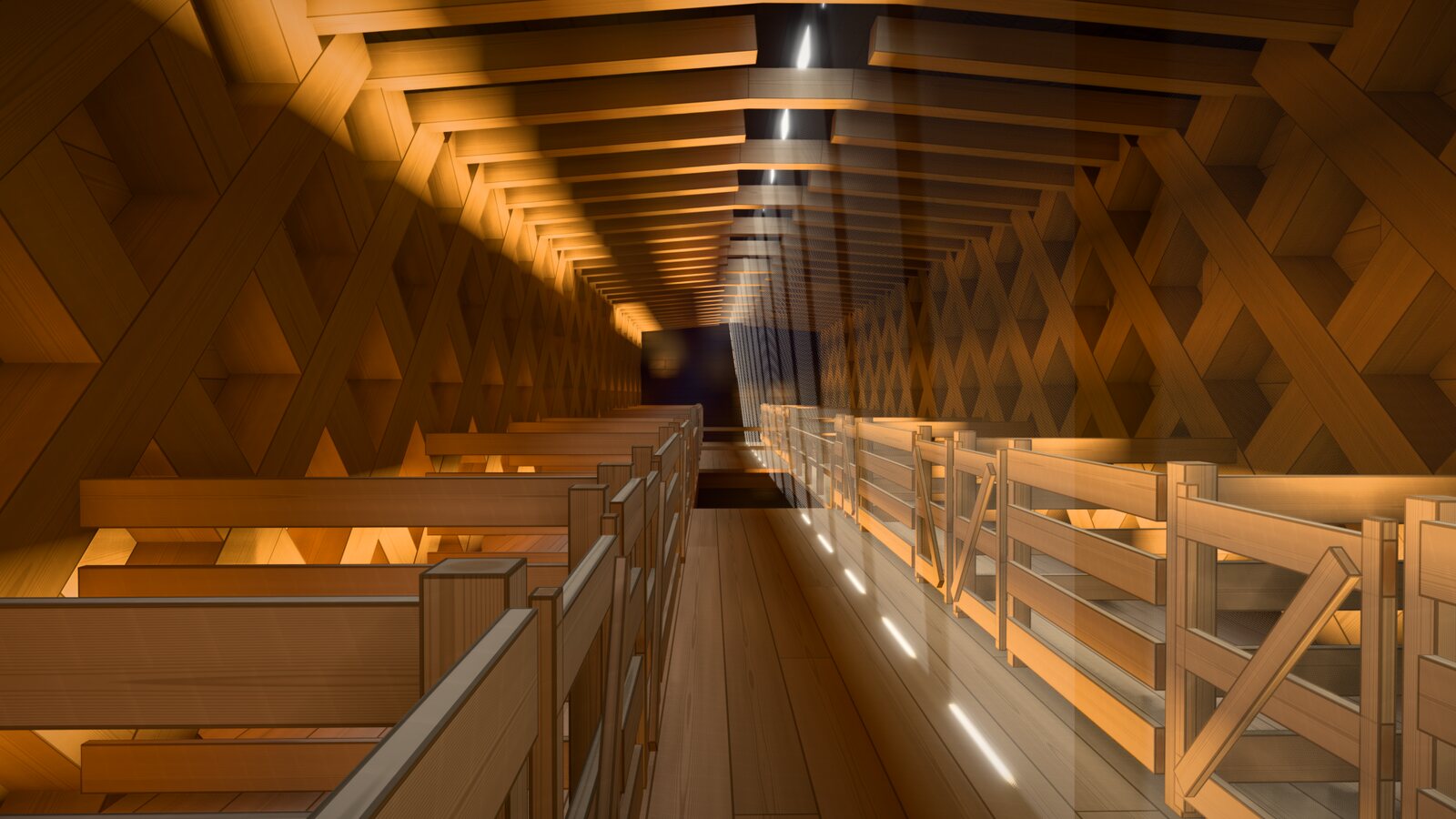
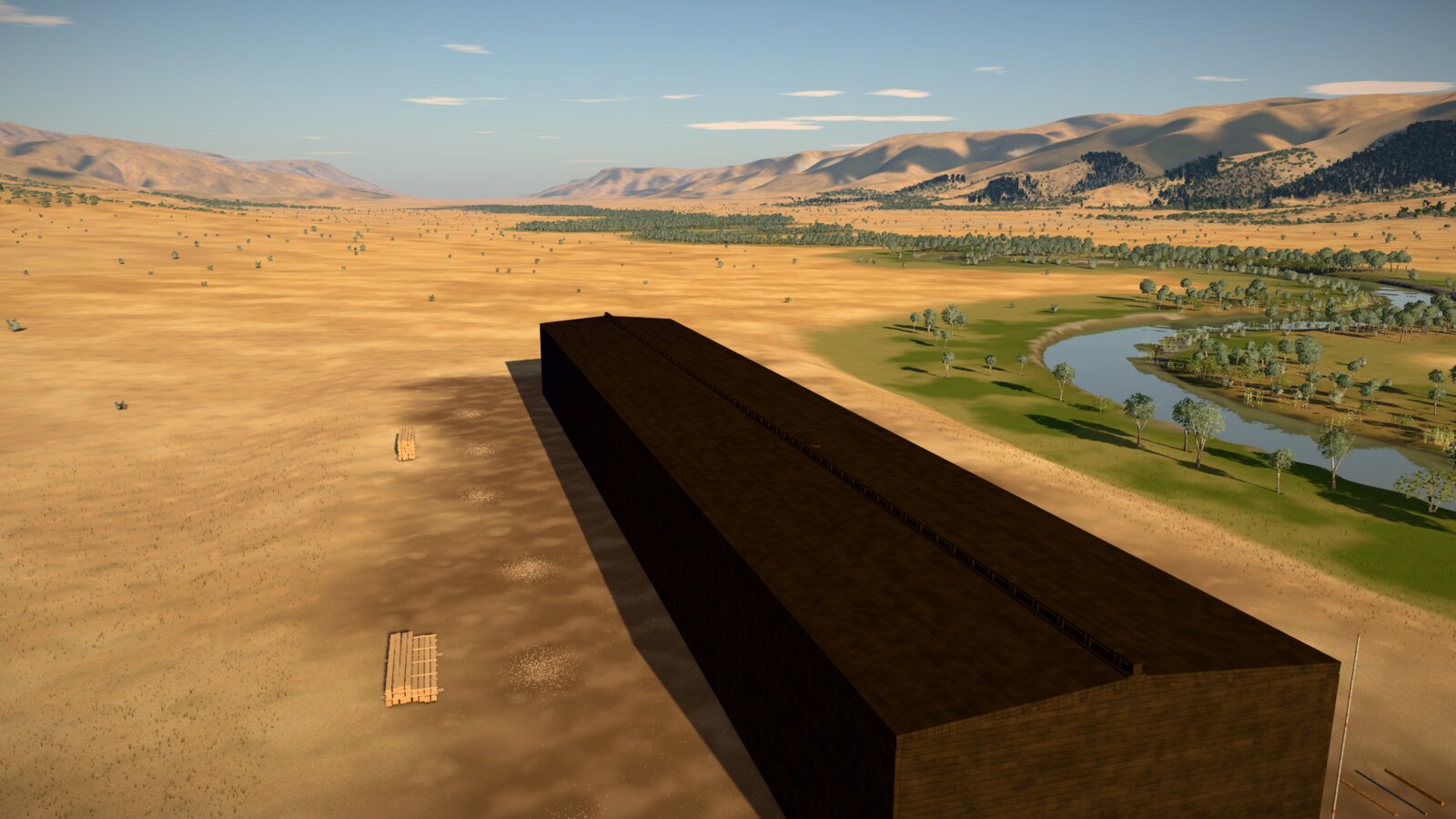
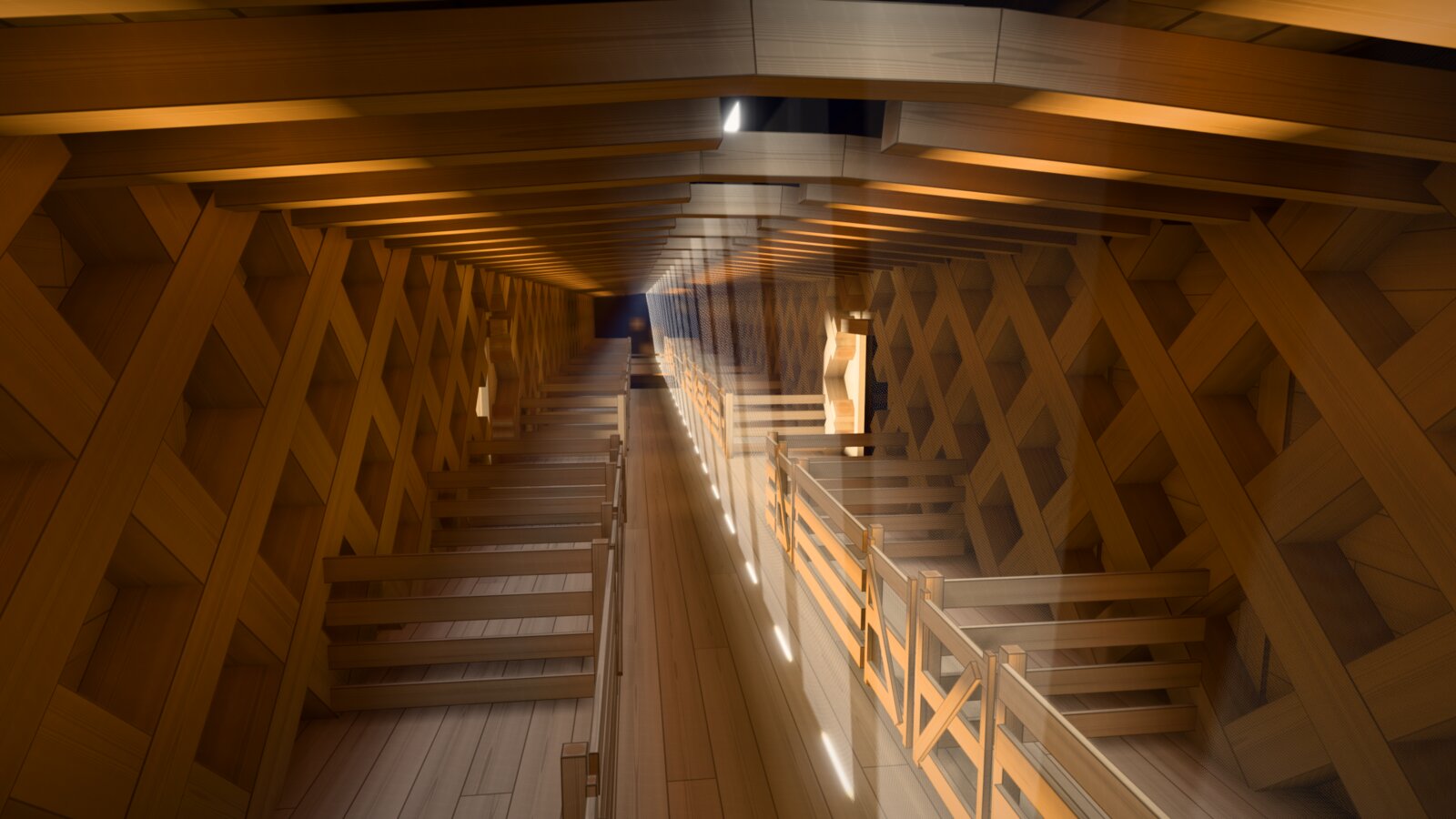
The game's reference ark is built sturdy, to come through the wave loads that ocean-going ships are designed for study. After its timber it has about 43,500 m³ of open space inside, 69 % of the blueprint's box. Its three storeys have 10,378 m² of floor; the reference layout's 678 pens and the halls by the ramps and the door make 7,029 m² that can hold animals and stores, the rest being aisles modelled.
Each animal gets the floor that the American Guide for the Care and Use of Laboratory Animals sets for housing it, from 97 cm² for a mouse to 13 m² for a horse, and feed by what free-living animals burn study, at 0.8 of it for penned animals, with 3 litres of water to each kilogram of dry feed modelled:
| Count | Seven | Animals | Food | Water | Floor needed | Against 7,029 m² |
|---|---|---|---|---|---|---|
| Low | animals | 4,236 | 457 t | 995 m³ | 4,190 m² | fits, 40 % spare |
| Low | pairs | 6,252 | 555 t | 1,211 m³ | 4,728 m² | fits, 33 % spare |
| Middle | animals | 27,329 | 1,750 t | 4,006 m³ | 12,784 m² | 1.8 times the room |
| Middle | pairs | 43,534 | 2,651 t | 6,067 m³ | 18,004 m² | 2.6 times |
| High | animals | 130,188 | 1,957 t | 4,109 m³ | 12,472 m² | 1.8 times |
| High | pairs | 202,106 | 3,385 t | 7,115 m³ | 19,539 m² | 2.8 times |
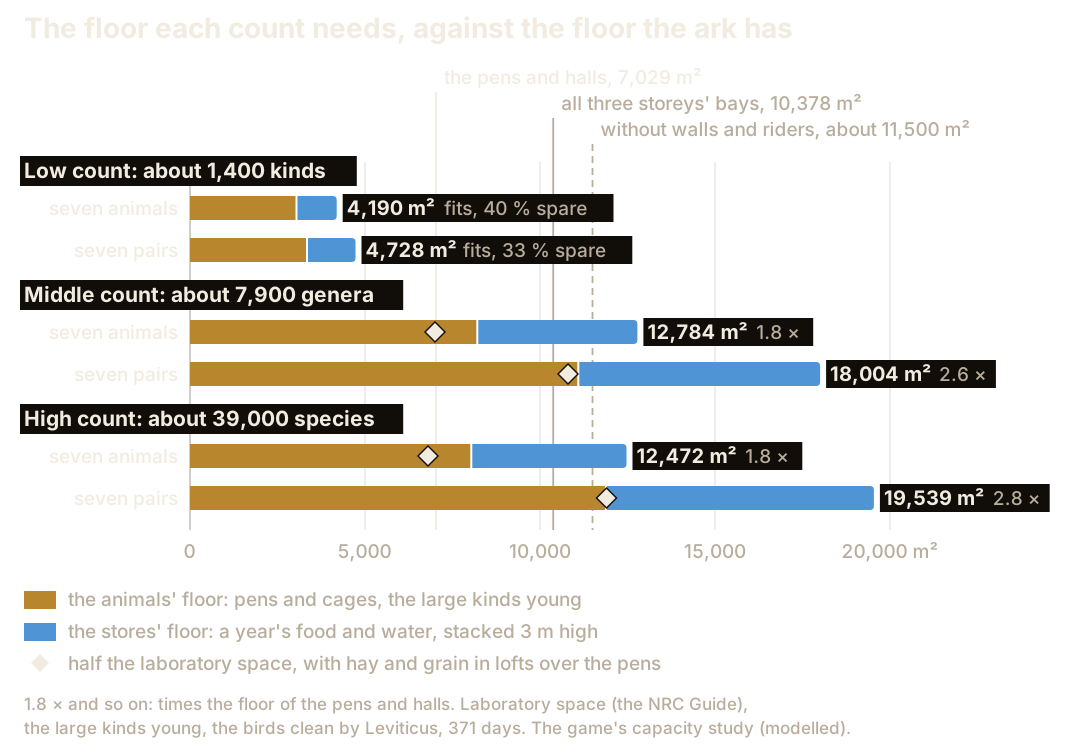
- The low count fits easily, either way of reading seven. The Talmud's arrangement nearly works: "The bottom story was for manure, the middle story was for animals, and the top story was for people" (Sanhedrin 108b) historical. The animals fill the middle storey's pens and part of the top's, and the stores go below, the water low in the hull, where its weight steadies the ark modelled.
- The middle and high counts don't fit at laboratory space: they need more than the whole floor. They fit only as seven animals rather than seven pairs, kept at about half that space, with hay and grain in lofts over the pens modelled.
- Grown animals instead of young would need 1.4 to 2 times the floor at every count modelled.
Seven pairs costs little at the low count, 13 % more floor, because the clean land kinds are few; at the genus count it costs 41 %, because the clean genera are many and of middle to large size. Whether all the birds come by sevens moves the floor by only 3 to 5 %: birds are small modelled.
What the sturdy hull costs
We began by asking whether building the ark strong leaves room. It takes a real share: the two long walls with their X-braced riders, the riders along the sides and the frames take about an eighth of the floor, and the timber inside the shell 13 % of the box modelled.
But it does not decide the answer. Without the walls and riders the bays would have about 11,500 m², and the genus and species counts need 12,500 to 19,500 m², so a plain hull would not hold them either. And the plain hull fails the storm modelled. The counting rule and the animals' age decide it.
What Part 1 takes from this
For the low count nothing in the ark has to change, but there are notes for the builders modelled:
- Stores. Genesis 6:21's food needs storerooms, 1,100 to 1,400 m² at the low count, or lofts over the pens. The rabbis thought much of it was "cakes of pressed figs" (Genesis Rabbah 31:14) historical.
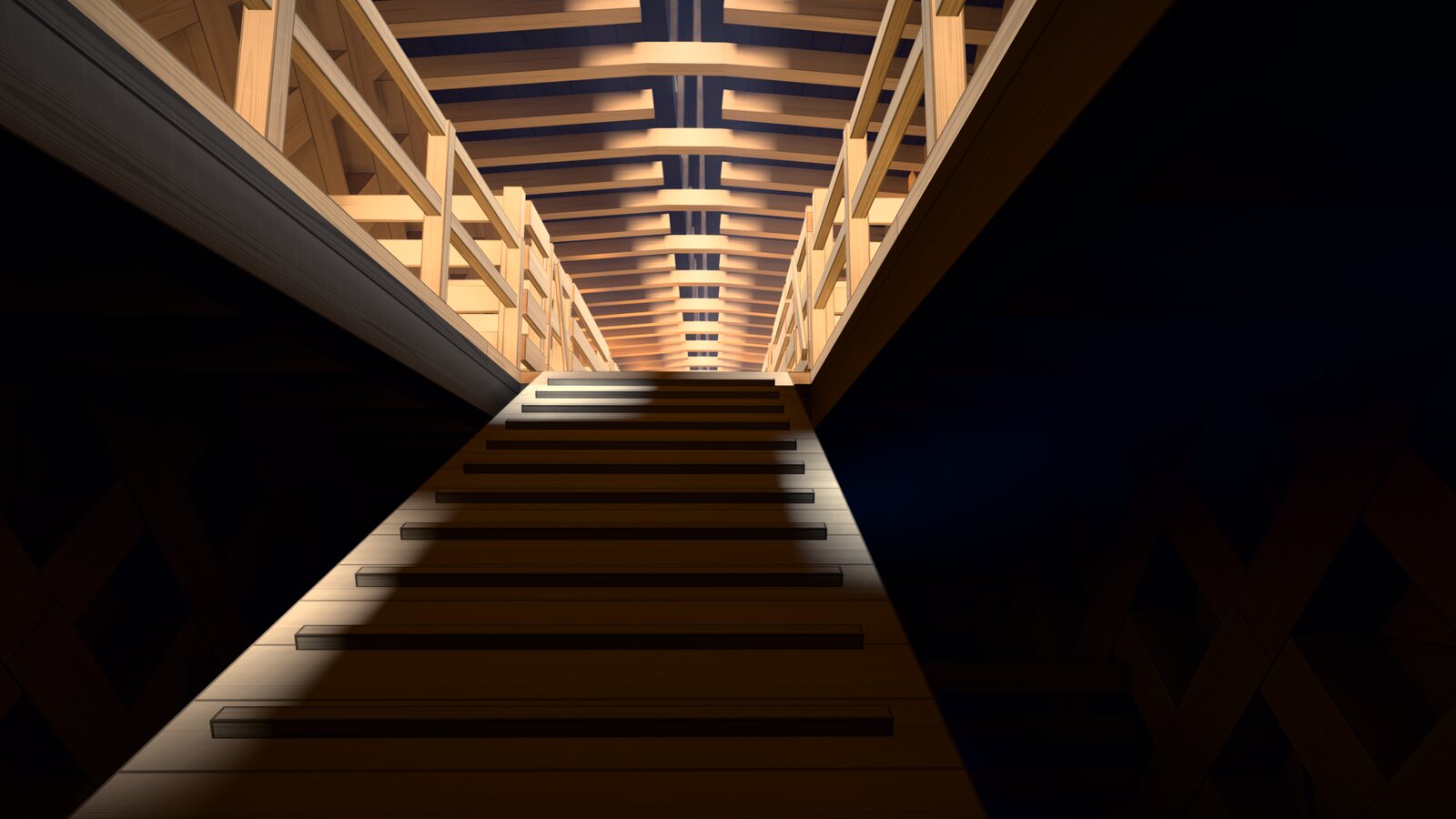
- Ramps. The ramps between the storeys climb at about 22 degrees. Europe's rules for animals in transport allow 26.6 for sheep and grown cattle but 20 for horses, calves and pigs study; a gentler ramp needs about a metre more run.
- Air. The opening along the ridge, 0.44 m wide, is what a modern barn of this width gets as its ridge vent, but a barn also has inlets low in its sides study. The ark's sides are pitched shut, and the low count's animals breathe out 1.3 to 1.6 tonnes of water a day modelled, so openings in the decks are a choice worth keeping.
The text asks for rooms (Genesis 6:14), not for a number of animals. Whether the animals fit depends on choices Part 2 gives a house: the count, the sevens, the birds, young or grown. So our research proposes that the final check report the room an ark has rather than pass or fail it on one count, and that Part 2 judge the loading against the house's readings; that is not yet decided modelled.
Water, the heaviest of the stores, is a question for a later page. On the floor alone, the ark built to Genesis's numbers holds the smallest count with a third or more to spare, and the larger two only packed close.