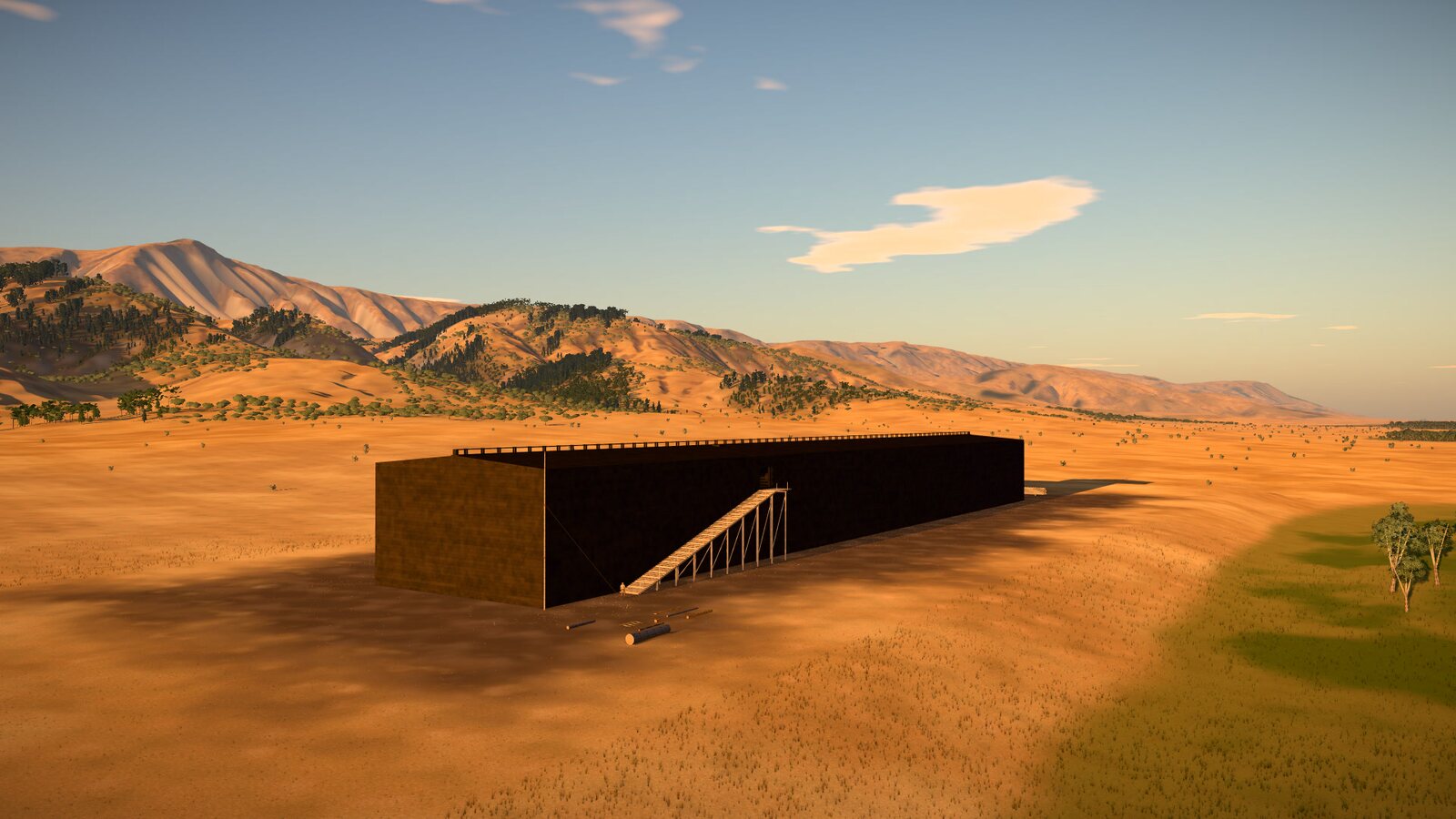
A roof that sheds the rain
Genesis says the ark was finished “in a cubit … above”. What that might mean, why the game's reference ark has a gently sloping roof after Rashi, and what the slope cost the hull.
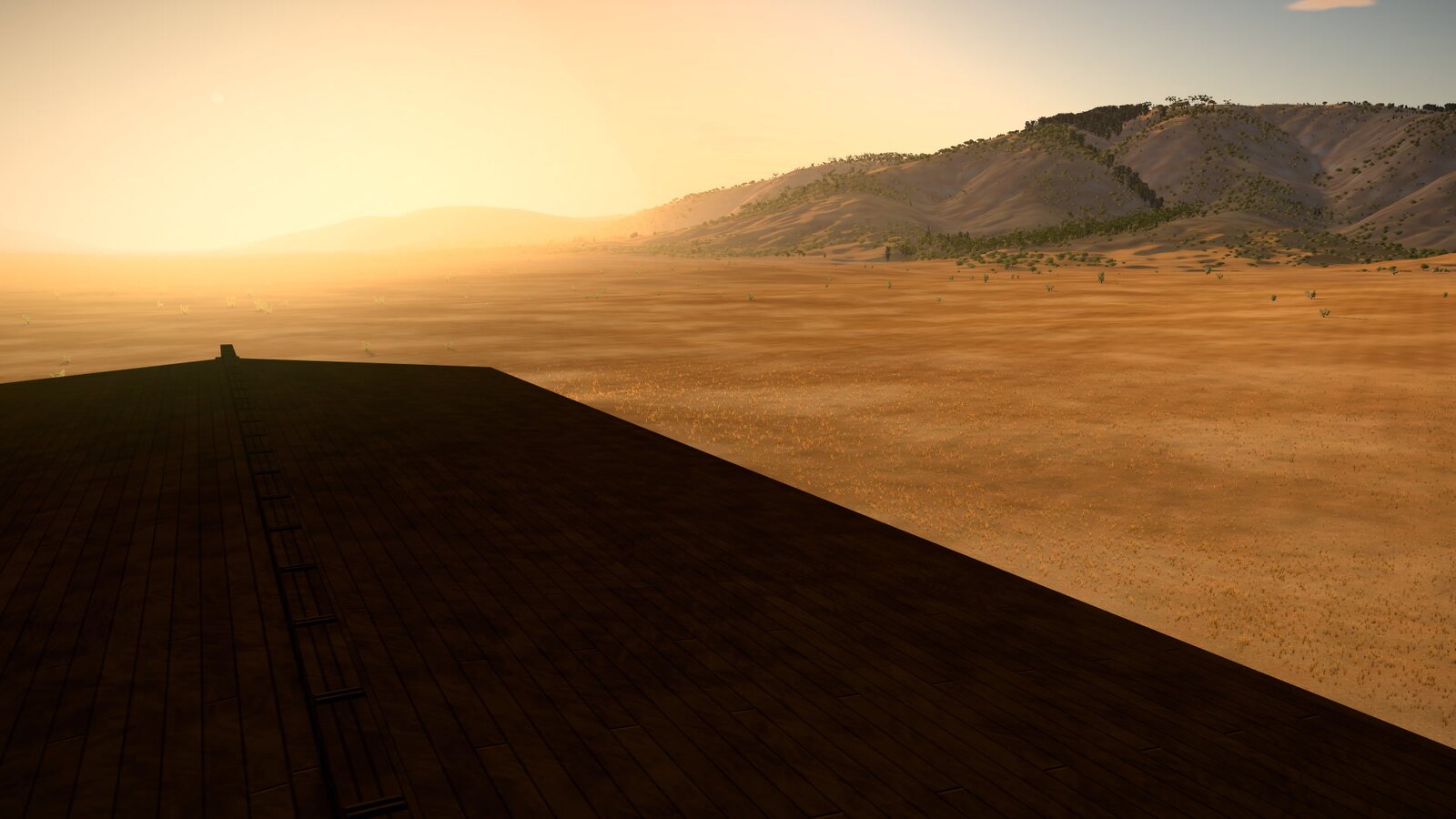
Most of the ark's blueprint is plain: the wood, the size, the three storeys, the door in the side. One sentence is not:
A window shalt thou make to the ark, and in a cubit shalt thou finish it above.
Genesis 6:16 text
What is the "window"? What is finished, and how is it "in a cubit … above"? Translators have struggled with this line for a very long time. The Jewish Publication Society's translation says plainly in a note: "Meaning of Heb. uncertain" text. For House of Noah we still had to build something, so this page is about how we read the verse, what we built, and what it cost.
Three Hebrew words
Translations split over the verse's first word, tsohar text. The King James Version says "a window". Others say "a roof": "Make a roof for the ark, and finish it to a cubit above" (RSV). The NIV reads both into it: "Make a roof for it, leaving below the roof an opening one cubit high all around". The JPS has "an opening for daylight … within a cubit of the top".
There is a small clue in the grammar. The word "it" in "finish it" is feminine in Hebrew, like the word for the ark, tevah, and not masculine like tsohar text. So it may be the ark itself that is to be finished within a cubit at the top.
Two later verses add more text. After the rain, "Noah opened the window of the ark which he had made" (8:6), and here the word is a different one, challon, an ordinary window that opens. Then "Noah removed the covering of the ark, and looked" (8:13). That word, mikhseh, is the one used for the covering laid over the tabernacle (Exodus 26:14). So the ark had a light opening, a window that could be opened, and a covering that could be taken off.
Rashi's sloping roof
Rashi, the great 11th-century commentator, explains each part historical. On tsohar: "Some say this was a window; others say that it was a precious stone that gave light to them." On the cubit: "Its covering slanted upwards so that it narrowed at the top to a cubit, in order that the water should run off on both sides." And on the door in the side: "in order that the rain might not penetrate."
That is an engineer's reading. A roof that rises to a narrow ridge sheds the rain to both sides, as pitched roofs do. A flat roof holds water, and a building that must ride out forty days and forty nights of rain (Genesis 7:12) text should not hold water on top.
Three readings
Put together, the verse can be built in at least three ways:
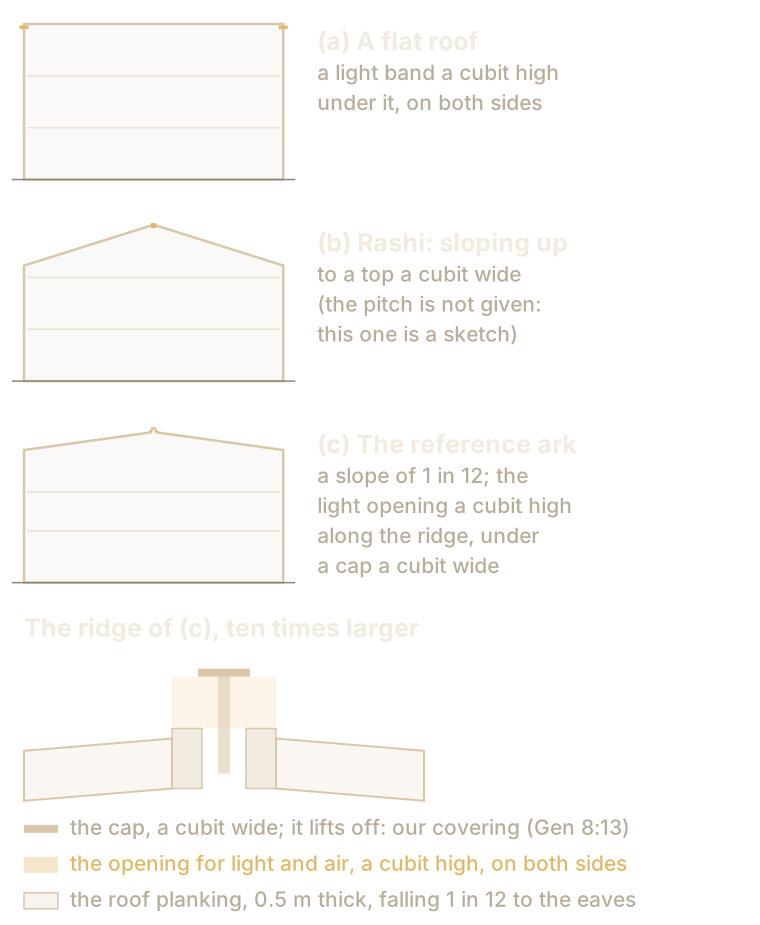
We chose (c) for the game's reference ark and for the film modelled: it follows Rashi's slope and his cubit at the top, and it gives the tsohar a real place as an opening for light and air along the ridge. In the game itself the roof stays the house's choice. The final check judges the ark that was built, not the path to it, and is meant to accept each of the main readings.
The roof as we built it
Here is the reference ark's roof in numbers modelled:
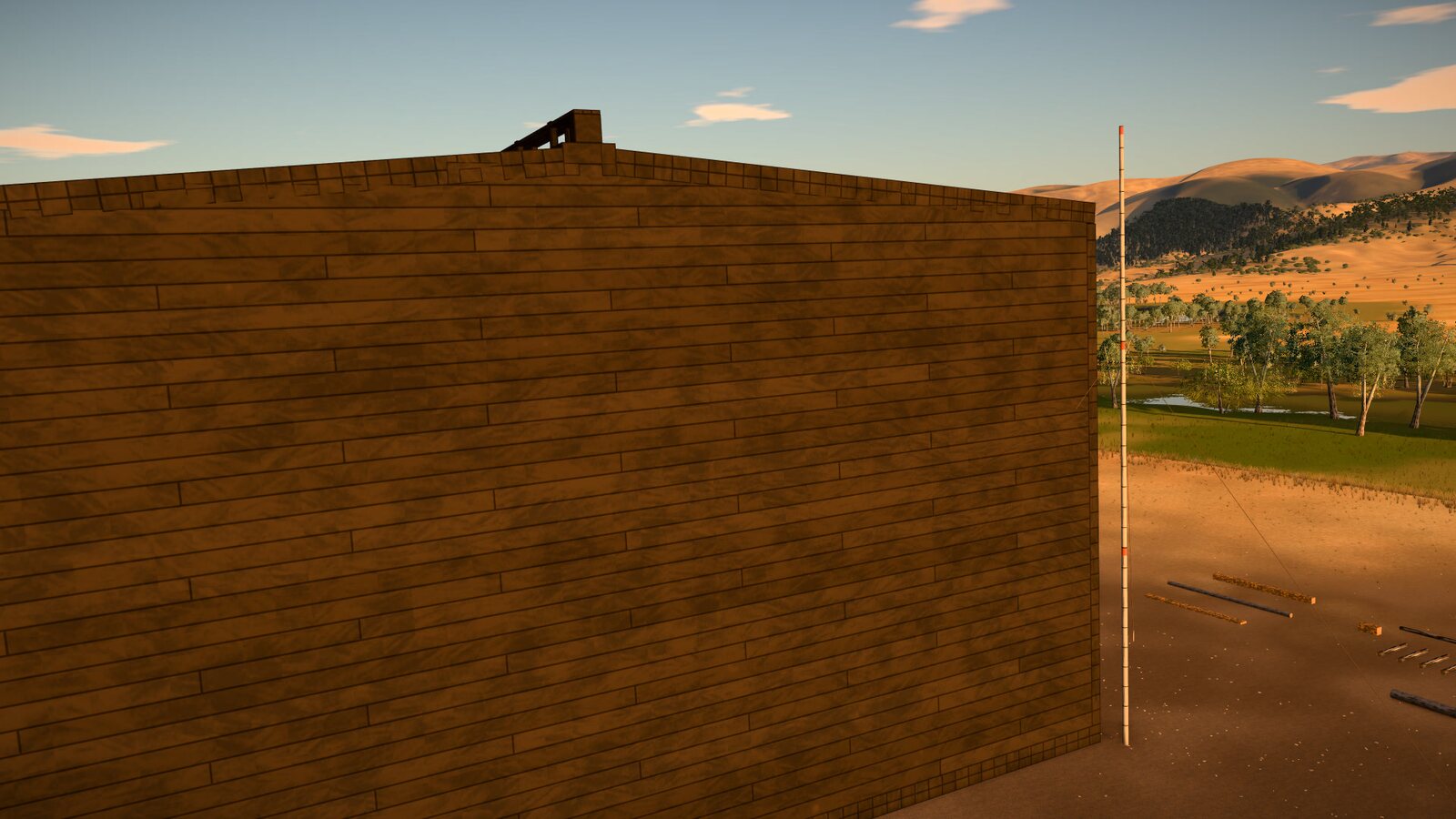
- The height. The 30 cubits of Genesis 6:15 are measured to the very top of the ridge, so the whole ark stays inside 300 by 50 by 30 cubits. The sides rise to the eaves at 13.26 metres.
- The slope. 1 in 12, about 5 degrees, a rise of about 2 cubits from each eave to the ridge. Rain runs off a sealed, pitched board roof at far less than that, and people can still walk on it to lay the pitch.
- The ridge. Two timbers run the whole length with a gap of 44 cm between them. Above the gap, on short posts, sits a cap one cubit wide. The light opening is the space between them: a cubit high, on both sides, all 155 metres long.
- The covering. The cap is made in panels 2.4 metres long, battened and pegged down, so they can be lifted off, our reading of Genesis 8:13.
- The window. One shuttered hatch in the slope on the river side, near the family's end of the ark: the window Noah opened in Genesis 8:6.
Inside, the light comes down from the ridge into the middle bay.
A roof of about 4,000 square metres also gathers a great deal of water: a roof sheds 75 to 90 % of the rain that falls on it study. Gutters along the eaves into cisterns or jars could give the family water for the voyage. The reference ark does not have them yet; they are a building choice for later modelled.
What the slope cost
Here is the surprise. A long hull at sea bends like a beam: in a storm, waves lift the middle and then the ends, and the hull must not break. Engineers treat it as a hollow girder, and its strength comes mostly from the roof and the bottom, the girder's two flanges. The farther apart they are, the stiffer it is.
A sloping roof brings the top flange down. At the sides, the roof planking now sits up to 2 cubits lower than a flat roof would, nearer the middle of the girder. The game's structure study worked out what that does, against the wave loads ocean-going ships are designed for study, with the reference ark's timber modelled:
| Roof | Stiffness of the hull | Load against strength | |
|---|---|---|---|
| Flat roof, planking 0.5 m thick | 100 % | 0.90 | passes |
| Sloping to the ridge, 0.5 m (as built) | about 81 % | about 1.12 | fails |
| The same, planking 0.6 m | about 86 % | about 1.01 | at the limit |
| The same, planking 0.7 m | about 90 % | about 0.94 | passes, with more timber and more joints |
| 30 cubits to the eaves, the ridge above it | about 106 % | about 0.96 | passes, but the ark is taller than 30 cubits |
A figure of 1.00 or less passes. So the sloping roof as we first built it costs the hull about a fifth of its stiffness, and the reference ark, which passed with a flat roof, no longer passes the storm.
The steepness matters less than where the 30 cubits are measured. A slope of 1 in 16 gives about 1.09, and 1 in 8 about 1.18 modelled. The fixes are real choices: a thicker roof, about 0.7 metres in three layers; iron straps, if a house makes them (Genesis 4:22 names iron) text; or reading the 30 cubits to the eaves, so the ridge stands above them. We have not chosen yet: it is decided before the final check is built. The film shows the roof as it was first built, and is not a claim that it passes.
Why it matters
This is the game in miniature. The text sets the goal. Tradition and engineering suggest how to meet it. Every choice has a price, and the game tells you what it is. A house that builds Rashi's roof will have to make up the strength somewhere else, and a house that builds a flat roof will have to keep the water off it some other way. Either can pass, if it is built right.