Rollers, sledges and tracks: moving timber without wheels
Dragged over the ground, the game's 2.5-tonne test log needs about 115 people to start it. On a sledge over greased rails it needs 14. How heavy timber was moved before carts, what experiments with rollers and sledges found, and how a house lays its own tracks in the game.
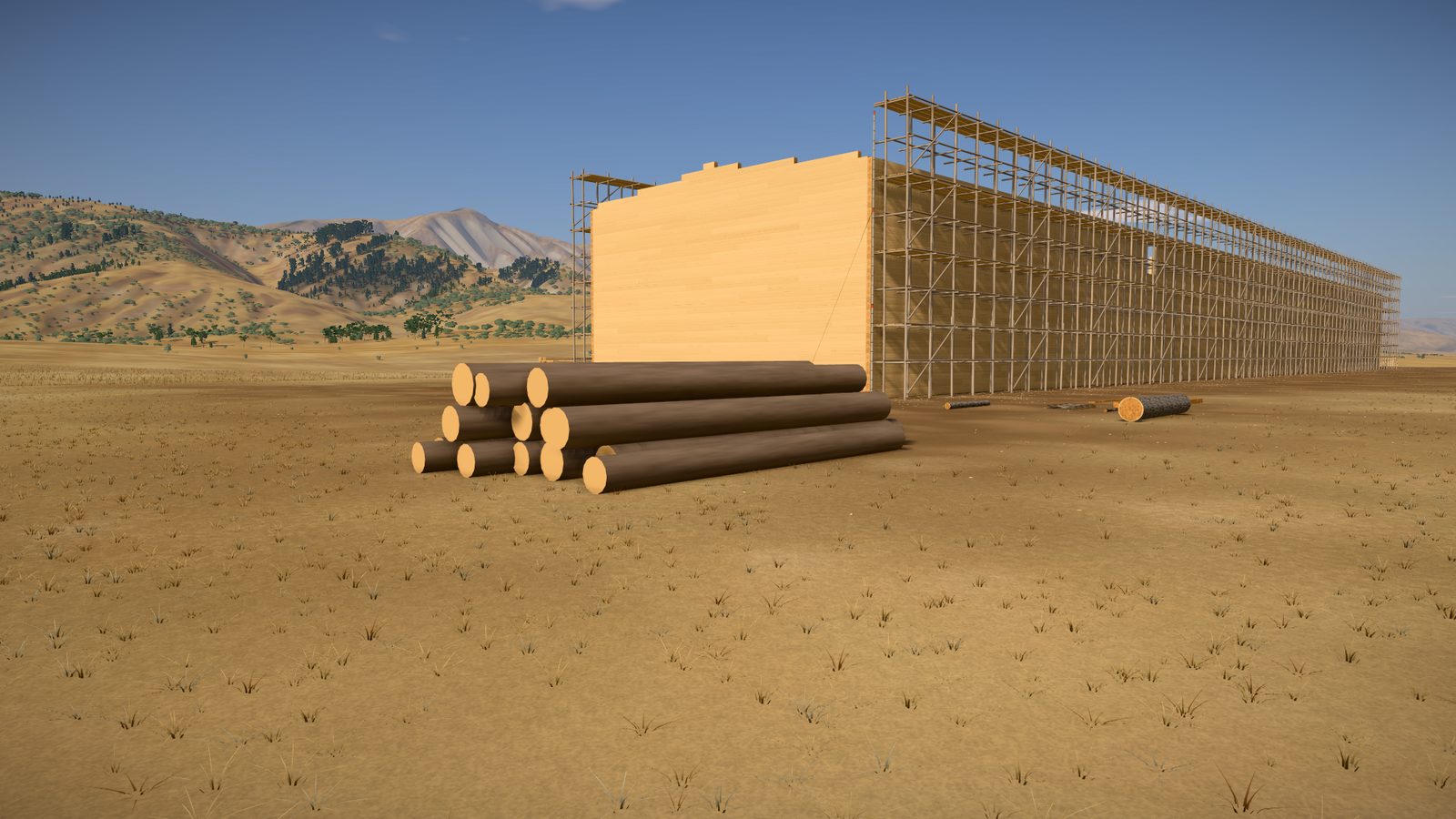
A felled tree is no use where it lies. Every timber in the ark has to travel from a slope in the hills to the building site, and the cypress groves in the game's valley are two kilometres or more away. What a log weighs gave the problem in one number: the test log by the site, 5.2 metres long and about 2.5 tonnes, needs about 115 people to start it moving over dry ground modelled.
There were three old answers, and the game has all of them: put rollers under the log, put it on a sledge, and give the sledge a track to run on.
No wheels
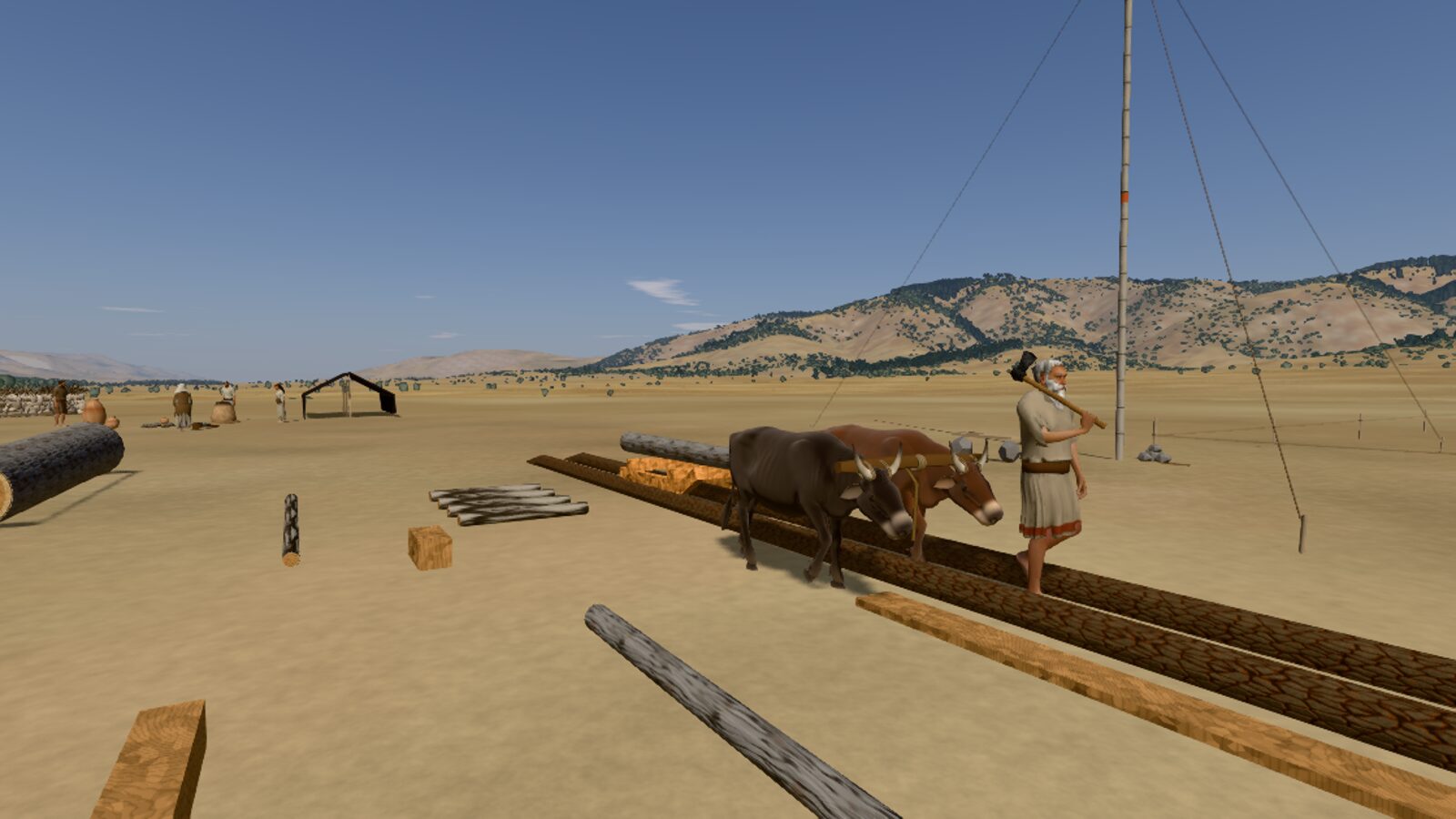
The obvious fourth answer is a cart. Genesis names no wheeled vehicle before Joseph's "second chariot" (41:43) and the wagons sent for Jacob (45:19), long after the flood text. Archaeologists date the earliest wheels by radiocarbon to about 3500 BC: a pot from Bronocice in Poland bearing a picture of a wagon to 3631–3380 BC, and a wooden wheel from the Ljubljana marshes to 3340–3030 BC archaeology. The text is silent on wheels before the flood, so the game leaves carts out modelled. Its timber moves on rollers and sledges, by people and oxen.
Rollers
A roller turns the log's drag into rolling, and rolling is easy on hard, smooth surfaces. Coulomb measured it in 1785 with planed hardwood cylinders rolled on planed oak: the resistance works out at a rolling arm of about half a millimetre. Rough or hewn timber, like a log's bark on a roller, is nearer 4 millimetres study.
Real crews do worse than the formula. In 1979 at Bougon in France, some 200 to 250 people, pulling and pushing, moved a 32-tonne concrete block 40 metres on rollers 40 centimetres across, laid on wooden rails study. Worked back from the crew, that is about an eighth to a quarter of the block's weight in pull, many times what the rolling formula gives modelled. Rollers skew, slip out at the back and have to be carried forward and laid again.
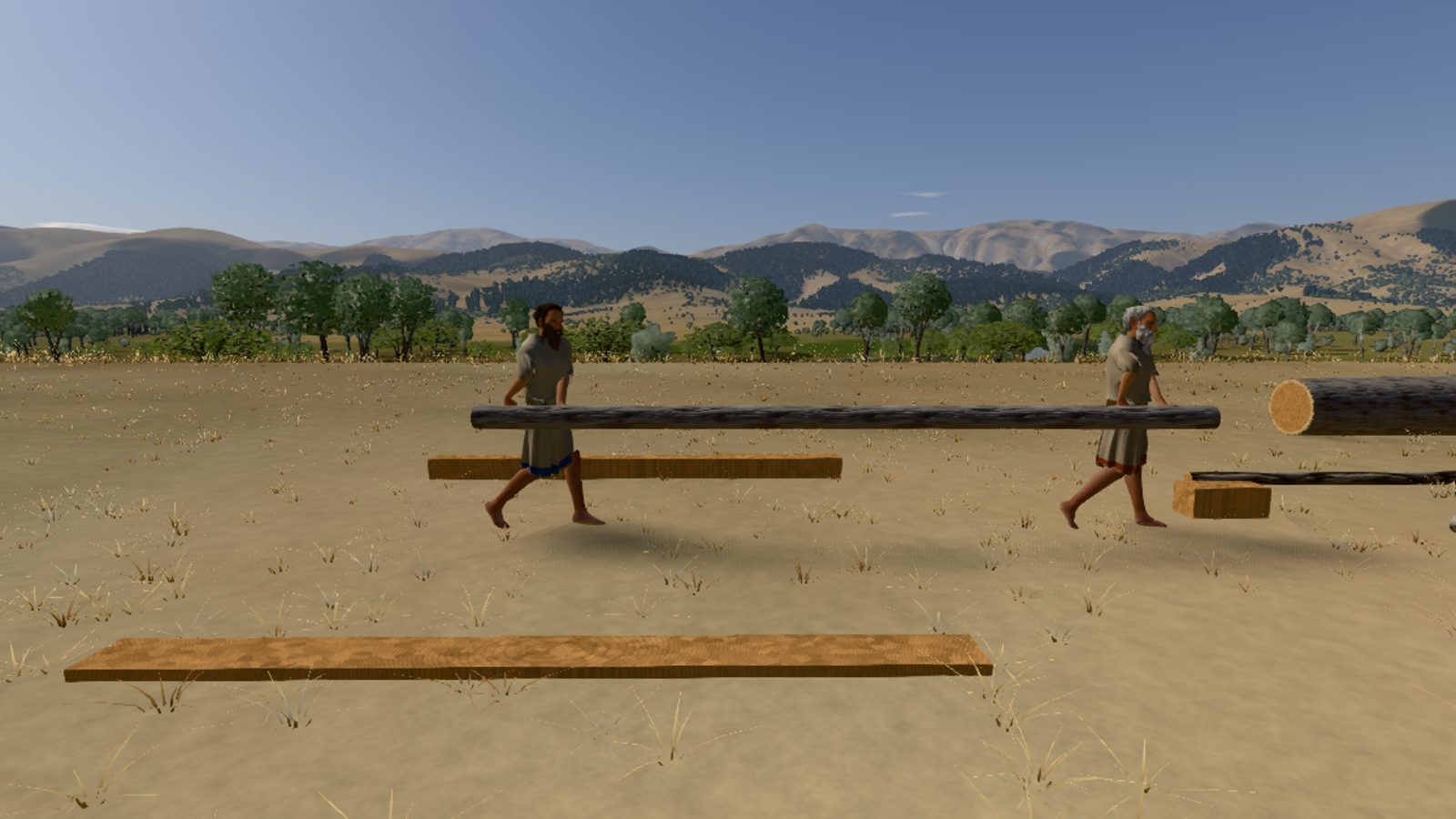
The game counts rollers at no better than a tenth of the load's weight, and every two metres a roller comes out at the back and a minute of someone's work lays it again ahead modelled. On rollers over dry ground the test log needs 40 people to start it; over a hewn track, 24 modelled.
Sledges
A sledge is simpler. The log rests on two runners and the runners slide. A wooden sledge from the tomb complex of Senwosret I at Lisht, which the Metropolitan Museum dates to the 12th Dynasty, is 1.75 metres long archaeology. An Egyptian tomb painting of the same period shows a colossus on a sledge, hauled by rows of men, with one man pouring water on the sand in front of it archaeology. In a laboratory, wetting the sand to the right degree nearly halved the pull a sledge needed study.
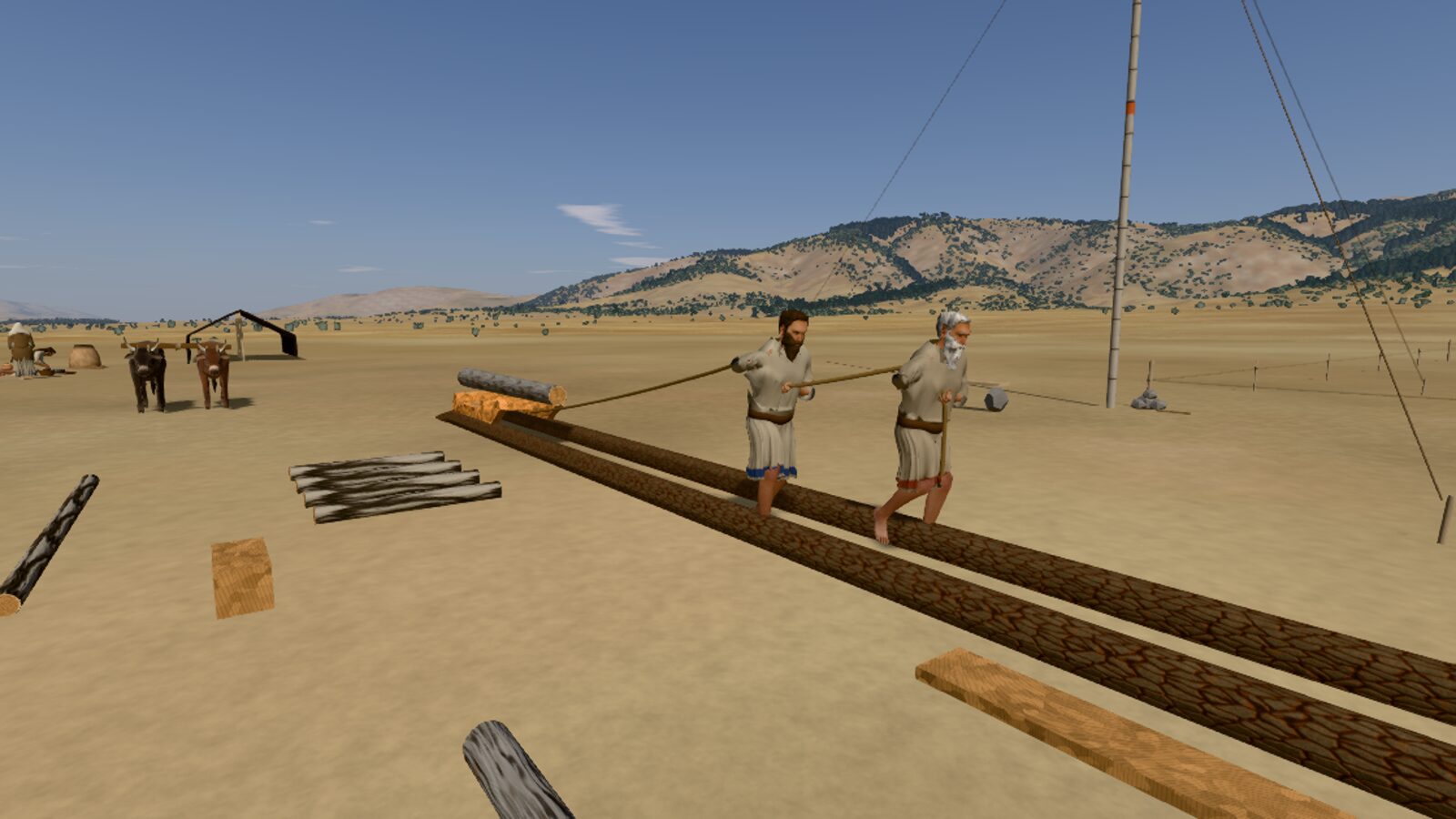
On bare ground a sledge alone helps little: the test log on the game's sledge needs 118 people to start it, against 115 dragged modelled. Its strength is on a track. In 2016 a team at University College London moved a stone of about a tonne with ten people, on a simple sledge over logs laid across its path study. And for a BBC programme in 1994, the archaeologist Julian Richards and the engineer Mark Whitby moved a 40-tonne stone on an oak sledge over greased timber rails, up a slope of 1 in 20, with 130 volunteers and about 50 kilograms of grease; the friction came out a little above the 0.05 they had estimated study.
The game's sledge is two oak runners 2.1 metres long with turned-up fronts and two bunks pegged across them, about 123 kilograms green, built for loads up to 3 tonnes modelled. A house makes one from a squared timber in about 8 person-hours, and loading a log onto it is a quarter of an hour's work modelled.
Tracks
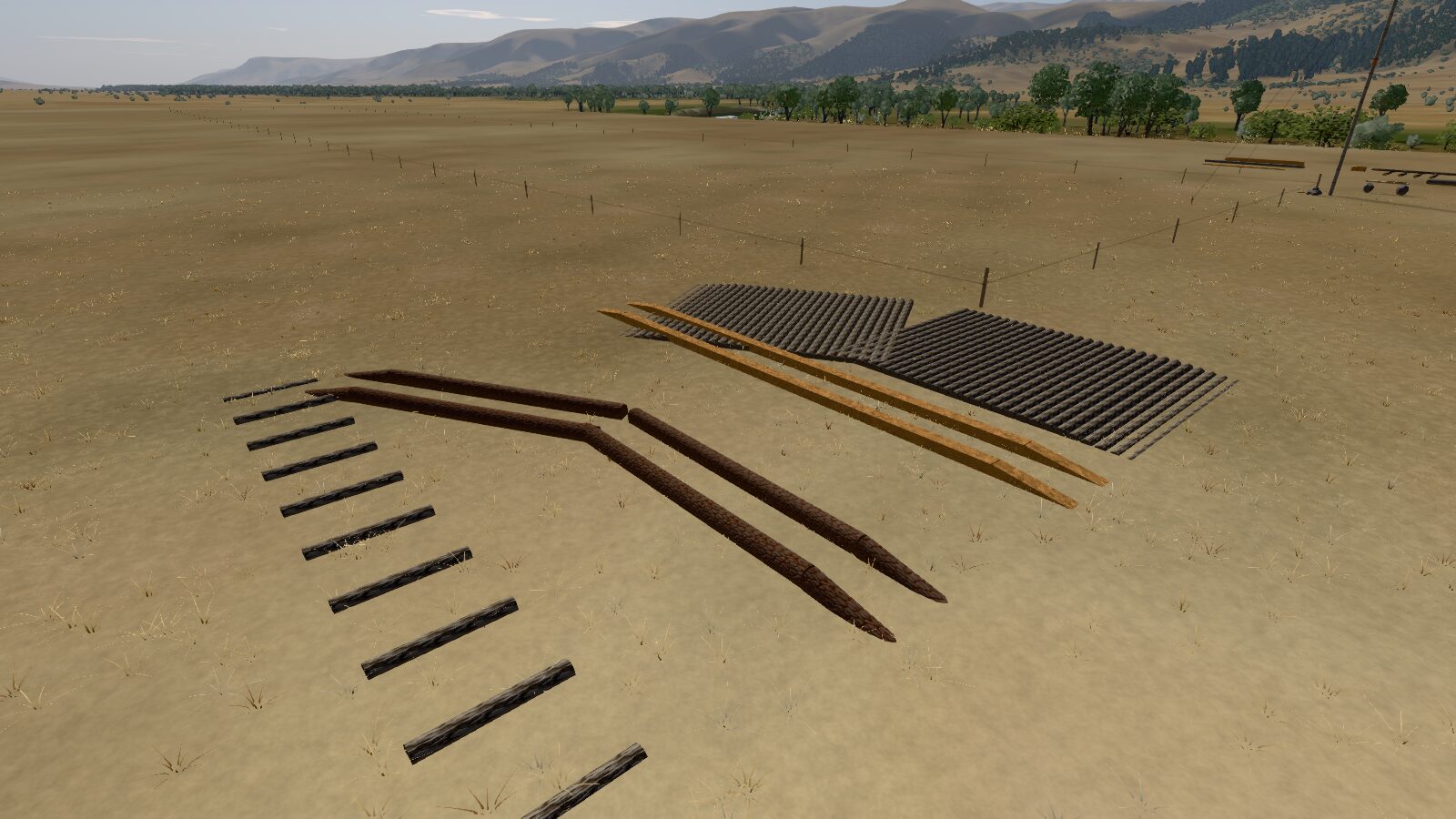
A track makes the ground the sledge runs on. The game has four kinds, each laid in spans of 5 metres modelled:
| Track | What it is | Work to lay, person-hours a metre |
|---|---|---|
| Crossties | logs about 18 cm across, a metre apart, half bedded | 0.5 |
| Pole rails | two round poles 25 cm across, 75 cm apart, their inner faces hewn | 0.6 |
| Hewn rails | two rails squared to 20 cm | 1.5 |
| Corduroy | logs laid side by side, for soft ground | 4 |
The pole rails come from American logging. In 1923 the forester Ralph Bryant wrote that on a pole road "six men and one team … build 500 feet of straight track daily", with curves taking about a third more labour historical. The game counts a third more on a curve too modelled. The hewn rails follow Richards and Whitby's, 200 millimetres square and 750 millimetres apart study, and the corduroy the US Army's field manual, logs "placed adjacent to each other" study.
A track is wetted or greased. Wetted, a sledge on it needs a pull of about a fifth of its weight, until the track dries by the next working day; greased, about 6 % study modelled. Wetting costs the game 0.005 person-hours a metre and greasing 0.001, and a track in use needs care: 1.5 person-hours a kilometre on each working day it is used, from Bryant's "One man can maintain 2 miles of track on half time" historical modelled.
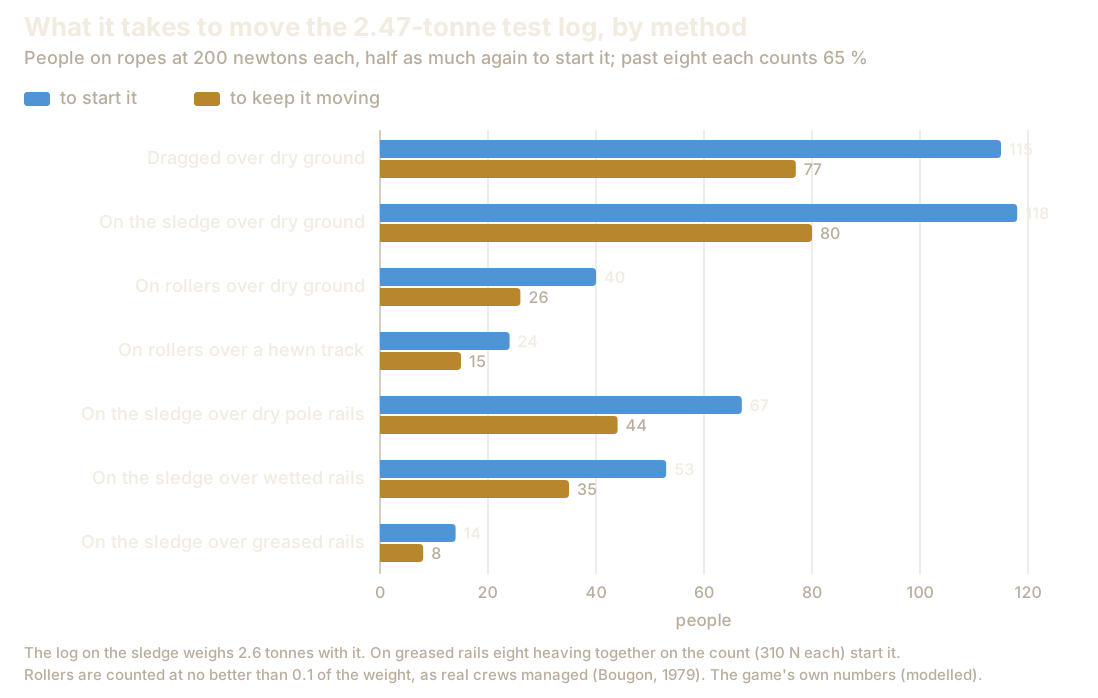
On greased rails the test log, 2.6 tonnes with its sledge, starts with 14 people pulling, or with 8 heaving together on the count, and 8 keep it moving modelled.
In the game
Laying track is work like any other. With the track tool in hand a player chooses the kind and lays the next 5-metre span where they look; a span of pole rails takes about 5 seconds of play and 3.45 hours of work on the calendar modelled. Once a span has been laid by hand, the rest can be laid in a batch toward a point.
Hauling works the same way. A load moved a metre by hand on a rope, on rollers or on the sledge leads a haul batch: a pile of timber hauled to a deck or a stack along the route the player sets. Before it runs, the game checks the heaviest load at the worst stretch of the route and, if the crew is too small, says what would move it modelled. Measured over 100 loads and 2 kilometres, people dragging timber over dry ground move about 0.25 tonne-kilometres each in a working day, along a wetted track about 0.56, and on a sledge over greased rails about 1.8, roughly seven times as much modelled.
What it means for the ark
The reference ark is about 12,400 tonnes of green timber modelled. Hauled 2 kilometres by people alone, dragged over the ground, it would take about 108,000 person-days; on a wetted track about 49,000; on sledges over greased rails about 25,000 modelled. Two kilometres of pole rails cost about 150 person-days to lay modelled. A track pays for itself many times over.
That is the game's kind of choice. A house can drag, roll, lay crossties or build a greased road to the groves, and each changes how many people the next load needs. The next page is the other answer, the one the text itself names: oxen.