Pitch within and without: kopher, kupru and the bitumen of Mesopotamia
Genesis asks for the ark to be pitched inside and out, and its Hebrew word for pitch is the Akkadian word for bitumen. What Mesopotamian boat bitumen was, what the Ark Tablet says, why pine tar is the other real option, and how the game's reference ark is pitched.
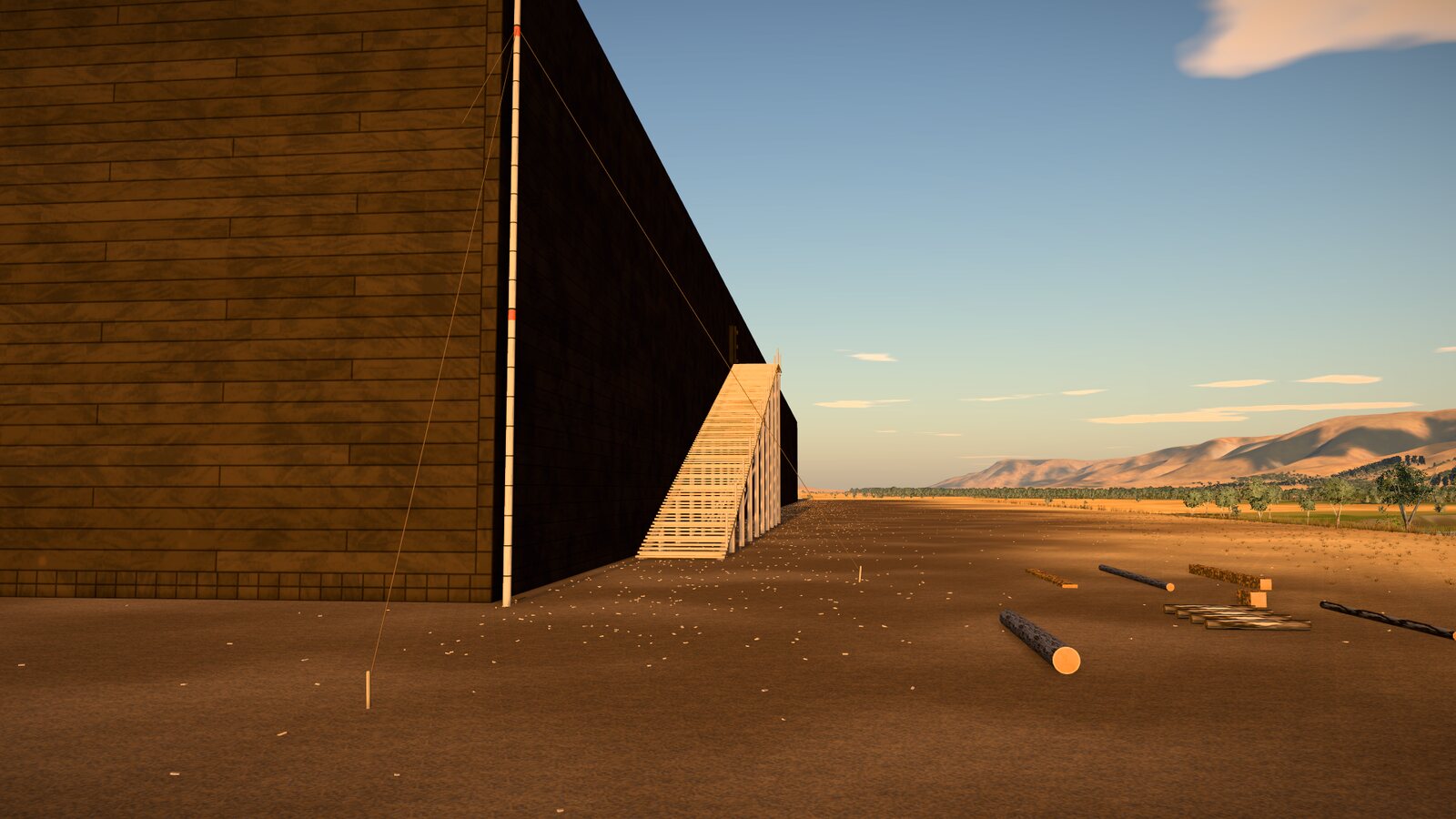
God's instructions for the ark give it one finish, inside and out:
Make thee an ark of gopher wood; rooms shalt thou make in the ark, and shalt pitch it within and without with pitch.
Genesis 6:14 text
Pitch is the third of the seven things the game's final check reads from Genesis. Here is what the coat was made of, how thick it was laid, and what it costs on an ark this size.
One word, said twice
In Hebrew the end of the verse reads wᵊkāpartā … bakkōper, "and thou shalt pitch it … with pitch" text. The verb and the noun are built on the same three letters, k-p-r, so the verse says its word twice.
The noun, kōper (often written kopher), matches the Akkadian kupru, bitumen study. The oldest translators read it the same way: the Greek Septuagint has asphaltos, and the Latin Vulgate bitumine text. The Akkadian word also turns up in the Gilgamesh flood story study, where the boat's builder tells what went into his kiln: "Three times 3,600 units of raw bitumen I poured into the bitumen kiln, three times 3,600 units of pitch […] into it" historical.
Kōper stands beside gōper, the gopher wood, in the same verse, and the two sound alike, a puzzle we looked at in What was gopher wood?. Whatever the gopher was, the pitch, by its name, is bitumen.
What boat bitumen was
Bitumen comes out of the ground at seeps. At Is on the Euphrates, now Hit, Herodotus wrote of lumps rising from the river, "and from there the bitumen was brought for the wall of Babylon" historical. In 1909 Gertrude Bell was told that the peasants could take 2,000 donkey-loads a day from the largest spring alone, "when they choose" historical. Workers pressed the floating "snakes" of bitumen into lumps by hand, rolled them in sand so they would not stick, and carried them off in baskets study.
Boats were not coated with pure bitumen, but with a mastic: bitumen worked together with mineral and chopped plant matter. Boat slabs from Ra's al-Jinz, from 2500–2100 BC, are mineral, mostly calcite, and bitumen with chopped plant temper in about equal shares archaeology. Far older, at H3 As-Sabiyah in Kuwait, 5300–4900 BC, slabs of bitumen still carry the prints of the reed bundles they coated, and barnacles. The coat there was generally 1–2 cm thick, sometimes 3 archaeology. In the shipyards of Umma and Girsu, about 2050 BC, a boat was issued 57 to 96.5 kg of bitumen for every gur (300 litres) of its capacity historical.
The Ark Tablet: a finger, or two millimetres
One Akkadian flood text seemed to give the thickness itself. The Ark Tablet, published by Finkel in 2014, describes a round boat of palm-fibre rope on ribs, coated in bitumen historical. Finkel read its lines on the coating as "I apportioned one finger of bitumen for her outsides … for her interior … for her cabins": a finger is about 1.66 cm historical.
Later editors, Streck in 2017 and Wasserman in 2020, read the same signs as "sixty" kors, a measure of capacity rather than length: "I allocated sixty (kors) of crude bitumen for her outsides …" historical. Spread over the boat, that comes to a coat of about 2 mm a face modelled.
So the tablet no longer backs a thick coat. Its kiln, though, is real practice: dry bitumen with crude bitumen poured in historical, as in the Ur III shipyards' records historical.
A thin hot coat is real practice too, but a short-lived one. In The Marsh Arabs (1964), Thesiger describes a boy melting bitumen over a small fire and spreading it "a quarter of an inch thick" on a canoe: "The bitumen never lasted more than a year" historical.
Pine tar, the other real option
Not every pitch is bitumen. Theophrastus describes a Macedonian pitch kiln, a great pile of wood that burned "nearly two days and nights" under constant watch historical. Pliny tells how the thicker part of the tar was boiled again in a bronze cauldron into pitch "for coating ships" historical.
The game's valley has the tree for it: Calabrian pine, resinous, and native as far as northern Iraq study. But tar is slow to make. Tar burners in 18th-century Ostrobothnia needed 8 to 13.5 days' work for a barrel of 125 litres historical, and boiling tar down into pitch loses a quarter of it or more historical. The game reckons 2 person-hours a litre modelled.
For the reference ark, pine tar would mean about 33,500 litres from some 1,300 stacked cubic metres of pine burned in pits, for a thin coat rather than a thick mastic modelled. In labour it comes out a little above bitumen modelled. The real difference is logistics: a seep and a long carry, or pinewood and kilns.
Within and without, on the reference ark
Genesis says "within and without", and not how far "within" reaches text. Our reading for the reference ark is that the pitch is the watertight skin modelled. Without, it covers the whole outside. Within, it covers the shell's inner faces, the bottom, the sides, the ends, the roof's underside and the curbs along the ridge, and the ribs that stand against them. The framing inside, the decks, beams, rafters, pillars, walls, riders and the rooms, is left raw, because it is not part of the skin.
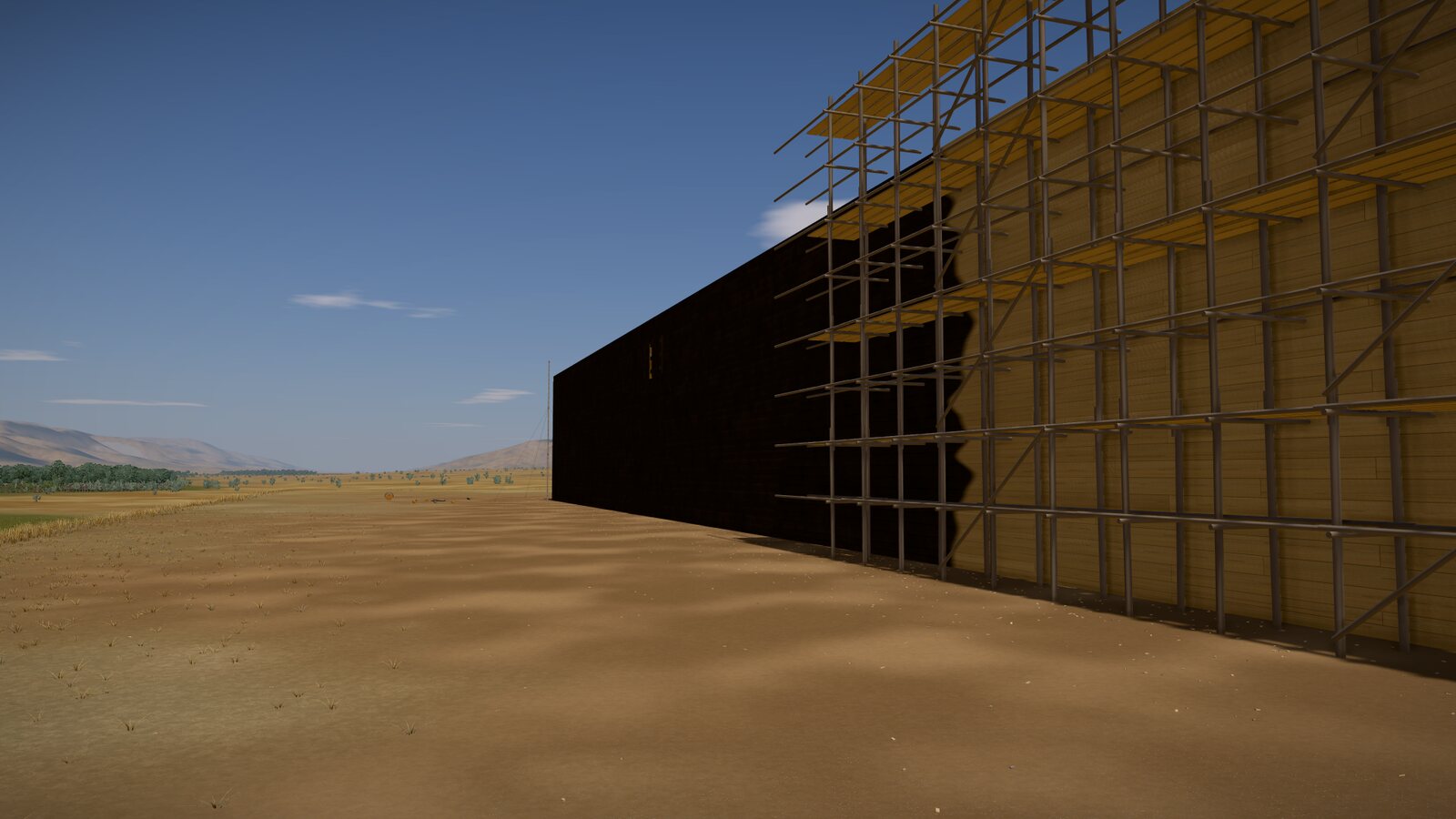
That makes about 26,800 square metres to coat. The game's numbers use a mastic 2 cm thick, from the archaeology's 1–3 cm, mixed as about 35 % bitumen, 50 % mineral (calcite, clay, sand) and 15 % chopped reed or straw: about 30 kg on every square metre of each face. For the whole ark that is about 800 tonnes of mastic, of which about 270 tonnes is bitumen modelled.
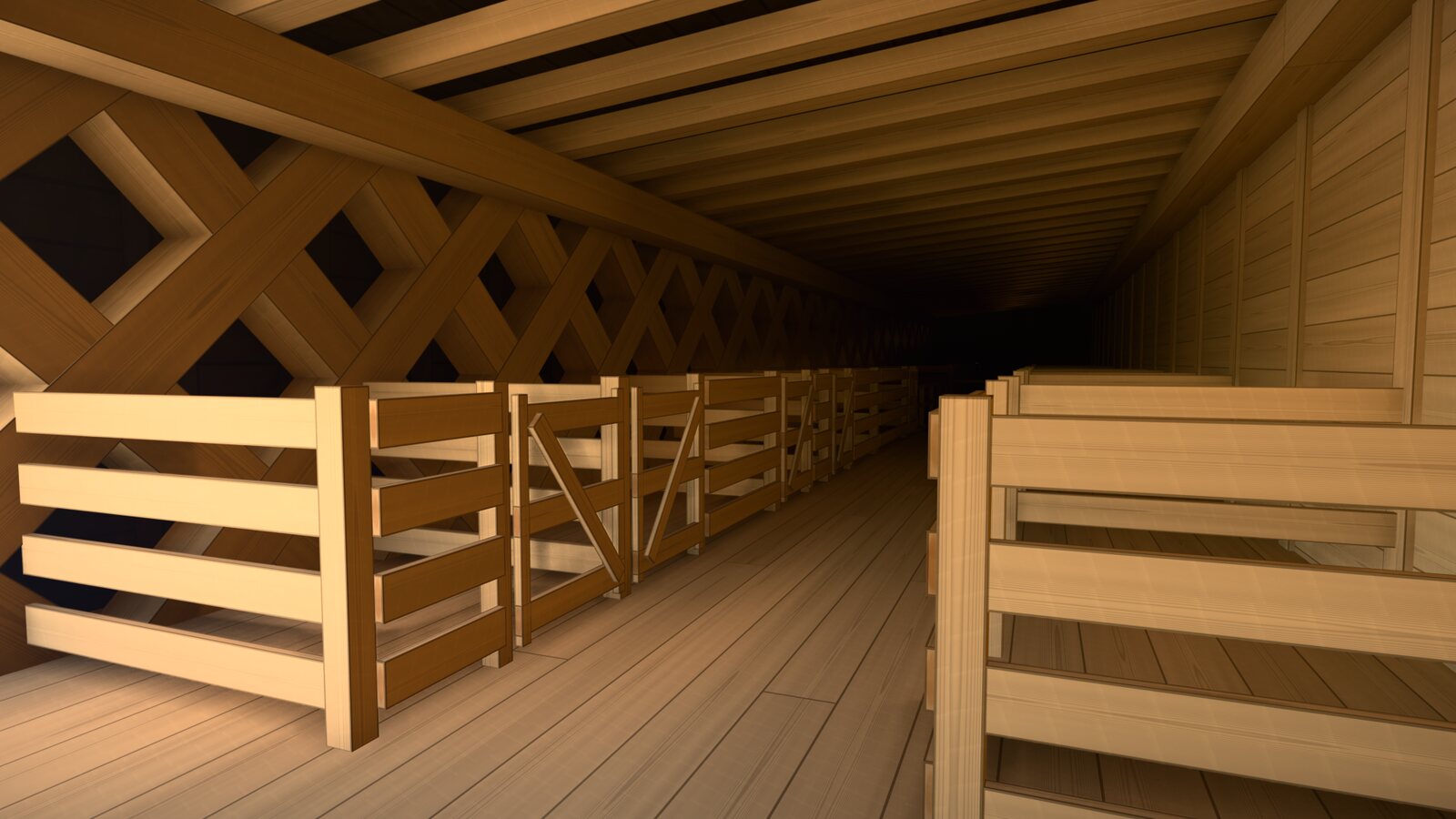
This is one sound way among several, and a house chooses its own. The final check judges the ark that was built, not how it got there: whether it is pitched inside and out, and how much water comes through.
What it costs
Gathering 270 tonnes of bitumen at a good seep is the easy part: about 8,000 person-hours, and a seep like Hit's could supply it in days modelled. Carrying is the real cost: about 9,000 loads of 30 kg for the bitumen alone, before the filler modelled.
Heating has a record. Two Ur III tablets about caulking a garden structure and a temple pond count the men: one gives 55 workmen for a day to heat 16,860 litres of dry bitumen historical. The two come to about 0.035 person-hours a kilogram, close to the 0.04 the game uses modelled.
Altogether, pitching the reference ark with bitumen comes to about 75,000 person-hours, some 9,400 working days of eight hours, out of about 970,000 hours for the whole ark modelled. At the extremes of every rate it is 31,000 to 216,000 modelled.
What is still open
No source we found times the gathering of bitumen at a seep, or its laying on a hull: both are our estimates modelled. Whether the Ur III "dry bitumen" was pure or already mixed with filler is unresolved. And whether a thin hot coat, like the Ark Tablet's on the later reading, would keep an ark tight is for the final check to show.
In the game
The valley is planned with a bitumen seep, and it already has pine on the hills. Pitch is a stage of the work chain we build next, and a house will be able to make it either way modelled. Pitch cannot be laid in the wet, and the pitch kiln and the bitumen pot are real fire risks, guarded against by distance from the timber stores and water at hand modelled.
When the pitch is on within and without, the game will mark the moment with the verse. In the final check, the ark's leak rate comes from every seam, every caulked joint and every coat of pitch modelled, and an ark not pitched within and without does not pass.