How long does it take to fell a cypress?
In the game a tree comes down in half a minute of play, and the calendar adds hours. Where those hours come from: felling experiments with replica axes, one formula fitted to them, and what it says the ark's 7,900 trees cost.
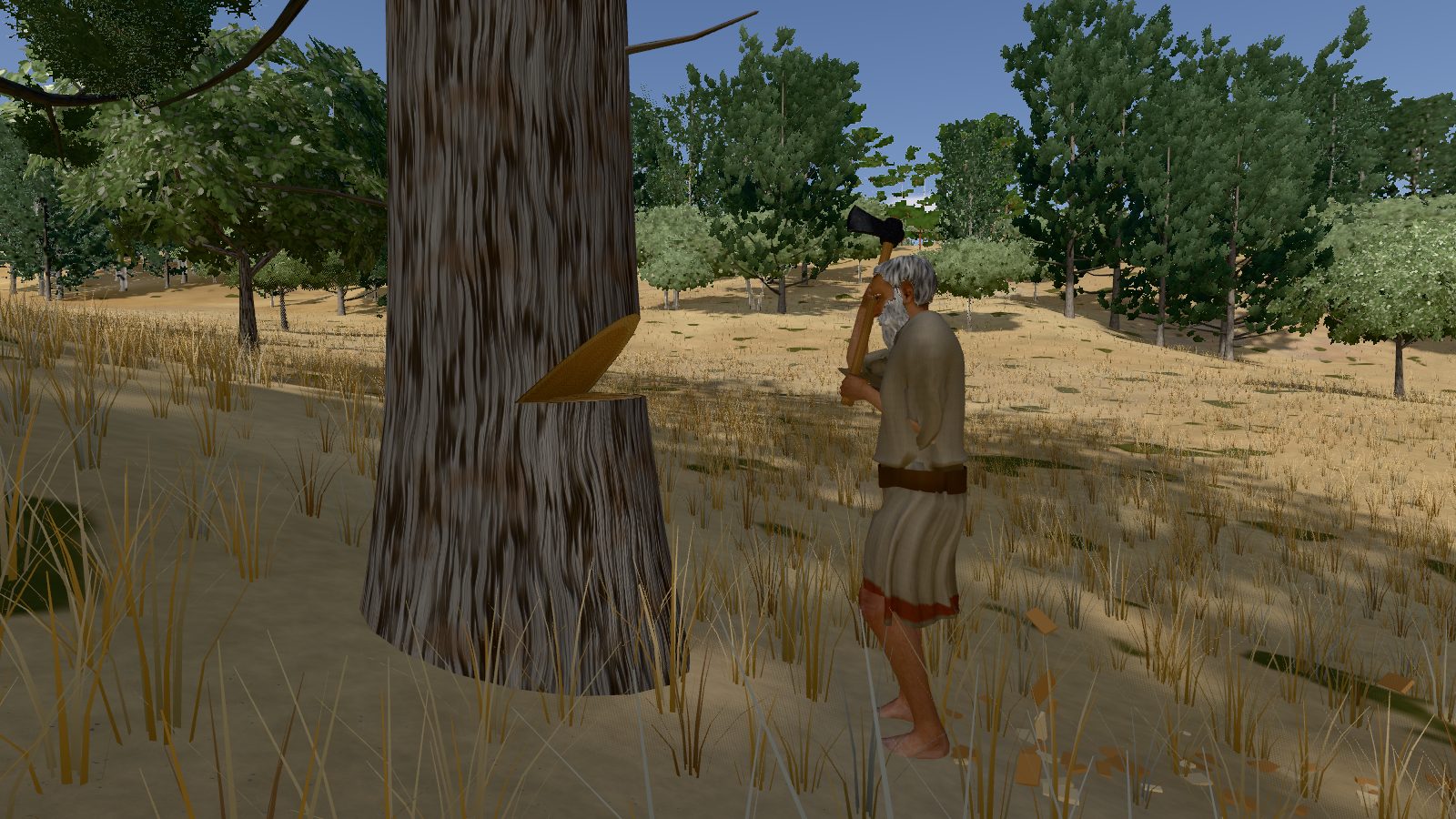
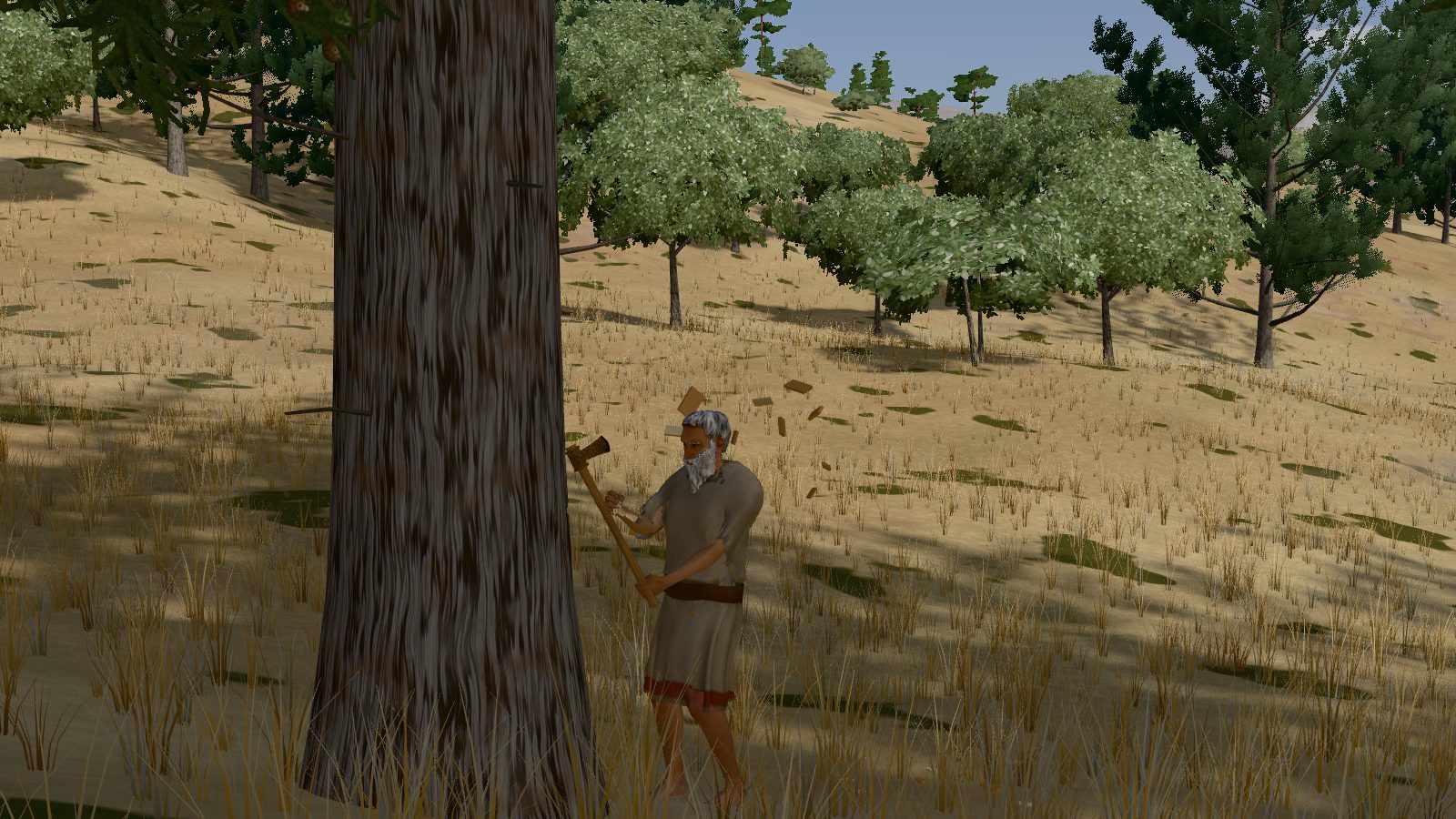
Felling is the first real work of the build, and the one players meet first. In House of Noah it takes about half a minute: you aim, cut the notch, walk round, cut the back cut, and the tree goes. Then the game tells you what that half-minute stood for, and it is hours.
Man goeth forth unto his work and to his labour until the evening.
Psalm 104:23 text
This page is about those hours: where they come from, and what they add up to.
What the experiments measured
No one timed a felling before the flood, so the game starts from people who have timed it since, with replica tools study:
- Steel. In one trial, a man used to the work felled an oak 55 centimetres across with a replica Roman axe in "a bit more than one hour" (Elburg and colleagues, 2015).
- Bronze. In another, an experienced feller with replica bronze axes took about 2.2 minutes for a birch 10 centimetres across and 7.5 to 11.5 minutes for one of 17 to 18 (Dolfini and colleagues, 2023). The time rose steeply with the trunk's size.
- Stone. Among the Baruya of New Guinea in 1968–69, men with stone adzes took 1 hour 38 minutes to fell a hardwood 43 centimetres across, and clearing a plot of 79 small trees took 46 hours of work (Godelier and Garanger, 1973).
These are different woods, tools and people, so they cannot simply be averaged. What they share is the shape: a tree twice as thick takes far more than twice as long.
One formula
The game's labour study fits one formula to them modelled:
time (minutes) = 0.0029 × tool × species × D^2.5, with D the trunk's diameter at breast height in centimetres, raised to the power 2.5.
- 0.0029 is set so that a steel axe fells a 55-centimetre oak in 65 minutes, the one measured steel-on-oak felling modelled. As a check, at 42 centimetres it gives 33 minutes, and the Baruya's stone-adze time divided by stone's measured slowness, 3 to 4.5 times steel's, gives 22 to 33 modelled.
- The power of 2.5 (somewhere between 2 and 3) is there because a bigger tree needs a wider notch, so the chips grow faster than the trunk's cross-section modelled. Doubling the diameter multiplies the time by about 5.7.
- Tool: iron 1, bronze 1.5; a page of its own explains why modelled.
- Species: oak 1, cypress 0.7. No measured species factor for metal axes was found, so softwoods like cypress are estimated at 0.6 to 0.8 of oak's time modelled.
That is the net time, chopping without a pause. A real feller also rests, sharpens and re-hafts, so the game multiplies by 1.4 for the gross time modelled.
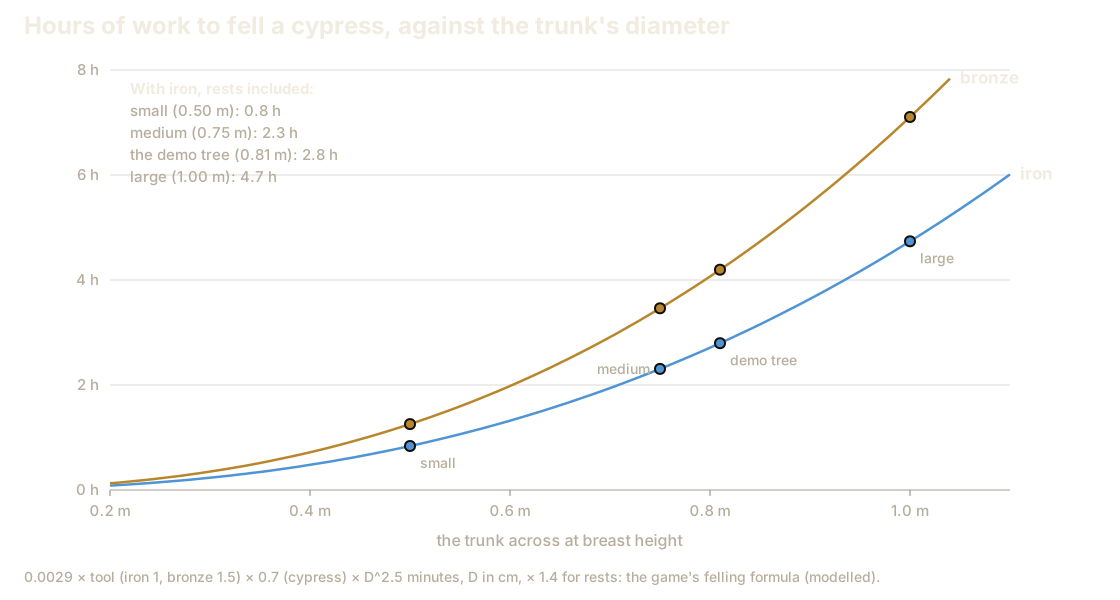
For cypress that gives modelled:
| Trunk across | Example | Hours, iron | Hours, bronze |
|---|---|---|---|
| 0.50 m | a small tree, 20 m tall | 0.8 | 1.3 |
| 0.75 m | a medium tree, 25 m tall | 2.3 | 3.5 |
| 0.81 m | the game's demo tree, 27.8 m tall | 2.8 | 4.2 |
| 1.00 m | a large tree, 30 m tall | 4.7 | 7.1 |
Half a minute of play
Nobody wants to chop for two hours at a screen, so the game speeds the hand work up by one factor for every tree, tool and species modelled. One swing takes 0.92 seconds, and each second of chopping in play stands for 430 seconds of one person's net work. A medium cypress is about 99 minutes of net work by the formula: about 15 swings, 14 seconds of chopping, and with the walk round and the fall, the 20 to 30 seconds of play the plan aims for.
The calendar adds the real work, not the play modelled. Each stroke that counts goes on as its share of the tree's labour, rests included: about 9.2 minutes a stroke on a medium cypress with iron. A wasted stroke, off the cut's line, is real work spent too. The game's demo tree, a cypress 27.8 metres tall and 0.81 metres across, comes down in about 18 good strokes; the game recorded it at about 2.9 hours of real work, near the formula's 2.8, and with 15 % more for tools, layout and rework, about 3.4 hours on the calendar.
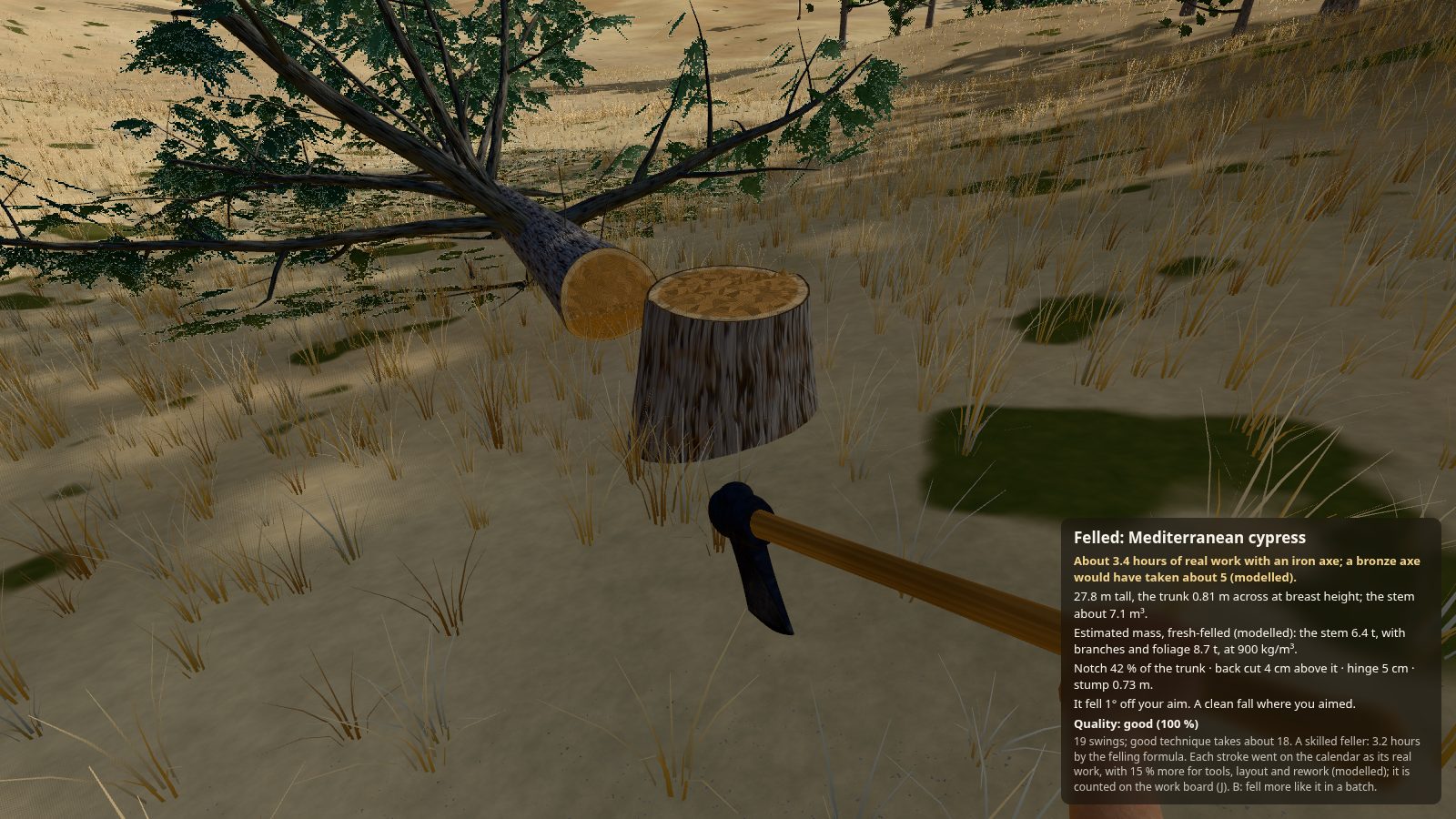
The working day in the game follows daylight, about 10 hours of work on average modelled, so the demo tree is about a third of a working day for one person.
Limbing and cross-cutting
A felled tree is not yet timber. Its branches have to come off, and its stem has to be cut into lengths. The game counts limbing at 0.6 of the felling time, from forestry figures for chainsaw crews, where limbing and bucking take 0.7 to 1.1 times as long as felling study modelled; and each cross-cut with the axe at 1.15 times the felling time at that diameter, from the bronze-axe trial, where the log has to be rolled to finish the cut study modelled. Cross-cutting with the axe takes longer than felling, which is why it pays to plan the cuts.
What it adds up to
The reference ark, one sound way of building it among several, needs 7,932 medium cypress modelled. Felling them alone, at 2.3 hours each, is about 18,000 person-hours; with the limbing and the cross-cuts, the game's labour study counts about 53,000 modelled. That is a lot of chopping, and only about 5 % of the whole build: the joints alone take about six times as much.
What we don't know
The formula rests on one steel-on-oak felling for its scale, and the cypress factor has no measurement behind it. An afternoon with a replica axe in a cypress grove would replace both guesses with numbers. Until then, every felling time in the game is marked as modelled, and the formula sits in one place, so a better measurement changes every tree at once.