Bronze and iron before the flood: Tubal-cain and the first axes
One verse in Genesis puts bronze and iron in the world before the flood. What it does and doesn't tell us, what the game's two axes are modelled on, and what replica-axe experiments say about how much slower bronze is than iron.
Genesis says little about how people lived before the flood. Two of its few details come from one family, the sons of Lamech, a descendant of Cain (not Noah's father) text. One son was Jabal, "the father of such as dwell in tents, and of such as have cattle" (Genesis 4:20) text. Another was a metalworker:
And Zillah, she also bare Tubalcain, an instructer of every artificer in brass and iron: and the sister of Tubalcain was Naamah.
Genesis 4:22 text
The King James Version's "brass" is the copper alloy we call bronze text. So Genesis puts both metals in the world before the flood. For a game about building the ark by hand, that verse matters: it means the axes, adzes and wedges can be of metal.
What the verse doesn't say
It names two metals and a craftsman. It does not say what was made of them, how good the tools were, or whether Noah's family had any text. The game has to fill that gap, and does it the way it fills every gap: with the earliest real practice it can find, labelled as modelled modelled.
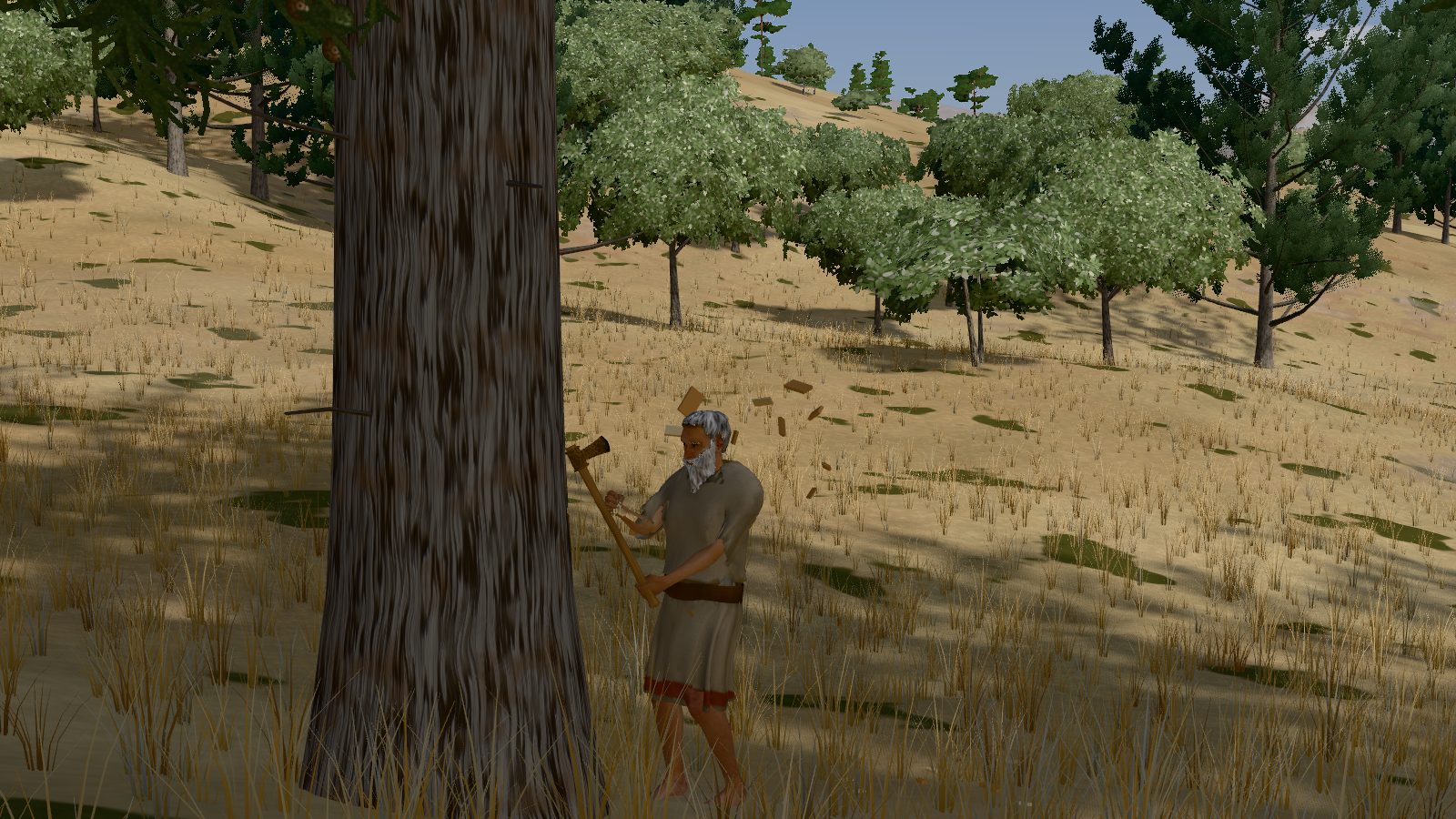
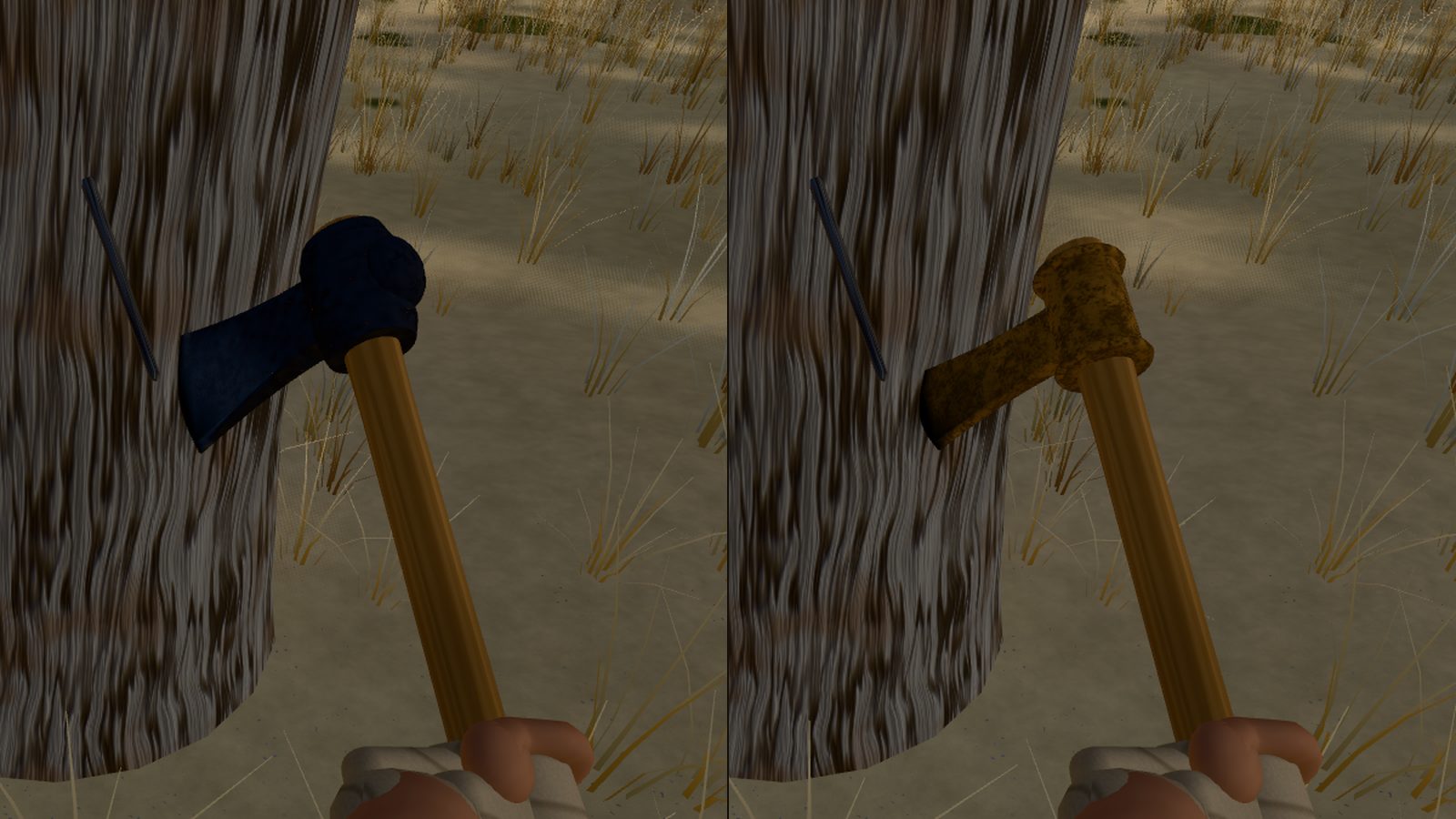
So a player in House of Noah carries two axes and switches between them with Q. On screen the game says what they are: "a shaft-hole axe of the earliest real form of its metal (modelled; Gen 4:22 names bronze and iron)".
The bronze axe
Cast axe heads survive from early Mesopotamia, and the game's bronze axe copies their shape: a cast shaft-hole axe, its narrow blade flaring slightly to a curved edge, with a tubular socket ringed at its ends for the wooden haft archaeology. Heads like it, dated to the third and second millennia BC, from Mesopotamia and western Iran, are about 16 centimetres long; one in the Metropolitan Museum of Art measures 15.9 archaeology. The game's head is 16 centimetres long with an edge of 6.5 and weighs about a kilogram, like the replica bronze axes in felling experiments study modelled. Its two-handed haft is 70 centimetres long modelled.
The iron axe
No iron axe of the period survives, so the iron axe is drawn from later, Iron Age shaft-hole axes: a heavy forged body, wedge-shaped, flaring to a broad edge, with a short poll behind the eye modelled. Its head weighs 1.2 kilograms, is 17 centimetres long with an edge of 9.5, and its haft is 72 centimetres, a little shorter than the 32-inch (81 cm) handle of a modern felling axe study modelled.
How much slower is bronze?
This is the number that matters for the calendar, and the experiments disagree.
In 1997 Mathieu and Meyer published felling trials with replica bronze and steel axes of about the same weight, about a kilogram each, the bronze 88 % copper and 12 % tin. They found the difference "not statistically significant"; as Mathieu later put it, "bronze axes were just as good as steel ones for felling trees" study. We could not read their paper itself, only his summary and others' citations of it.
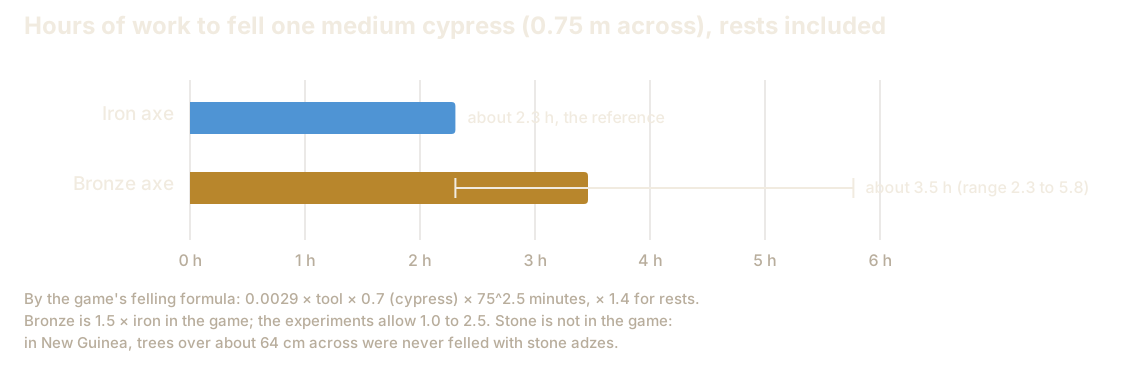
In 2023 Dolfini and colleagues felled birch 9 to 18 centimetres thick with four replica bronze axes: about 2.2 minutes for a 10-centimetre trunk, 7.5 to 11.5 for one of 17 to 18 study. Set beside a steel axe felling a 55-centimetre oak in "a bit more than one hour" study, bronze comes out 1.4 to 4 times slower, depending on how the time grows with the size of the tree modelled. That comparison crosses species and sizes, so it is rough.
The game takes the middle: bronze takes 1.5 times as long as iron to fell a tree, within a range from 1.0 (Mathieu and Meyer) to 2.5 modelled. Iron itself is counted as fast as steel; it might be up to a fifth slower, but no felling experiment with an Iron Age axe was found modelled.
For other work the factors differ modelled. Hewing with a bronze adze is reckoned about 1.3 times slower than iron, between "a little slower" and "no slower" in two accounts of rebuilding a Bronze Age boat study. Sawing with a copper or bronze saw might be three to five times slower, but that guess has no measurement behind it.
And stone?
Genesis gives the builders metal, so the game has no stone axes. The experiments show why that matters. In one study a stone axe took "over six times as long" as steel study. In New Guinea in the late 1960s, men with stone adzes felled small trees one and a half to two and a half times slower than with steel, and trees over a metre round three to four and a half times slower; trees over two metres round, about 64 centimetres across, they never felled with the adze at all, but girdled and left study. A medium cypress of 75 centimetres would have been beyond them.
Axes, not saws
One more consequence of the age: the game fells and cross-cuts with the axe alone. Long two-person crosscut saws were known to the Romans but little used, and became common in Europe only from the middle of the fifteenth century historical. Copper pull saws are known in Egypt from its earliest dynasties archaeology; saws for cutting timber into planks belong to a later page.
What it means for the game
Choosing bronze over iron costs a house time. On the game's labour study, building the whole reference ark with bronze tools instead of iron adds about 7 % to the work, from about 122,000 to 130,000 person-days modelled. The difference is small because felling and hewing are only a part of the job: the joints, the pitch and the lifting take more.
The method is open, as everywhere in the game. A house may fell with bronze, with iron, or with both; Genesis allows either, and the final check judges only the ark.