Dressing the family, and showing them with respect
Genesis mentions a few garments and no fashions. How the game dresses Noah's house from the oldest pictures of West-Asian people, what it leaves out, and how it handles skin, faces and the picturing of Noah himself.
Clothing appears in Genesis almost as soon as people do:
Unto Adam also and to his wife did the LORD God make coats of skins, and clothed them.
Genesis 3:21 text
After that the text mentions only a few garments. When Shem and Japheth cover their father, they take "a garment", the simlah, and lay it "upon both their shoulders" (Genesis 9:23) text: a mantle wide enough to cover a man, the same cloak a poor man sleeps in (Exodus 22:26–27) text. Much later Rebekah "took a vail, and covered herself" (Genesis 24:65) text. That is all the text says about what Noah's family wore. Everything else the game shows is a reconstruction modelled, and this page is about how we made it.
The nearest pictures
No picture of anyone from Noah's world survives. The nearest images of West-Asian people in everyday dress are Egyptian: a painted procession of West-Asian travellers, the Aamu, in the tomb of Khnumhotep II at Beni Hasan, from about 1890 BC archaeology. The men are bearded and wear belted tunics or kilts, some wrapped over one shoulder; the women wear long dresses; the cloth is patterned in many colours archaeology. Mesopotamian reliefs show fleece skirts and bare shoulders archaeology, which the game does not use: it is a family game, and modest dress is a rule.
What the family wears
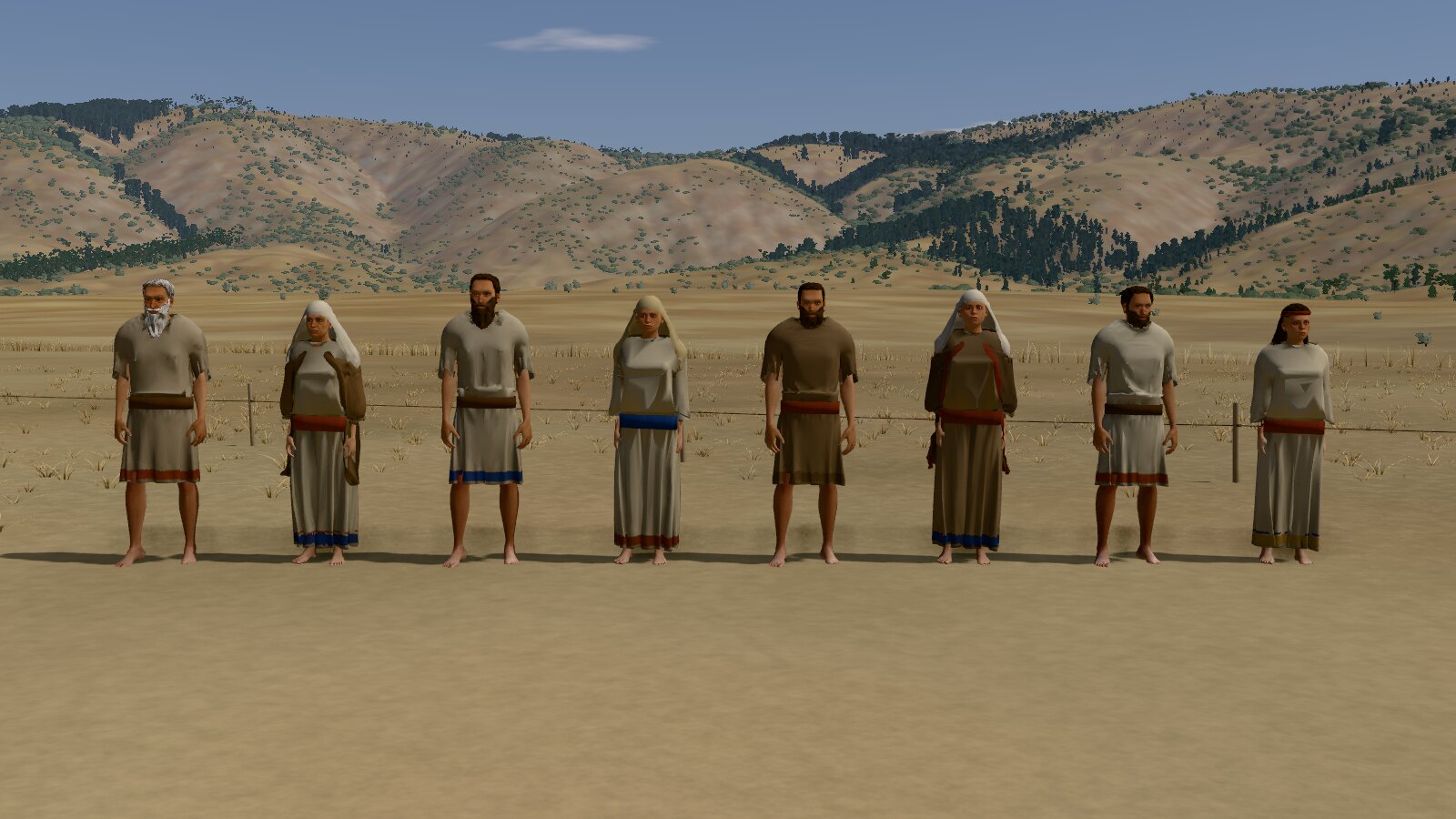
From those pictures and the text, the game dresses the house simply modelled:
- The men: a tunic of undyed wool or linen reaching to the knee, belted, and girded up for work; a mantle for resting or travel; beards; bare feet or sandals.
- The women: a dress to the ankle with long sleeves and a sash; a mantle; a head covering, tied back for work.
- Colours: cream, brown and grey, the colours of undyed cloth, with a few bands of madder red and indigo blue, as on the Beni Hasan garments.
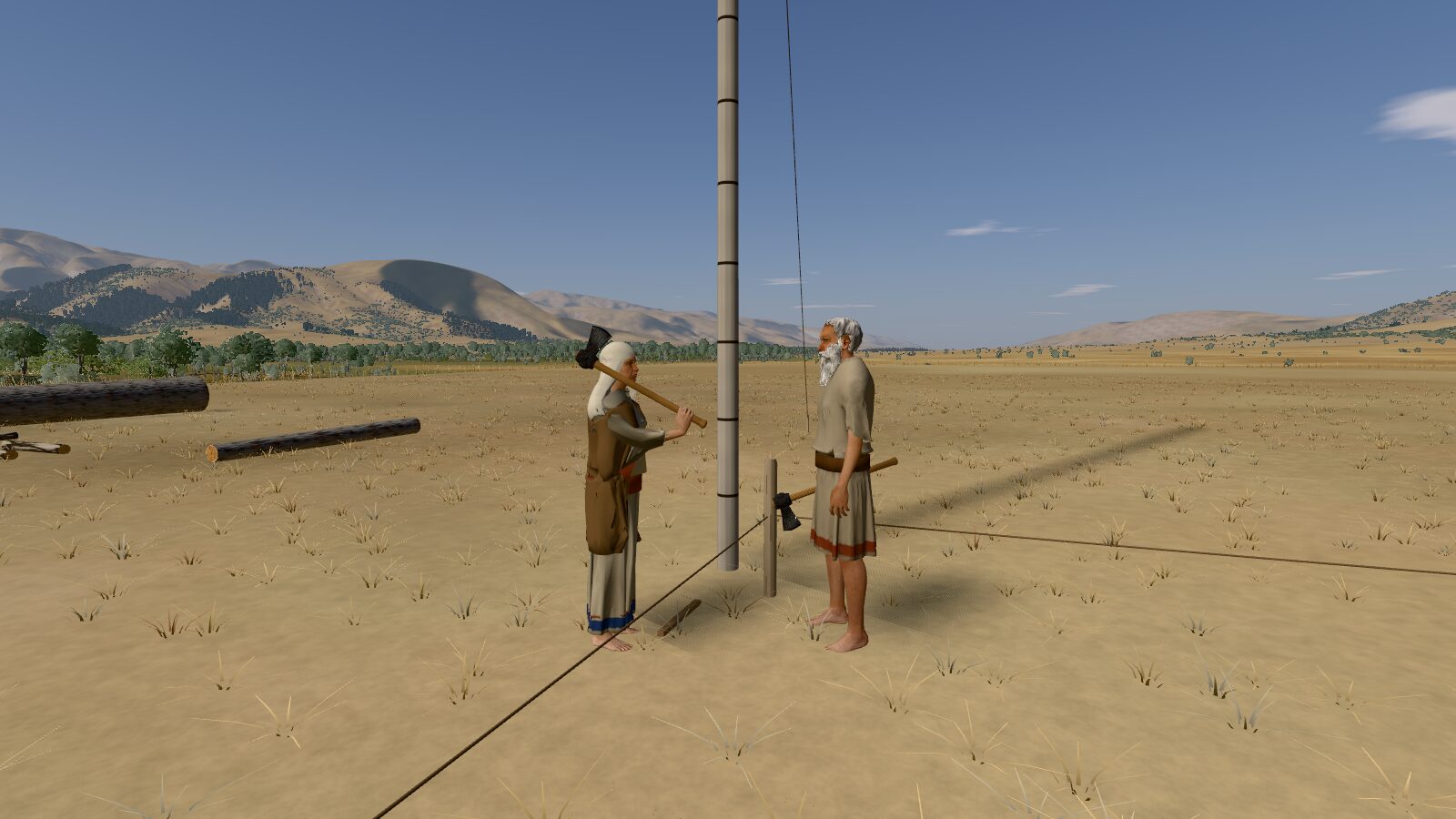
Each person has their own clothes. Noah wears a wool tunic with elbow sleeves, girded over a leather belt, with a red band at the hem; his wife a long linen dress, a red sash with a blue stripe, a linen head covering and a brown wool mantle. Shem's tunic has an indigo band, Ham's is brown wool with a red belt, Japheth's is linen with a red band. Shem's wife has an indigo sash and an ochre-tinted head covering; Ham's wife a brown wool dress, a red sash and a mantle; and Japheth's wife wears her long hair loose under a woven headband, the way the Beni Hasan women wear theirs modelled.
The clothes are made by a script, not drawn by hand. They are draped on each body by a cloth simulation, given a homespun weave, and then worn in: turned hems with their stitching, side seams, soil toward the hem, shoulders faded by the sun, dust modelled.
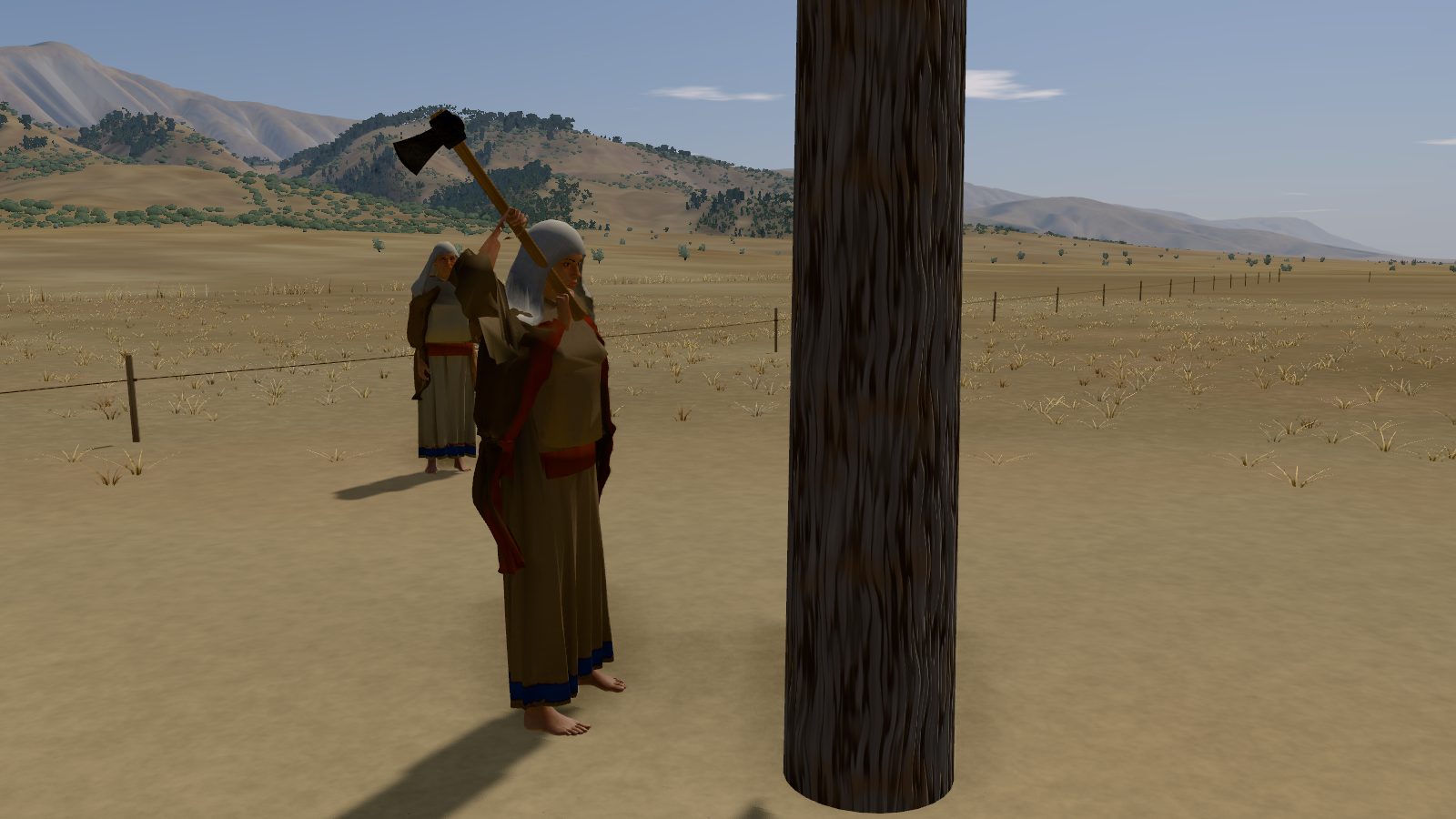
Head coverings
The evidence on head coverings is mixed. The earliest written rule on veiling is a Middle Assyrian law, from about 1400 to 1100 BC, for married women historical. The Beni Hasan women, by contrast, wear their long hair loose under a band archaeology, and Rebekah's veil comes much later in the story text. The game gives most of the women a plain cloth that sits on the hairline, with the hair showing at the front, never a veil over the face modelled. Japheth's wife's headband shows the other way the evidence allows.
What the game leaves out
The game keeps away from the usual pictures of Bible times modelled: armour, straps and masked hoods from fantasy games; the white robes and striped headcloths of Hollywood epics; modern Arab dress; Roman or Greek costume; glamour proportions; and anything revealing. Every garment covers both shoulders, and the necklines are small and round.
There are rules underneath the cloth too modelled. The clothes cannot be taken off. Nothing is modelled under them, so if a garment ever slipped there would be a hole, not skin; and the build of the bodies fails if a garment slides down.
Skin and faces
The family spent their lives outdoors in a hot, bright land, and the first faces we made were too pale for that. They are now sun-browned: the skin is set to a measured colour in the range dermatologists call "tan" to "brown", the skin types IV to V of Fitzpatrick's scale study, browner on the face, neck, forearms, hands and shins, and paler where clothes cover it modelled. Ancient DNA from the Bronze Age southern Levant shows a mix of local Neolithic and Chalcolithic Iranian ancestry study, and Egyptian painters gave West-Asian people a yellowish-brown skin with dark hair and beards archaeology.
The tones go by person, not by son modelled. The three brothers differ by only a few shades, and their wives, who came from other families of the same land, vary a little more. No son is given a "type": the curse on Canaan (Genesis 9:25) was later read as an origin of dark skin and a justification for slavery, but the text mentions neither race nor skin colour historical. All eight are one family of one people.
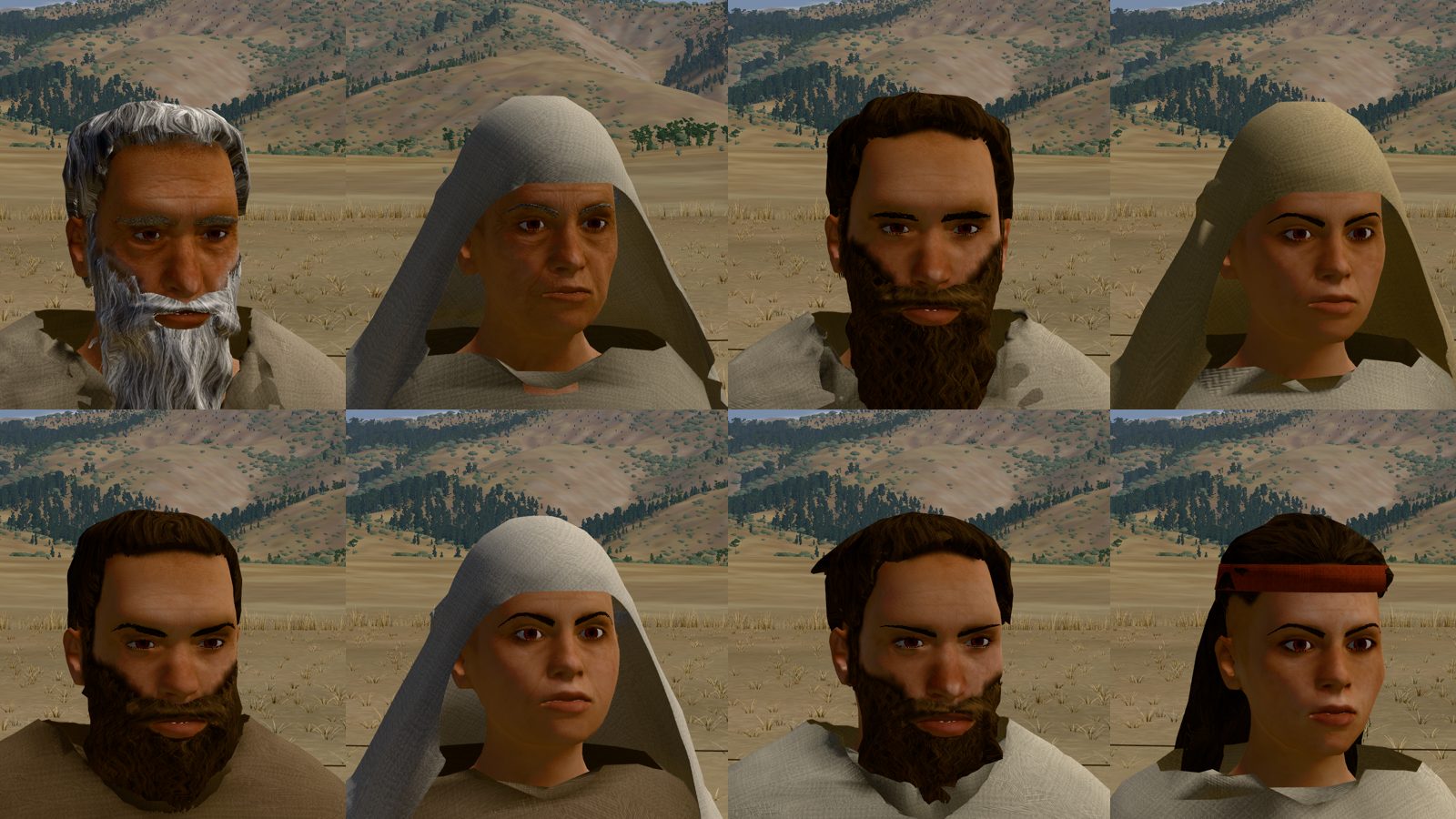
The faces are generated, never copied from a real person modelled. To learn how a full beard grows from a face, from the sideburns down to a soft line on the cheek, we studied photographs of men from Iran, Afghanistan, Kurdistan and Yemen and a portrait from Roman Egypt, looked at only, not copied study.
Picturing Noah
Noah is honoured in Judaism, Christianity and Islam. In Islam he is a prophet, Nuh, and Islamic practice is aniconic about prophets: Sunni opinion has generally been against picturing them, Shia practice more permissive, and Persian painters often veiled a prophet's face study. Judaism and Christianity have pictured Noah since late antiquity historical.
We weighed four ways: show Noah like everyone else; show him as a role but never his face up close; veil his face in the Persian manner; or leave him out. We chose the first modelled. Noah was a man, and the game shows him as one, face included, as it shows his family. A veiled face remains possible as a regional option, and nothing in the models depends on the choice.
What it means for the game
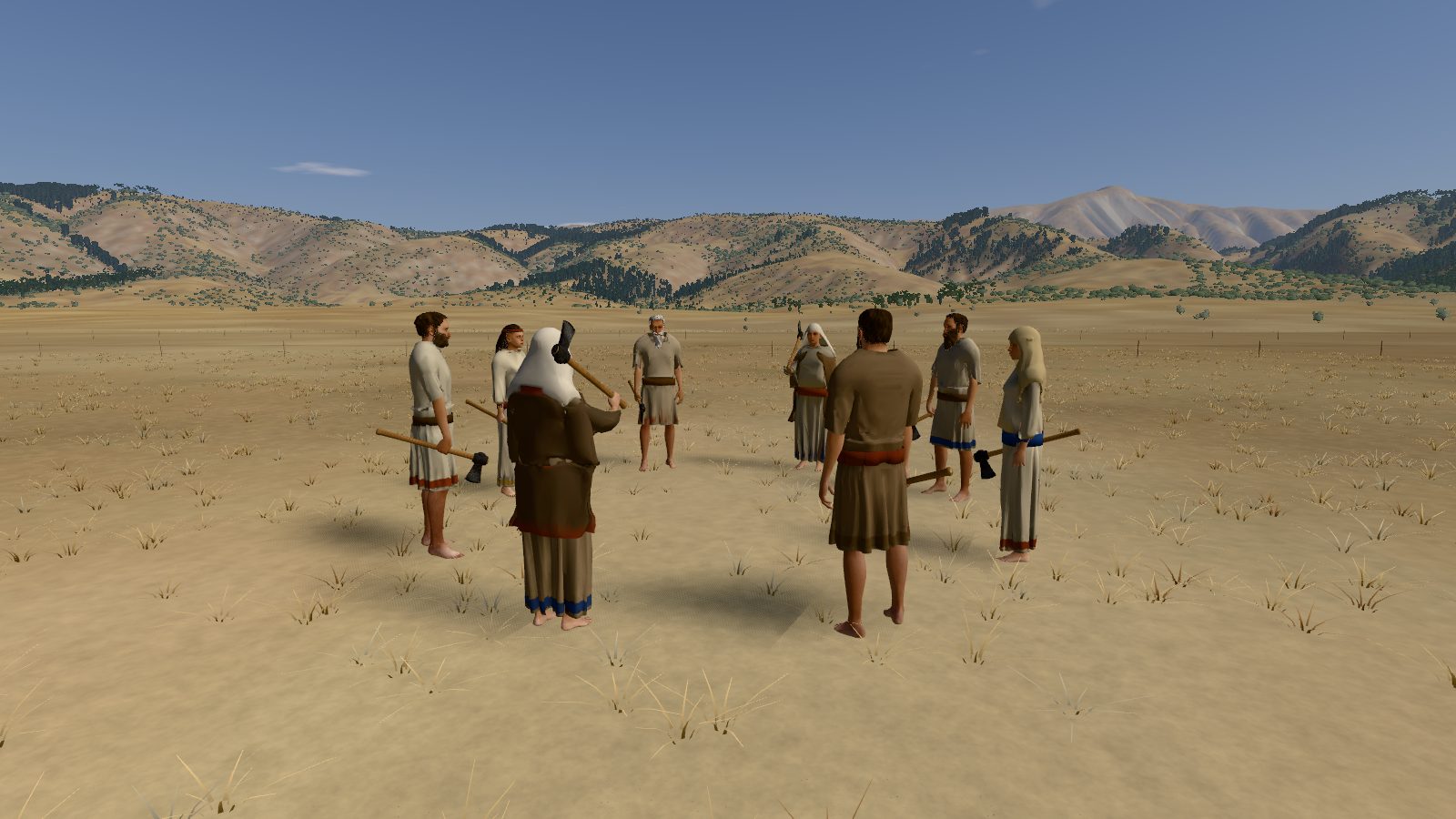
Players in House of Noah are roles, never names, and the roles are fixed. So the eight people have to be right once, for everyone: modest, of their land and their age, and as real as the valley around them.