Splitting, hewing and the pit saw: from log to timber
A log is not yet a beam or a plank. The three old ways of turning one into the other, what each costs by the records of experiments, shipyards and sawyers, how much of the tree is left at the end, and which of them the game will offer.
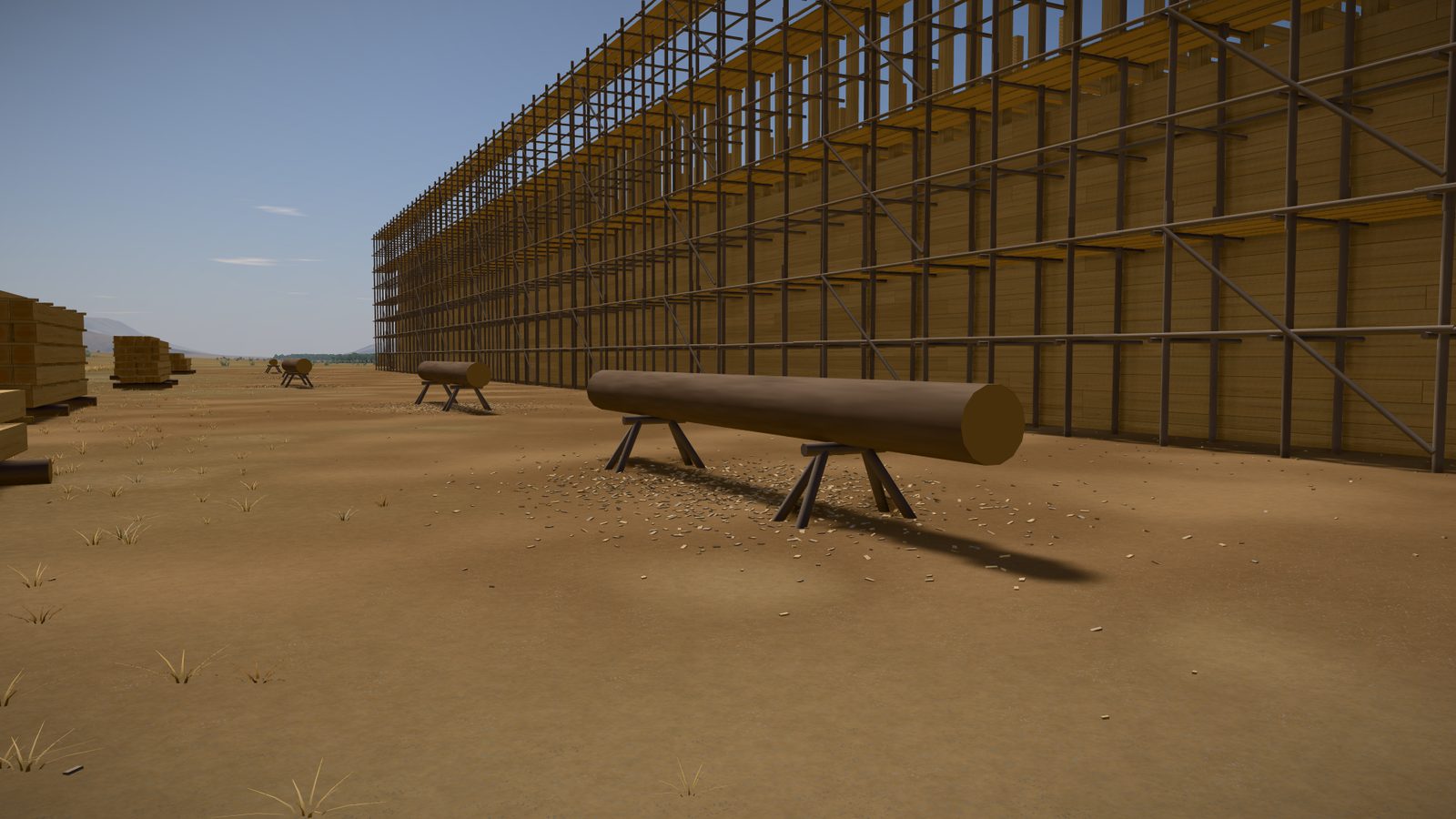
When a tree is down, limbed and cut into lengths, much of the work is still ahead. The ark is built of squared beams and long planks, and a log is round, tapered and too thick. The labour research behind House of Noah calls turning one into the other converting, and sums it up in a sentence: "Converting is where the hours go" modelled.
There were three ways to do it with hand tools: split the log with wedges, hew it with axe and adze, or saw it. All three are planned for the game's work chain, in its next phase modelled. Today the game takes a tree as far as logs.
Splitting
Wood splits along its grain, and a log can be opened with wedges and a heavy wooden mallet, a beetle. The first split is the hard one. At the Viking Ship Museum in Roskilde, builders of the Gislinge boat split a 7-metre oak a metre thick into halves in 50 minutes study. "Once the first split is done further splits are easy," wrote a woodworker who helped rebuild a Bronze Age boat study. For that boat's original, built about 1550 BC, one estimate puts felling a tree, halving it and cutting it to length at about 100 hours of skilled work with bronze tools study.
The game's labour study counts the first split at about half a person-hour for every square metre of the face it opens, and later splits at a quarter modelled. Splitting needs no metal at all: the wedges and the beetle can be wood.
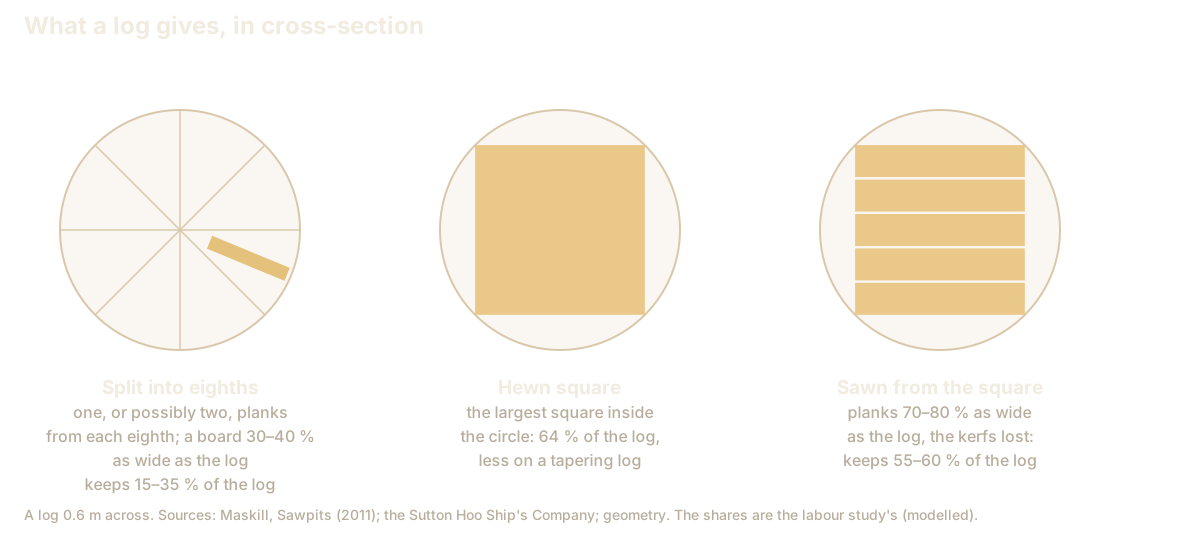
Splitting is quick, but a split board is narrow. Boards cleft from a log are typically 30 to 40 % as wide as the log is thick, against 70 to 80 % for sawn ones historical, and a boatbuilders' guide to cleaving gets "one, or possibly two, planks" from each eighth of a log study.
Hewing
To square a log, a hewer cuts its sides flat with a broad axe or an adze. Some of the clearest records come from hewing railway ties in the United States: "The average tie cutter makes from 20 to 25 ties a day" in pine, felling included (1905), and a later guide gives "12 to 15 hardwood or 20 softwood ties per man per day" historical. Practitioners today square a 10-foot timber in about an hour in pine and two or more in oak study.
From those the game's study takes about one person-hour per square metre of hewn face in oak, half that in softwoods like cypress, and 1.3 times as long with bronze tools modelled.
The pit saw
The third way is to saw the log lengthwise into planks. With a long two-handled saw, one man stands above the log, the top sawyer, and one below it in the pit, the pitman. Neither can work without the other historical. It is the clearest case in the whole build of a job that needs exactly two people, and the plan for the game says so: "A pit saw needs one person above and one below. Alone, you hew instead (slower)" modelled.
Sawyers were paid by the area of the face they cut, so their rates were written down historical. In an English shipyard in 1846, "the cutting of 200 feet of hard wood is considered a good day's work" for a pair in a day of ten and a half hours, about 19 square metres of sawn face historical. London sawyers cutting Baltic softwood managed over half as much again, and in the Punjab in 1911 a pair sawed 60 to 80 square feet of cedar a day but only 32 to 35 of an acacia historical. The game's study takes about 1.1 person-hours per square metre of sawn face in oak and 0.7 in softwood, with a fifth to two-fifths more for getting the log onto the pit and marking it out modelled.
There is a catch: the evidence for a saw worked by two is late. Copper pull saws are known in Egypt from its earliest dynasties, but saws with tensioned frames belong to the Iron Age archaeology, and the labour research found no Bronze Age saw for two people study. When the pit saw first appeared was not established; it is one of the gaps the research still has to close. The plan keeps it as one of the methods a house may choose, and the design for the work chain makes it a saw of iron, the metal Genesis 4:22 names, labelled as modelled text modelled.
What is left of the tree
Every method wastes wood. A square cut inside a round log keeps at most 64 % of it, less when the log tapers modelled. Cleft and hewn planks keep 15 to 35 % of the log; sawn ones from a squared log, 55 to 60 % modelled. And a whole boat wastes far more: the Roskilde replica Roar Ege took 54.21 cubic metres of green timber for a hull that is 4.85 % of it, about 20 cubic metres of log for every cubic metre in the boat study.
What it means for the game
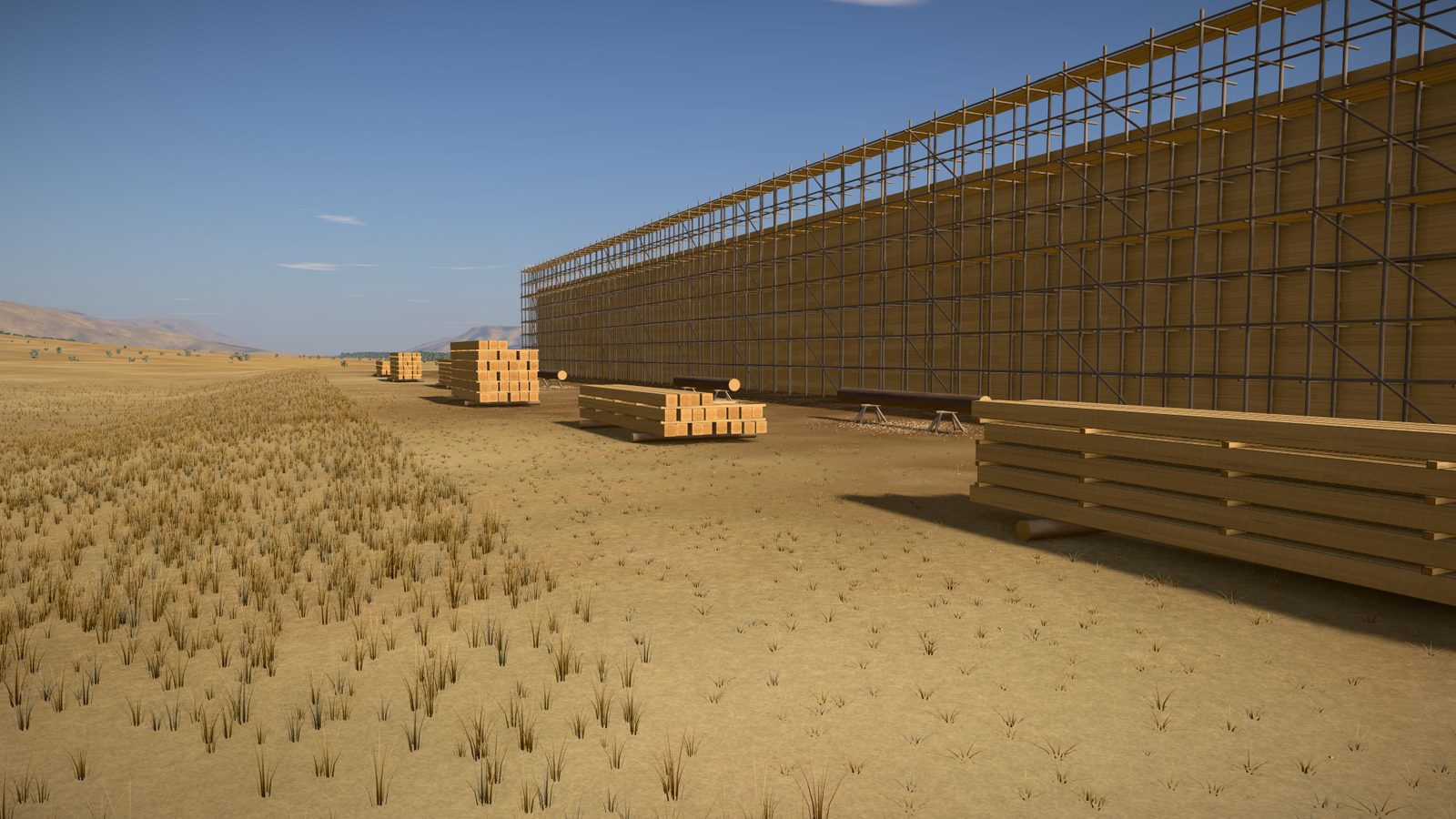
The reference ark, one sound way of building it among several, has about 167,000 square metres of hewn faces and 42,000 square metres of split or sawn planes, and the game's labour study puts the hewing at about 84,000 person-hours and the splitting at about 21,000, together about 11 % of the whole build modelled. Sawing instead of splitting changes the total by only about 2 % modelled.
That is the kind of choice the game is built on. A house that splits works fast and wastes wood; one that saws needs two people at the pit and gets more planks from each tree; one that hews works alone. All of them can build an ark that passes.